1,830 posters, 67 videos, 75 audios, 29 topics, 22 sessions, 4,727 authors, 1,697 institutions
ePostersLive by SciGen Technologies S.A. All rights reserved.
RCOG World Congress 2023
June 12 - 14, 2023 | London, UK

EP.1099
Transferable soft skills - their importance in providing equitable healthcare
Part of Topic
Adolescent Gynaecology
Communication, teamwork and other ‘soft skills’: essential tools in a modern-day workplace
Garance BIOSSE-DUPLAN1, Zoë TAYLOR1, Nana SACKEY1, Elizabeth BALL2Mehreen MIRZA1
1Department of Obstetrics and Gynaecology, Newham University Hospital, Barts Health NHS Trust; 2Royal London Hospital, Barts Health NHS Trust
Objective:
•We present the case of a 16-year-old who’s complex medical and social background had the potential to disadvantage her care
•Whilst clinically her case was relatively straightforward, cases like hers remind us that clinicians require strong ‘soft skills’ including leadership, communication and teamwork to ensure the delivery of good and equitable patient care
Case report:
Presentation:
Presentation:
•16-year-old Portuguese-speaking girl presenting with vomiting and abdominal pain
•Background of cerebral palsy and spastic quadriplegia, low body mass index, and learning difficulty
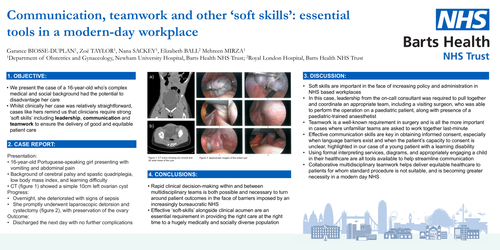
•CT (figure 1) showed a simple 10cm left ovarian cyst
Progress:
•Overnight, she deteriorated with signs of sepsis
•She promptly underwent laparoscopic detorsion and cystectomy (figure 2), with preservation of the ovary
Progress:
•Overnight, she deteriorated with signs of sepsis
•She promptly underwent laparoscopic detorsion and cystectomy (figure 2), with preservation of the ovary
Outcome:
•Discharged the next day with no further complications
•Discharged the next day with no further complications
Discussion:
•Soft skills are important in the face of increasing policy and administration in NHS based workplaces
•In this case, leadership from the on-call consultant was required to pull together and coordinate an appropriate team, including a visiting surgeon, who was able to perform the operation on a paediatric patient, along with presence of a paediatric-trained anaesthetist
•Teamwork is a well-known requirement in surgery and is all the more important in cases where unfamiliar teams are asked to work together last-minute
•Effective communication skills are key in obtaining informed consent, especially when language barriers exist and when the patient’s capacity to consent is unclear, highlighted in our case of a young patient with a learning disability
•Using formal interpreting services, diagrams, and appropriately engaging a child in their healthcare are all tools available to help streamline communication
•Collaborative multidisciplinary teamwork helps deliver equitable healthcare to patients for whom standard procedure is not suitable, and is becoming greater necessity in a modern day NHS
Conclusions:
•Rapid clinical decision-making within and between multidisciplinary teams is both possible and necessary to turn around patient outcomes in the face of barriers imposed by an increasingly bureaucratic NHS
•Effective ‘soft-skills’ alongside clinical acumen are an essential requirement in providing the right care at the right time to a hugely medically and socially diverse population