1,830 posters, 67 videos, 75 audios, 29 topics, 22 sessions, 4,727 authors, 1,697 institutions
ePostersLive by SciGen Technologies S.A. All rights reserved.
RCOG World Congress 2023
June 12 - 14, 2023 | London, UK

EP.1088
Pyometra with Spontaneous Uterine Perforation: A Rare Complication of Caesarean Section
Poster Presenter
Authors
Affiliations
Part of Topic
High Risk Pregnancy
Pyometra with Spontaneous Uterine Perforation: A Rare Complication of Caesarean Delivery
Dr Roy Matheus Menezes, Dr Rupa Padwalkar, Dr Pearle Fernandes
Goa Medical College, India
Introduction
Obstetrics has seen a drastic rise in the incidence of caesarean section in the modern era. However, its complications can be catastrophic: a sombre truth often ignored by obstetricians to their peril. We present this case of pyometra with spontaneous uterine perforation following an apparently uncomplicated caesarean section.
Case report
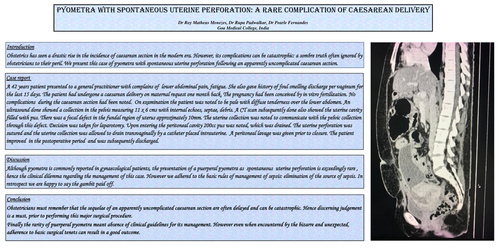
A 42 years patient presented to a general practitioner with complains of lower abdominal pain, fatigue. She also gave history of foul smelling discharge per vaginum for the last 15 days. The patient had undergone a caesarean delivery on maternal request one month back. The pregnancy had been conceived by in vitro fertilization. No complications during the caesarean section had been noted. On examination the patient was noted to be pale with diffuse tenderness over the lower abdomen. An ultrasound done showed a collection in the pelvis measuring 11 x 6 cms with internal echoes, septae, debris. A CT scan subsequently done also showed the uterine cavity filled with pus. There was a focal defect in the fundal region of uterus approximately 10mm. The uterine collection was noted to communicate with the pelvic collection through this defect. Decision was taken for laparotomy. Upon entering the peritoneal cavity 200cc pus was noted, which was drained. The uterine perforation was sutured and the uterine collection was allowed to drain transvaginally by a catheter placed intrauterine. A peritoneal lavage was given prior to closure. The patient improved in the postoperative period and was subsequently discharged.
Discussion
Although pyometra is commonly reported in gynaecological patients, the presentation of a puerperal pyometra as spontaneous uterine perforation is exceedingly rare , hence the clinical dilemma regarding the management of this case. However we adhered to the basic rules of management of sepsis: elimination of the source of sepsis. In retrospect we are happy to say the gambit paid off.
Conclusion
Obstetricians must remember that the sequelae of an apparently uncomplicated caesarean section are often delayed and can be catastrophic. Hence discerning judgement is a must, prior to performing this major surgical procedure.
Finally the rarity of puerperal pyometra meant absence of clinical guidelines for its management. However even when encountered by the bizarre and unexpected, adherence to basic surgical tenets can result in a good outcome.