1,830 posters, 67 videos, 75 audios, 29 topics, 22 sessions, 4,727 authors, 1,697 institutions
ePostersLive by SciGen Technologies S.A. All rights reserved.
RCOG World Congress 2023
June 12 - 14, 2023 | London, UK

EP.1078
Bilateral ovarian cysts in adolescence: considerations for management
Poster Presenter
Authors
Affiliations
Part of Topic
Adolescent Gynaecology
Rare Case of Mature Cystic Teratoma in Adolescent: Where Do We Go Now?
AUTHORS: DR AUDAY MARWAHA, DR MEGAN WRIGHT, MISS NIVEDITA DAS
Objective
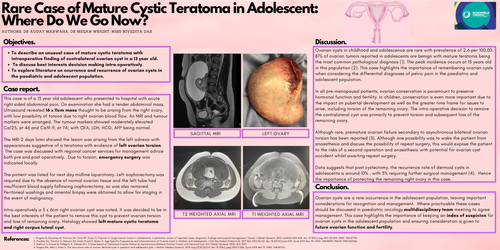
To describe an unusual case of mature cystic teratoma with intraoperative finding of contralateral ovarian cyst in a 13 year old. To discuss best interests decision making intra-operatively. To explore literature on ocurrence and recurrence of ovarian cysts in the paediatric and adolescent population.
Case report
This case is of a 13 year old adolescent who presented to hospital with acute right sided abdominal pain. On examination she had a tender abdominal mass. Ultrasound revealed 16 x 11cm mass thought to be arising from the right ovary, with low possibility of torsion due to right ovarian blood flow. An MRI and tumour markers were arranged. The tumour markers showed moderately elevated Ca125, at 46 and Ca19-9, at 74; with CEA, LDH, HCG, AFP being normal. The MRI 2 days later showed the lesion was arising from the left adnexa with appearances suggestive of a teratoma with evidence of left ovarian torsion. The case was discussed with regional cancer services for management advice both pre and post operatively. Due to torsion, emergency surgery was indicated locally. The patient was listed for next day midline laparotomy. Left oophorectomy was required due to the absence of normal ovarian tissue and the left tube had insufficient blood supply following oophorectomy, so was also removed. Peritoneal washings and omental biopsy were obtained to allow for staging in the event of malignancy. Intra-operatively a 5 x 6cm right ovarian cyst was noted. It was decided to be in the best interests of the patient to remove this cyst to prevent ovarian torsion and loss of remaining ovary. Histology showed left mature cystic teratoma and right corpus luteal cyst.
Discussion
Ovarian cysts in childhood and adolescence are rare with prevalence of 2.6 per 100,00. 81% of ovarian tumors reported in adolescents are benign with mature teratoma being the most common pathological diagnosis (1). The peak incidence occurs at 15 years old in this population (2). This case highlights the importance of remembering ovarian cysts when considering the differential diagnoses of pelvic pain in the paediatric and adolescent population. In all pre-menopausal patients, ovarian conservation is paramount to preserve hormonal function and fertility. In children, conservation is even more important due to the impact on pubertal development as well as the greater time frame for issues to arise, including torsion of the remaining ovary. The intra-operative decision to remove the contralateral cyst was primarily to prevent torsion and subsequent loss of the remaining ovary. Although rare, premature ovarian failure secondary to asynchronous bilateral ovarian torsion has been reported (3). Although one possibility was to wake the patient from anaesthesia and discuss the possibility of repeat surgery, this would expose the patient to the risks of a second operation and anaesthesia with potential for ovarian cyst accident whilst awaiting repeat surgery. Data suggests that post cystectomy, the recurrence rate of dermoid cysts in adolescents is around 10% , with 3% requiring further surgical management (4). Hence the importance of protecting the remaining right ovary in this case.
Conclusion
Ovarian cysts are a rare occurrence in the adolescent population, leaving important considerations for recognition and management. Where practicable these cases should be discussed in paediatric oncology multidisciplinary team meeting to agree management. This case highlights the importance of keeping an index of suspicion for ovarian cysts in the adolescent population and ensuring consideration is given to future ovarian function and fertility.
References:
1. Grigore M, Murarasu M, Himiniuc LM, Toma BF, Duma O, Popovici R. Large ovarian tumors in adolescents, a systematic review of reported cases, diagnostic findings and surgical management. Taiwan J Obstet Gynecol. 2021 Jul;60(4):602-608. doi: 10.1016/j.tjog.2021.05.005. PMID: 34247795. 2. Emeksiz HC, Derinöz O, Akkoyun EB, Güçlü Pınarlı F, Bideci A. Age-Specific Frequencies and Characteristics of Ovarian Cysts in Children and Adolescents. J Clin Res Pediatr Endocrinol. 2017 Mar 1;9(1):58-62. doi: 10.4274/jcrpe.3781. Epub 2016 Dec 30. PMID: 28044991; PMCID: PMC5363166. 3. Malmusi S, Airoud M, Pellegrini R, Galassi MC. A Case Report of Premature Ovarian Failure by Asynchronous Bilateral Ovarian Torsion with Dermoid Cyst. Ann Obstet Gynecol. 2021; 4(1): 1027 4. Rogers EM, Allen L, Kives S. The recurrence rate of ovarian dermoid cysts in pediatric and adolescent girls. J Pediatr Adolesc Gynecol. 2014 Aug;27(4):222-6. doi: 10.1016/j.jpag.2013.11.006. Epub 2014 Mar 19. PMID: 24656705.