1,830 posters, 67 videos, 75 audios, 29 topics, 22 sessions, 4,727 authors, 1,697 institutions
ePostersLive by SciGen Technologies S.A. All rights reserved.
RCOG World Congress 2023
June 12 - 14, 2023 | London, UK

EP.1076
Missed diagnosis of Twin Reverse Arterial Perfusion (TRAP) Sequence
Part of Topic
High Risk Pregnancy
Video
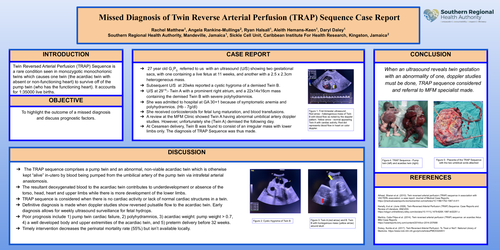
Missed Diagnosis of Twin Reverse Arterial Perfusion (TRAP) Sequence Case Report
Rachel Matthew1, Angela Rankine-Mullings2, Ryan Halsall1, Aleith Hemans-Keen1, Daryl Daley1
Southern Regional Health Authority, Mandeville, Jamaica1, Sickle Cell Unit, Caribbean Institute For Health Research, Kingston, Jamaica2
INTRODUCTION:
Twin Reversed Arterial Perfusion (TRAP) Sequence is a rare condition seen in monozygotic monochorionic twins which causes one twin (the acardiac twin with absent or non-functioning heart) to survive off of the pump twin (who has the functioning heart). It accounts for 1:35000 live births.
OBJECTIVE:
To highlight the outcome of a missed diagnosis and discuss prognostic factors.
CASE REPORT:
-
27 year old G1P0 referred to us with an ultrasound (U/S) showing two gestational sacs, with one containing a live fetus at 11 weeks, and another with a 2.5 x 2.3cm heterogeneous mass.
-
Subsequent U/S at 20wks reported a cystic hygroma of a demised Twin B.
-
U/S at 29+4:- Twin A with a prominent right atrium, and a 22x14x16cm mass containing the demised Twin B with severe polyhydramnios.
-
She was admitted to hospital at GA 30+1 because of symptomatic anemia and polyhydramnios. (Hb - 7g/dl)
-
She received corticosteroids for fetal lung maturation, and blood transfusions.
-
A review at the MFM Clinic showed Twin A having abnormal umbilical artery doppler studies. However, unfortunately she (Twin A) demised the following day.
-
At Cesarean delivery, Twin B was found to consist of an irregular mass with lower limbs only. The diagnosis of TRAP Sequence was thus made.
-
The TRAP sequence comprises a pump twin and an abnormal, non-viable acardiac twin which is otherwise kept “alive” in-utero by blood being pumped from the umbilical artery of the pump twin via intrafetal arterial anastomosis.
-
The resultant deoxygenated blood to the acardiac twin contributes to underdevelopment or absence of the torso, head, heart and upper limbs while there is more development of the lower limbs.
-
TRAP sequence is considered when there is no cardiac activity or lack of normal cardiac structures in a twin.
-
Definitive diagnosis is made when doppler studies show reversed pulsatile flow to the acardiac twin. Early diagnosis allows for weekly ultrasound surveillance for fetal hydrops.
-
Poor prognosis include 1) pump twin cardiac failure, 2) polyhydramnios, 3) acardiac weight: pump weight > 0.7, 4) a well developed body and upper extremities of the acardiac twin, and 5) preterm delivery before 32 weeks.
-
Timely intervention decreases the perinatal mortality rate (55%) but isn’t available locally.
CONCLUSION:
When an ultrasound reveals twin gestation with an abnormality of one, doppler studies must be done, TRAP sequence considered and referral to MFM specialist made.
Athwal, Sharan et al. (2010). Twin reversed arterial perfusion (TRAP) sequence in association with VACTERL association: a case report. Journal of Medical Case Reports. https://jmedicalcasereports.biomedcentral.com/articles/10.1186/1752-1947-4-411
Hanafy, A et al. (June 2008). Twin-Reversed Arterial Perfusion (TRAP) Sequence: Case Reports and Review of Literature. ANZJOG. https://obgyn.onlinelibrary.wiley.com/doi/abs/10.1111/j.1479-828X.1997.tb02251.x
Martins, Catia Filipa et al. (2014). Twin reversed arterial perfusion (TRAP) sequence: an acardiac fetus. BMJ Case Reports
https://casereports.bmj.com/content/2014/bcr-2014-207688
Dubey, Sunita et al. (2017). Twin Reversed Arterial Perfusion: To Treat or Not?. National Library of Medicine. https://www.ncbi.nlm.nih.gov/pmc/articles/PMC5324451/