1,830 posters, 67 videos, 75 audios, 29 topics, 22 sessions, 4,727 authors, 1,697 institutions
ePostersLive by SciGen Technologies S.A. All rights reserved.
RCOG World Congress 2023
June 12 - 14, 2023 | London, UK

EP.1061
A Rare Case of A Primary Signet-Ring Cell Carcinoma of the Cervix
Poster Presenter
Authors
Affiliations
Part of Topic
Gynae Oncology
A Rare Case of Primary Signet-Ring Cell Carcinoma of the Cervix
Riezyl P. BARBADILLO, MD, MPH1, Aida J. BAUTISTA, MD,FPOGS, FSGOP2, Sabrina ANG-SY, MD, FPOGS3
Department of Obstetrics and Gynecology, Manila Doctor’s Hospital, Philippines
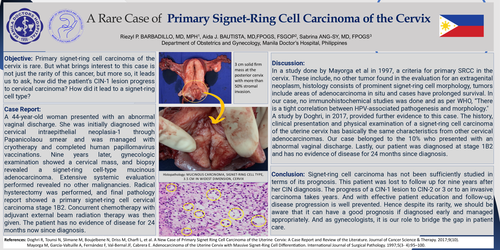
Objective: Primary signet‐ring cell carcinoma of the cervix is rare. But what brings interest to this case is not just the rarity of this cancer, but more so, it leads us to ask, how did the patient’s CIN-1 lesion progress to cervical carcinoma? How did it lead to a signet-ring cell type?
Case Report:
A 44-year-old woman presented with an abnormal vaginal discharge. She was initially diagnosed with cervical intraepithelial neoplasia-1 through Papanicolaou smear and was managed with cryotherapy and completed human papillomavirus vaccinations. Nine years later, gynecologic examination showed a cervical mass, and biopsy revealed a signet-ring cell-type mucinous adenocarcinoma. Extensive systemic evaluation performed revealed no other malignancies. Radical hysterectomy was performed, and final pathology report showed a primary signet‐ring cell cervical carcinoma stage 1B2. Concurrent chemotherapy with adjuvant external beam radiation therapy was then given. The patient has no evidence of disease for 24 months now since diagnosis.
Discussion:
In a study done by Mayorga et al in 1997, a criteria for primary SRCC in the cervix. These include, no other tumor found in the evaluation for an extragenital neoplasm, histology consists of prominent signet-ring cell morphology, tumors include areas of adenocarcinoma in situ and cases have prolonged survival. In our case, no immunohistochemical studies was done and as per WHO, “There is a tight correlation between HPV-associated pathogenesis and morphology."
A study by Doghri, in 2017, provided further evidence to this case. The history, clinical presentation and physical examination of a signet-ring cell carcinoma of the uterine cervix has basically the same characteristics from other cervical adenocarcinomas. Our case belonged to the 10% who presented with an abnormal vaginal discharge. Lastly, our patient was diagnosed at stage 1B2 and has no evidence of disease for 24 months since diagnosis.
Conclusion: Signet-ring cell carcinoma has not been sufficiently studied in terms of its prognosis. This patient was lost to follow up for nine years after her CIN diagnosis. The progress of a CIN-1 lesion to CIN-2 or 3 or to an invasive carcinoma takes years. And with effective patient education and follow-up, disease progression is well prevented. Hence despite its rarity, we should be aware that it can have a good prognosis if diagnosed early and managed appropriately. And as gynecologists, it is our role to bridge the gap in patient care.
References:
Doghri R, Tounsi N, Slimane M, Boujelbene N, Driss M, Charfi L, et al. A New Case of Primary Signet Ring Cell Carcinoma of the Uterine Cervix: A Case Report and Review of the Literature. Journal of Cancer Science & Therapy. 2017;9(10).
Mayorga M, García-Valtuille A, Fernández F, Val-Bernal JF, Cabrera E. Adenocarcinoma of the Uterine Cervix with Massive Signet-Ring Cell Differentiation. International Journal of Surgical Pathology. 1997;5(3- 4):95–100.