1,830 posters, 67 videos, 75 audios, 29 topics, 22 sessions, 4,727 authors, 1,697 institutions
ePostersLive by SciGen Technologies S.A. All rights reserved.
RCOG World Congress 2023
June 12 - 14, 2023 | London, UK

EP.1060
Postpartum microangiopathy -thinking of differentials
Poster Presenter
Authors
Affiliations
Part of Topic
High Risk Pregnancy
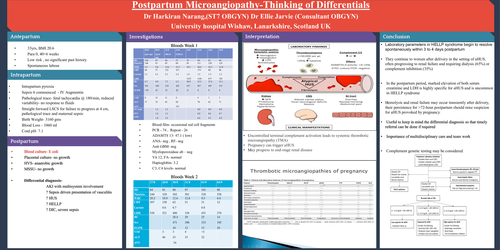
Postpartum Microangiopathy-Thinking of Differentials
Dr Harkiran Narang,(ST7 OBGYN) Dr Ellie Jarvie (Consultant OBGYN)
University hospital Wishaw, Lanarkshire, Scotland UK
Antepartum
33yrs, BMI 20.6
Para 0, 40+6 weeks
Low risk , no significant past history
Spontaneous labour
Intrapartum pyrexia
Sepsis 6 commenced - IV Augmentin
Pathological trace- fetal tachycardia @ 180/min, reduced variability- no response to fluids
Straight forward LSCS for failure to progress at 4 cm, pathological trace and maternal sepsis
Birth Weight- 3160 gms
Blood Loss - 1060 ml
Cord pH- 7.1
Postpartum
Blood culture- E coli
Placental culture- no growth
HVS- anaerobic growth
MSSU- no growth
Differential diagnosis-
AKI with multisystem involvement
? Sepsis driven presentation of vasculitis
? HUS
? HELLP
? DIC, severe sepsis
Investigations
Blood film- occasional red cell fragments
PCR - 74 , Repeat - 26
ADAMTS 13- 47.1 ( low)
ANA- neg , RF- neg
Anti GBM- neg
Myeloperoxidase ab – neg
Vit 12, FA- normal
Haptoglobin- 3.2
C3, C4 levels- normal
Interpretation
Conclusion