1,830 posters, 67 videos, 75 audios, 29 topics, 22 sessions, 4,727 authors, 1,697 institutions
ePostersLive by SciGen Technologies S.A. All rights reserved.
RCOG World Congress 2023
June 12 - 14, 2023 | London, UK

EP.1029
Obstetrics Cholestasis, investigations to rule out differential diagnosis -are these really needed?
Poster Presenter
Authors
Affiliations
Part of Topic
High Risk Pregnancy
Title: Obstetrics cholestasis, investigations to rule out differential diagnosis -are these really needed?
Author: Dr Ambrin Gull Shamas
Affiliation: East Surrey Hospital Redhill
Objectives:
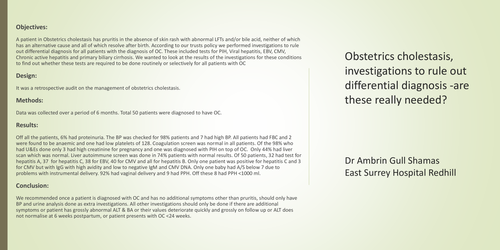
A patient in Obstetrics cholestasis has pruritis in the absence of skin rash with abnormal LFTs and/or bile acid, neither of which has an alternative cause and all of which resolve after birth. According to our trusts policy we performed investigations to rule out differential diagnosis for all patients with the diagnosis of OC. These included tests for PIH, Viral hepatitis, EBV, CMV, Chronic active hepatitis and primary biliary cirrhosis. We wanted to look at the results of the investigations for these conditions to find out whether these tests are required to be done routinely or selectively for all patients with OC
Design:
It was a retrospective audit on the management of obstetrics cholestasis.
Methods:
Data was collected over a period of 6 months. Total 50 patients were diagnosed to have OC.
Results:
Off all the patients, 6% had proteinuria. The BP was checked for 98% patients and 7 had high BP. All patients had FBC and 2 were found to be anaemic and one had low platelets of 128. Coagulation screen was normal in all patients. Of the 98% who had U&Es done only 3 had high creatinine for pregnancy and one was diagnosed with PIH on top of OC. Only 44% had liver scan which was normal. Liver autoimmune screen was done in 74% patients with normal results. Of 50 patients, 32 had test for hepatitis A, 37 for hepatitis C, 38 for EBV, 40 for CMV and all for hepatitis B. Only one patient was positive for hepatitis C and 3 for CMV but with IgG with high avidity and low to negative IgM and CMV DNA. Only one baby had A/S below 7 due to problems with instrumental delivery. 92% had vaginal delivery and 9 had PPH. Off these 8 had PPH <1000 ml.
Conclusion:
We recommended once a patient is diagnosed with OC and has no additional symptoms other than pruritis, should only have BP and urine analysis done as extra investigations. All other investigations should only be done if there are additional symptoms or patient has grossly abnormal ALT & BA or their values deteriorate quickly and grossly on follow up or ALT does not normalise at 6 weeks postpartum, or patient presents with OC <24 weeks.