1,830 posters, 67 videos, 75 audios, 29 topics, 22 sessions, 4,727 authors, 1,697 institutions
ePostersLive by SciGen Technologies S.A. All rights reserved.
RCOG World Congress 2023
June 12 - 14, 2023 | London, UK

EP.1018
Shoulder Dystocia: Audit Findings in a Busy Tertiary Unit
Poster Presenter
Part of Topic
Labour Ward Management
Shoulder Dystocia: Audit Findings in a Busy Tertiary Unit
Background:
Shoulder Dystocia (SD) is an acute obstetric emergency, which occurs in around 1% of all vaginal births. Even with appropriate management, maternal and infant morbidity and mortality risks are significant.
Objective and Design
This was a retrospective audit to assess the quality of
shoulder dystocia care in the King’s College Hospital(KCH) Labour Ward in a one-year time period (2019-
2020). The prevalence of antenatal and intrapartum risk factors was also assessed in this patient cohort.
Method
Electronic patient records were retrieved from March 2019 to March 2020, and 62 shoulder dystocia cases were selected for inclusion. A standardised table was used to collect data.
The prevalence of several antenatal and intrapartum risk factors was registered (Figure 1).
Adherence to the Trust SD prediction guideline was assessed in the following criteria: specialist registrar available during the active stage of labour, completion of a standardised SD proforma, and incident reporting on Datix (a risk management database).
SD complications recorded included Postpartum Haemorrhage (PPH), perineal tears, and foetal injury
Results
SD Risk Factors
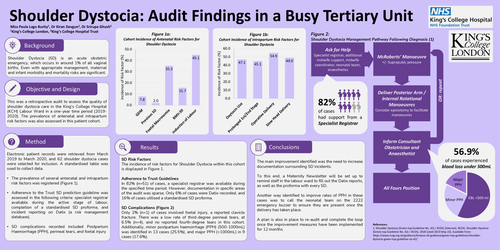
The incidence of risk factors for Shoulder Dystocia within this cohort is displayed in Figure 1.
Adherence to Trust Guidelines
In 82% (n=51) of cases, a specialist registrar was available during the specified time period. However, documentation in specific areas of the audit was sparse. Only 6% of cases were Datix-recorded, and 16% of cases utilised a standardised SD proforma.
SD Complications (Figure 2)
Only 2% (n=1) of cases involved foetal injury, a reported clavicle fracture. There was a low rate of third-degree perineal tears, at 6.5% (n=4), and no reported fourth-degree tears in this cohort. Additionally, minor postpartum haemorrhage (PPH) (500-1000mL) was identified in 13 cases (25.5%), and major PPH (>1000mL) in 9 cases (17.6%).
Conclusions
The main improvement identified was the need to increase documentation surrounding SD incidents.
To this end, a Maternity Newsletter will be set up to remind staff in the labour ward to fill out the Datix reports, as well as the proforma with every SD.
Another way identified to improve rates of PPH in these cases was to call the neonatal team on the 2222 emergency buzzer to ensure they are present once the delivery has taken place.
A plan is also in place to re-audit and complete the loop once the improvement measures have been implemented for 12 months.