1,830 posters, 67 videos, 75 audios, 29 topics, 22 sessions, 4,727 authors, 1,697 institutions
ePostersLive by SciGen Technologies S.A. All rights reserved.
RCOG World Congress 2023
June 12 - 14, 2023 | London, UK

EP.1016
PERINATAL OUTCOME IN WOMEN PRESENTING WITH REDUCED FETAL MOVEMENT AT TERM
Poster Presenter
Part of Topic
High Risk Pregnancy
PERINATAL OUTCOME IN WOMEN PRESENTING WITH REDUCED FETAL MOVEMENT AT TERM
Seema Ghani, Shabnum Hasan, Fouzia Ali, Shabnam Nadeem
Hamdard University Hospital Karachi, Pakistan
OBJECTIVE
To determine perinatal outcome in women presenting with reduced fetal movement at term gestation.
INTRODUCTION
Normal fetal movements during pregnancy are typically perceived as a sign of a healthy central nervous system and sufficient oxygenation1. Many international standards emphasize RFM as a crucial warning sign linked to the fetus's risk of stillbirth, and mothers are advised to keep an eye on their baby's movements and contact their clinicians if they have any concerns2,3. The evidence, however, is still insufficient to warrant the inclusion of RFM in national recommendations and as part of a more comprehensive stillbirth reduction strategy 4,5.
Reduced awareness of fetal movements reported by mothers enables the early detection, prompt assessment, and intervention for fetuses who may have unfavorable outcomes. This study is aimed to evaluate the pregnancy features and outcomes of expectant mothers who presented to hospitals with reduced fetal movements (RFM), so that appropriate counselling of patients can be done and timely interventions can be planned.
MATERIALS AND METHODS
A descriptive cross-sectional study was conducted in Hamdard University Hospital Karachi during January 2021 to June 2021, 216 pregnant women with reduced fetal movement at term were recruited from outpatient clinics, wards and labour room triage. All women having single fetus and term gestation according to LMP (last menstrual period) with maternal perception of reduced fetal movements of less than 10 in 2hrs were included.
Data was collected regarding number of episodes of the reduced fetal movements, maternal age, gravidity, BMI, gestational age, CTG category, ultrasound finding, mode of delivery, induction of labour, neonatal birth weight, APGAR score, NICU admission, stillbirth/ IUFD, presence of meconium and early neonatal death. Data was collected on a pre-formed performa and analysed using frequencies, percentages and Chi square test of association on SPSS version 26.
Results
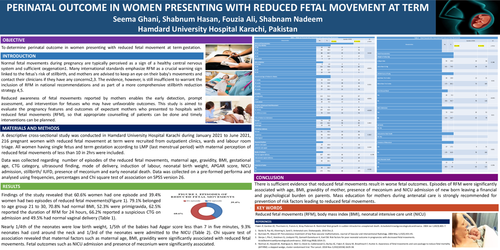
Findings of the study revealed that 60.6% women had one episode and 39.4% women had two episodes of reduced fetal movements(Figure 1). 79.1% belonged to age group 21 to 30, 70.8% had normal BMI, 52.3% were primigravida, 62.5% reported the duration of RFM for 24 hours, 66.2% reported a suspicious CTG on admission and 49.5% had normal vaginal delivery.
Nearly 1/4th of the neonates were low birth weight, 1/5th of the babies had Apgar score less than 7 in five minutes, 9.3% neonates had cord around the neck and 1/3rd of the neonates were admitted to the NICU. Chi square test of association revealed that maternal factors such as maternal age, BMI, gravidity were significantly associated with reduced fetal movements. Fetal outcomes such as NICU admission and presence of meconium were significantly associated.
CONCLUSION
There is sufficient evidence that reduced fetal movements result in worse fetal outcomes. Episodes of RFM were significantly associated with age, BMI, gravidity of mother, presence of meconium and NICU admission of new born leaving a financial and psychological burden on parents. Mass education for mothers during antenatal care is strongly recommended for prevention of risk factors leading to reduced fetal movements.
Keywords
Reduced fetal movements (RFM), body mass index (BMI), neonatal intensive care unit (NICU)