296 posters, 7 videos, 13 audios, 14 topics, 10 sessions, 1,019 authors, 259 institutions
ePostersLive by SciGen Technologies S.A. All rights reserved.
RCOphth Annual Congress 2026
18 - 21 May, 2026 | Manchester Central, Manchester

P095
Diagnostic Accuracy of Neuro-ophthalmic Conditions seen in an Emergency Eye Department
Poster Presenter
Authors
Affiliations
Part of Topic
Emergency ophthalmology
Title
Diagnostic Accuracy of Neuro-ophthalmic Conditions seen in an Emergency Eye Department
Authors
Shie Wei Chan, Salim Khan, Lily-Rouhi Parkouhi, Ali Yagan
Manchester Royal Eye Hospital
Background:
•Patients with neuro-ophthalmic conditions present to the emergency eye department on a regular basis.
•Many of them are challenging and there is the potential of misdiagnosis in these cases which may lead to harm1.
•Aim of the study was to examine the diagnostic accuracy of neuro-ophthalmic conditions referred from an emergency eye department.
Methods
•Retrospective review of EMR of patients seen in an emergency eye department (EED) and referred to the neuro-ophthalmology department between Jan 2024 and Sep 2024.
•Collected data on demographics, conditions referred, urgency of referrals, EED diagnosis and final diagnosis in the neuro-ophthalmic clinic.
•Diagnostic process errors were identified and categorised using the Diagnosis Error Evaluation and Research (DEER) taxonomy tool2.
Results:
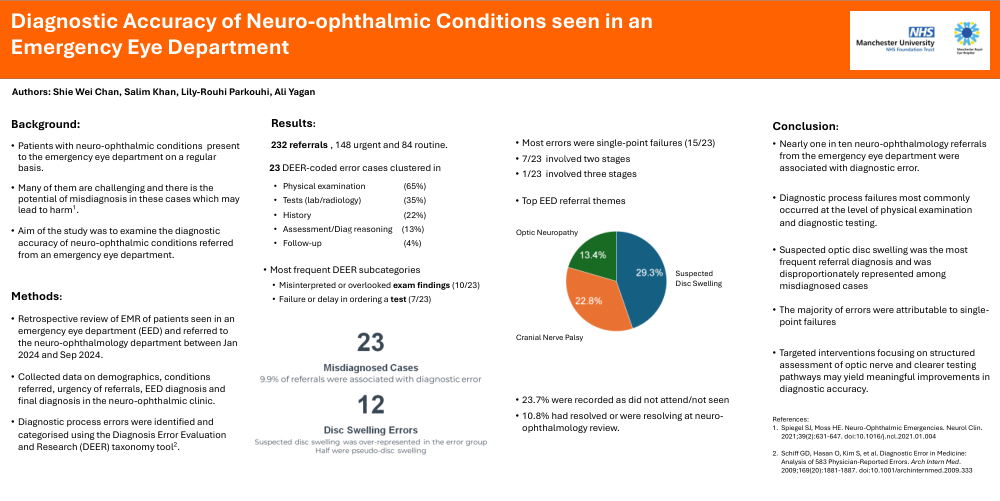
232 referrals , 148 urgent and 84 routine
23 DEER-coded error cases clustered in
•Physical examination (65%)
•Tests (lab/radiology) (35%)
•History (22%)
•Assessment/Diag reasoning (13%)
Follow-up (4%)
•Most frequent DEER subcategories
•Misinterpreted or overlooked exam findings (10/23)
•Failure or delay in ordering a test (7/23)
Conclusion:
•Nearly one in ten neuro-ophthalmology referrals from the emergency eye department were associated with diagnostic error.
•Diagnostic process failures most commonly occurred at the level of physical examination and diagnostic testing.
•Suspected optic disc swelling was the most frequent referral diagnosis and was disproportionately represented among misdiagnosed cases
•The majority of errors were attributable to single-point failures
•Targeted interventions focusing on structured assessment of optic nerve and clearer testing pathways may yield meaningful improvements in diagnostic accuracy.