296 posters, 7 videos, 13 audios, 14 topics, 10 sessions, 1,019 authors, 259 institutions
ePostersLive by SciGen Technologies S.A. All rights reserved.
RCOphth Annual Congress 2026
18 - 21 May, 2026 | Manchester Central, Manchester

P093
Balancing Urgency and Capacity: An Audit of Urgent Ophthalmology Referrals from Eye Casualty At A Large Tertiary Unit
Poster Presenter
Authors
Part of Topic
Emergency ophthalmology
Introduction
Timely access to subspecialty ophthalmology services is crucial for preventing
sight-threatening complications in patients presenting to eye casualty. Urgent
referrals from Accident & Emergency (A&E) departments to subspecialty clinics must
balance clinical urgency with service capacity constraints. Discrepancies between
clinician-requested appointment timings, actual booking performance, and
departmental guideline recommendations may result in delays to time-critical
treatments. Additionally, inappropriate use of urgent referral pathways for non-urgent
cases can contribute to system inefficiencies. This audit aimed to analyse referral
patterns from Western Eye Hospital A&E (Imperial College Healthcare Trust,
London) to subspecialty clinics, assess compliance with local clinical guidelines, and
identify opportunities to improve referral pathways and appointment timeliness.
Methods
A comprehensive retrospective audit was conducted analysing all urgent referrals
documented on the A&E referral spreadsheet at Western Eye Hospital over an
eight-month period from October 2024 to May 2025. This was a system intended for
patients who required urgent sub-specialty followup under two weeks from an initial
AnE visit. Data from 2,540 sequential patients was analysed, including referral date,
day of week, patient demographics, requested referral timeframe, actual
appointment date achieved, subspecialty, and specific clinical conditions. Referral
patterns were evaluated by temporal trends, age demographics, subspecialty
volumes, and urgency distributions. A three-way comparison was performed
between clinician-requested urgency timeframes, actual appointment timing, and
recommended timelines in the local clinical guidelines. Primary outcomes were the
percentage of appointments booked within requested timeframes by subspecialty
and identification of inappropriate referral patterns. Secondary outcomes included
magnitude of delays in days for breached appointments and analysis of high-volume
conditions requiring pathway optimisation.
Results
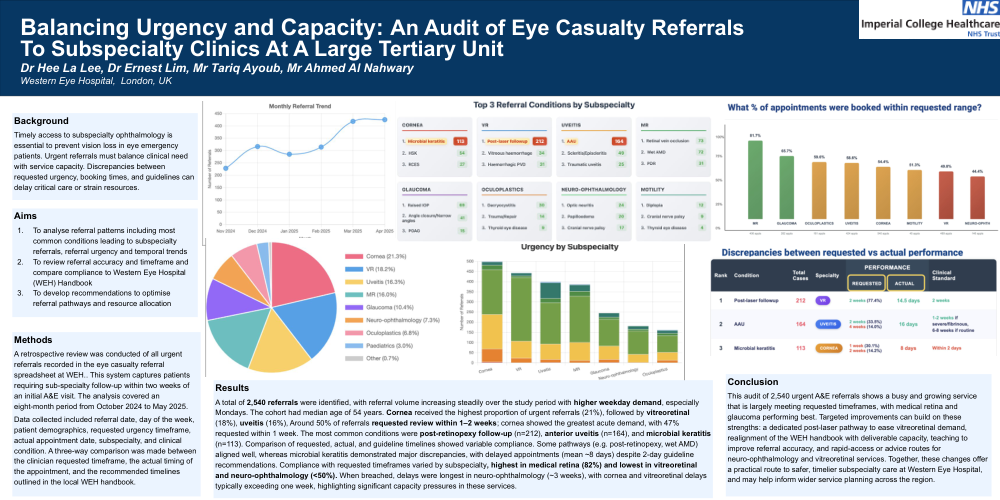
Over the eight-month study period, referral volumes demonstrated a consistent
upward trend, reaching nearly 450 monthly referrals in April 2025. Temporal analysis
revealed significantly higher weekday referral volumes compared to weekends, with
Monday representing the peak referral day. Patient demographics showed a wide
age distribution with a mean age of 51.
By subspecialty distribution, cornea accounted for the highest proportion of urgent
referrals (21%, excluding a separate cornea primary-care-clinic pathway), followed
by vitreoretinal (18%), uveitis (16%), and medical retina (16%). Analysis of requested
urgency revealed approximately 50% of referrals requested within one-to-two weeks.
Urgency patterns varied by subspecialty, with cornea demonstrating highest acute
demand with 47% of cornea referrals requested within one week.
The three highest-volume conditions were post-retinopexy follow-up (212), anterior
uveitis (164), and microbial keratitis (113). Analysis of top three conditions per
subspecialty revealed diverse pathology requiring urgent assessment.
Three-way comparison between requested timeframes, actual appointments, and
handbook guidelines identified substantial compliance variation. Post-retinopexy
follow-ups (2-weeks) and wet age-related macular degeneration (2-weeks)
demonstrated concordance across all parameters. Critical discrepancies emerged in
microbial keratitis where two-day review was recommended per local guidelines, yet
requesting clinician timeframes were inappropriately ranging from one to two weeks,
and actual appointment timelines at eight days, indicating both capacity constraints
and gaps in guideline awareness or applicability.
Compliance with clinician-requested timeframes varied dramatically by subspecialty.
Medical retina achieved the highest compliance rates (82%). In contrast, vitreoretinal
and neuro-ophthalmology services booked fewer than 50% of appointments within
requested timeframes, representing the most acute pressure and capacity mismatch.
When appointments breached requested timeframes, delay magnitude varied
substantially. Neuro-ophthalmology experienced the longest delays, averaging
almost three weeks beyond requested timeframes. Cornea and vitreoretinal services
demonstrated delays exceeding one week, suggesting need for more rapid-access
pathways in these high-demand subspecialties.
Conclusion
This audit of 2,540 urgent A&E referral patterns reveals significant system pressures,
with particularly high-demand and clinically complex subspecialty services such as
vitreoretinal and neuro-ophthalmology demonstrating the greatest mismatch between
requested urgency and achievable appointment timelines. Critical gaps exist
between local guidelines and practice. These findings support targeted local service
improvements, including pathway-based booking, guideline realignment with
deliverable capacity, and clinician education, and may also inform wider regional and
national discussions on urgent ophthalmic service configuration