296 posters, 7 videos, 13 audios, 14 topics, 10 sessions, 1,019 authors, 259 institutions
ePostersLive by SciGen Technologies S.A. All rights reserved.
RCOphth Annual Congress 2026
18 - 21 May, 2026 | Manchester Central, Manchester

P048
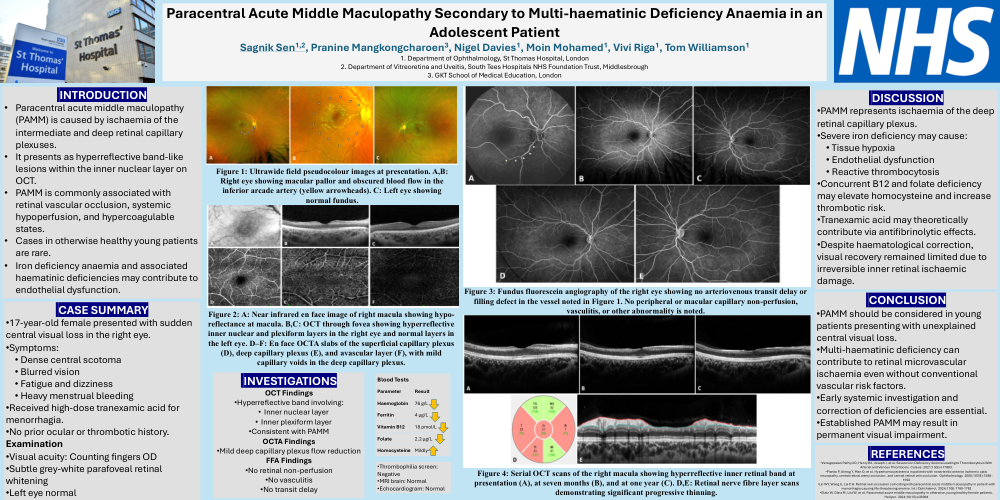
Paracentral Acute Middle Maculopathy Secondary to Multi-haematinic Deficiency Anaemia in an adolescent
Poster Presenter
Part of Topic
Case reports
INTRODUCTION
•Paracentral acute middle maculopathy (PAMM) is caused by ischaemia of the intermediate and deep retinal capillary plexuses.
•It presents as hyperreflective band-like lesions within the inner nuclear layer on OCT.
•PAMM is commonly associated with retinal vascular occlusion, systemic hypoperfusion, and hypercoagulable states.
•Cases in otherwise healthy young patients are rare.
•Iron deficiency anaemia and associated haematinic deficiencies may contribute to endothelial dysfunction.
CASE SUMMARY
•17-year-old female presented with sudden central visual loss in the right eye.
•Symptoms:
•Dense central scotoma
•Blurred vision
•Fatigue and dizziness
•Heavy menstrual bleeding
•Received high-dose tranexamic acid for menorrhagia.
•No prior ocular or thrombotic history.
Examination
•Visual acuity: Counting fingers OD
•Subtle grey-white parafoveal retinal whitening
•Left eye normal
INVESTIGATIONS
OCT Findings
•Hyperreflective band involving:
•Inner nuclear layer
•Inner plexiform layer
•Consistent with PAMM
OCTA Findings
•Mild deep capillary plexus flow reduction
FFA Findings
•No retinal non-perfusion
•No vasculitis
•No transit delay
|
Parameter |
Result |
|
Haemoglobin |
76 g/L |
|
Ferritin |
4 µg/L |
|
Vitamin B12 |
18 pmol/L |
|
Folate |
2.2 µg/L |
|
Homocysteine |
Mildly elevated |
Blood Tests
Additional Workup
•Thrombophilia screen: Negative
•MRI brain: Normal
•Echocardiogram: Normal
DISCUSSION
•PAMM represents ischaemia of the deep retinal capillary plexus.
•Severe iron deficiency may cause:
•Tissue hypoxia
•Endothelial dysfunction
•Reactive thrombocytosis
•Concurrent B12 and folate deficiency may elevate homocysteine and increase thrombotic risk.
•Tranexamic acid may theoretically contribute via antifibrinolytic effects.
•Despite haematological correction, visual recovery remained limited due to irreversible inner retinal ischaemic damage.
CONCLUSION
•PAMM should be considered in young patients presenting with unexplained central visual loss.
•Multi-haematinic deficiency can contribute to retinal microvascular ischaemia even without conventional vascular risk factors.
•Early systemic investigation and correction of deficiencies are essential.
•Established PAMM may result in permanent visual impairment.