296 posters, 7 videos, 13 audios, 14 topics, 10 sessions, 1,019 authors, 259 institutions
ePostersLive by SciGen Technologies S.A. All rights reserved.
RCOphth Annual Congress 2026
18 - 21 May, 2026 | Manchester Central, Manchester

P031
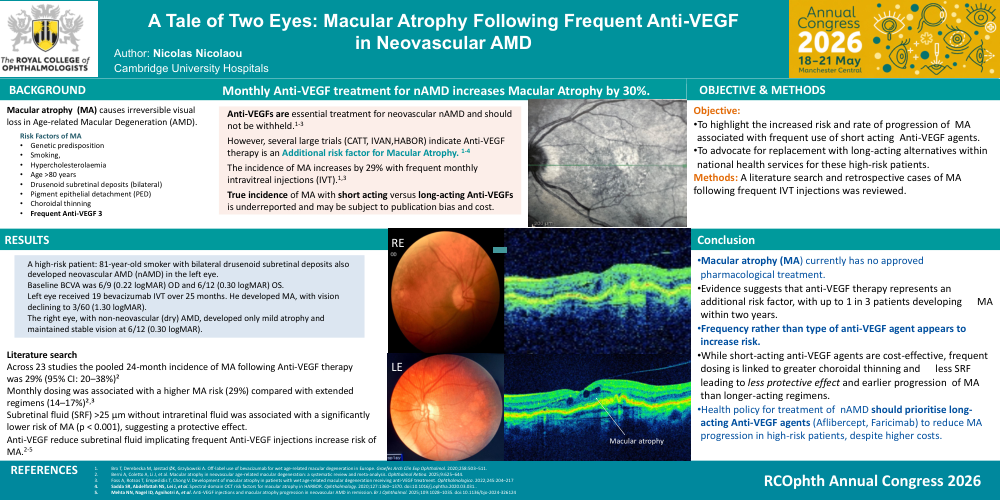
A Tale of Two Eyes: Macular Atrophy Following Frequent Anti-VEGF in Neovascular AMD Versus Untreated Non- Neovascular AMD
Poster Presenter
Authors
Affiliations
Part of Topic
Case reports
Introduction
Macular atrophy (MA) in age-related macular degeneration (AMD) causes irreversible vision loss and currently has no
approved pharmacological treatment. Established risk factors include smoking, advancing age, and genetic predisposition.
Patients presenting with drusenoid pigment epithelial detachments (PEDs) and choroidal thinning are at particularly increased
risk of MA progression. Frequent intravitreal injections (IVTs) for neovascular nAMD have emerged as an additional modifiable
risk factor. The aim of this report is to advocate for the prioritisation of longer-acting IVTs over short-acting, low-cost
alternatives such as bevacizumab within national health systems, in order to reduce the risk of MA in high-risk patients.
Method
A literature search of PubMed, EMBASE, and the Cochrane Library was conducted to identify studies evaluating the incidence
of MA in patients with nAMD treated with anti-VEGF therapy. Particular focus was placed on treatment frequency, comparing
monthly (4-weekly) versus extended (12–16-weekly) regimens. Additionally, we report a case of a patient with visible drusen
who developed MA in one eye following frequent anti-VEGF injections.
Results
Results: An 81-year-old male smoker with bilateral soft drusen and drusenoid PEDs at the macula presented with nAMD in
the left eye. At baseline, best-corrected visual acuity (BCVA) measured 6/9 (0.22 logMAR) in both eyes. The left eye received
19 intravitreal bevacizumab injections over a 25-month period. Despite treatment, progressive MA developed, resulting in a
decline in BCVA to 6/60 (1.00 logMAR). In comparison, the right eye with large drussen without nAMD maintained relatively
stable vision at 6/12 (0.30 logMAR), supporting the association between repeated IVTs and MA progression in the treated eye.
Across 23 studies identified in the literature, the pooled 24-month incidence of MA following anti-VEGF therapy was 29% (95%
CI: 20–38%). Monthly dosing carried a higher risk (24–29%) compared with extended regimens (14–17%).
Conclusion
Evidence suggests that monthly anti-VEGF therapy is an additional risk factor for the development of MA, with up to one in
three patients affected within two years. Despite this, treatment-related risk is often overlooked in the management of patients
already predisposed to MA. Short-acting anti-VEGF agents such as bevacizumab remain cost-effective options for nAMD,
particularly in individuals at lower risk of atrophic progression. However, frequent IVT administration may exacerbate choroidal
thinning and accelerate MA development. Prioritising longer-acting anti-VEGF agents within publicly funded health services