296 posters, 7 videos, 13 audios, 14 topics, 10 sessions, 1,019 authors, 259 institutions
ePostersLive by SciGen Technologies S.A. All rights reserved.
RCOphth Annual Congress 2026
18 - 21 May, 2026 | Manchester Central, Manchester

P045
Irvine-Gass Syndrome Serendipitous Resolution Following Systemic Pembrolizumab for Lung Adenocarcinoma: A Case Report
Part of Topic
Case reports
Title: Irvine-Gass Syndrome Serendipitous Resolution Following Systemic Pembrolizumab for Lung Adenocarcinoma: A Case Report
Authors: Roque De Monte Furtado¹, Mr Abdulmalik Alsaif², Mr Dominic McHugh²
Affiliations: ¹GKT School of Medical Education, King's College London, London, UK; ²Department of Ophthalmology, King's College Hospital NHS Foundation Trust, London, UK
Introduction
-
Irvine-Gass syndrome is a common post-cataract complication (1–2% clinically significant).
-
Pathophysiology: Multifactorial inflammatory origin; surgical trauma releases mediators like VEGF, impairing the blood-retinal barrier.
-
Management: Typically topical NSAIDs/steroids; refractory cases use anti-VEGF or intravitreal steroids.
Case Details
-
75-year-old male, 12 weeks post-uncomplicated cataract surgery (LE).
-
Visual deterioration (VA 6/24-1).
-
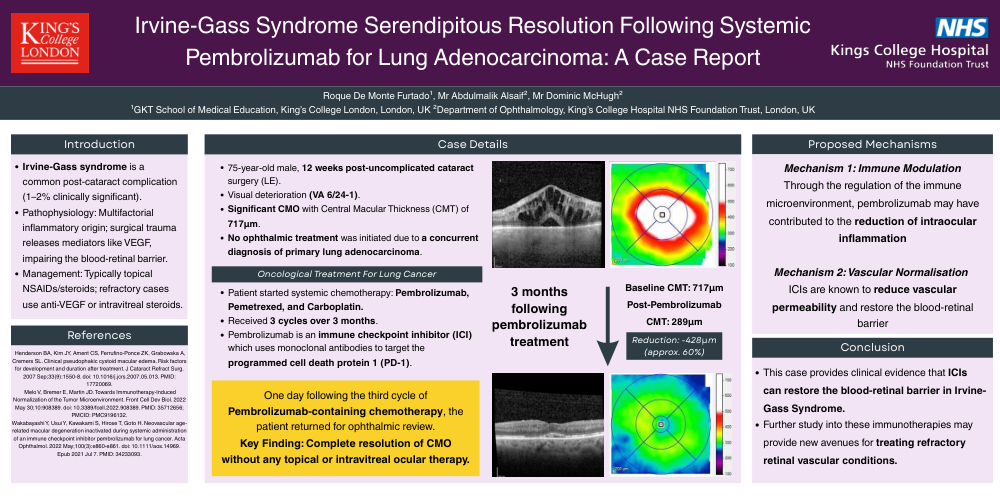
Significant CMO with Central Macular Thickness (CMT) of 717µm.
-
No ophthalmic treatment was initiated due to a concurrent diagnosis of primary lung adenocarcinoma.
Oncological Treatment For Lung Cancer
-
Patient started systemic chemotherapy: Pembrolizumab, Pemetrexed, and Carboplatin.
-
Received 3 cycles over 3 months.
-
Pembrolizumab is an immune checkpoint inhibitor (ICI) which uses monoclonal antibodies to target the programmed cell death protein 1 (PD-1).
Results
-
One day following the third cycle of Pembrolizumab-containing chemotherapy, the patient returned for ophthalmic review.
-
Key Finding: Complete resolution of CMO without any topical or intravitreal ocular therapy.
-
Quantitative Change: Baseline CMT: 717µm; Post-Pembrolizumab CMT: 289µm. Reduction: 428µm (approx. 60%).
Proposed Mechanisms
-
Mechanism 1: Immune Modulation: Through the regulation of the immune microenvironment, pembrolizumab may have contributed to the reduction of intraocular inflammation.
-
Mechanism 2: Vascular Normalisation: ICIs are known to reduce vascular permeability and restore the blood-retinal barrier.
Conclusion
-
This case provides clinical evidence that ICIs can restore the blood-retinal barrier in Irvine-Gass Syndrome.
-
Further study into these immunotherapies may provide new avenues for treating refractory retinal vascular conditions.
References
-
Henderson BA, et al. J Cataract Refract Surg. 2007 Sep;33(9):1550-8.
-
Melo V, et al. Front Cell Dev Biol. 2022 May 30;10:908389.
-
Wakabayashi Y, et al. Acta Ophthalmol. 2022 May;100(3):e860-e861.