296 posters, 7 videos, 13 audios, 14 topics, 10 sessions, 1,019 authors, 259 institutions
ePostersLive by SciGen Technologies S.A. All rights reserved.
RCOphth Annual Congress 2026
18 - 21 May, 2026 | Manchester Central, Manchester

P044
Intermittent Diplopia and Headaches in Obese Women With Polycystic Ovary Syndrome (PCOS) Without Papilloedema
Poster Presenter
Authors
Affiliations
Part of Topic
Case reports
Introduction
Women of reproductive age with recent substantial weight gain often present with intractable headaches and blurred vision,
and 15–57% also have obesity-related PCOS.1 In the absence of papilloedema, they are frequently undertreated. This study
aims to improve awareness, recognition, and management of idiopathic intracranial hypertension without papilloedema
(IIHWOP) in this clinical subgroup.4-8
Method
We present a case of a woman with refractory headaches and intermittent visual disturbance evaluated for suspected
IIHWOP. A focused literature review was conducted using PubMed, Cochrane Library, and Embase to identify studies relating
to IIHWOP, obesity, PCOS and exenatide
Results
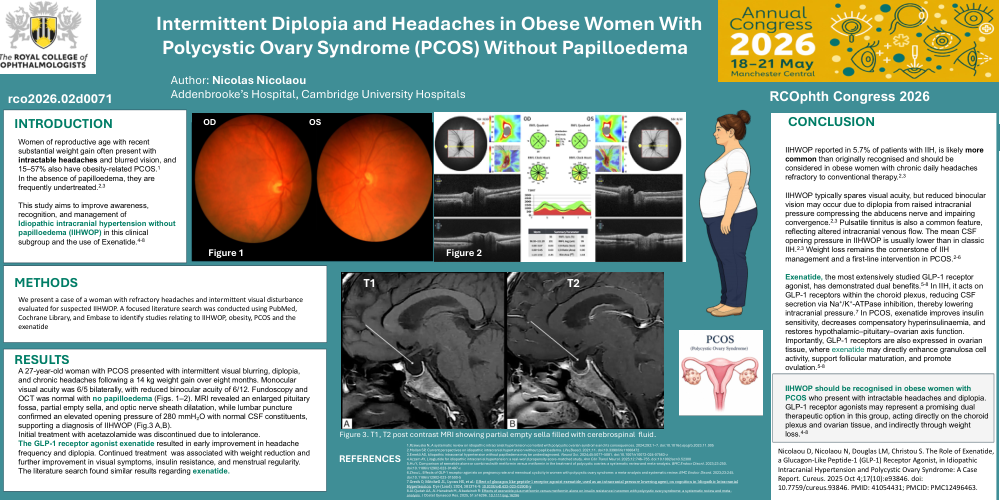
A 27-year-old woman with PCOS presented with intermittent visual blurring, diplopia, and chronic headaches following a 14 kg
weight gain over eight months. Monocular visual acuity was 6/5 bilaterally, with reduced binocular acuity of 6/12. Fundoscopy
was normal with no papilloedema. MRI revealed an enlarged pituitary fossa, partial empty sella, and optic nerve sheath
dilatation, while lumbar puncture confirmed an elevated opening pressure of 280 mmH₂O with normal CSF constituents,
supporting a diagnosis of IIHWOP.
Initial treatment with acetazolamide was discontinued due to intolerance. The GLP-1 receptor agonist exenatide resulted in
early improvement in headache frequency and diplopia. Continued treatment was associated with weight reduction and further
improvement in visual symptoms, insulin resistance, and menstrual regularity. The literature search found similar results regarding exenatide.
Conclusion
IIHWOP, reported in 5.7% of patients with IIH, is likely more common than originally recognised and should be considered in
obese women with chronic daily headaches refractory to conventional therapy. IIHWOP typically spares visual acuity, but
reduced binocular vision may occur due to diplopia from raised intracranial pressure compressing the abducens nerve and
impairing convergence.2-3 Pulsatile tinnitus is also a common feature, reflecting altered intracranial venous flow. The mean CSF
opening pressure in IIHWOP is usually lower than in classic IIH.2-3
Weight loss remains the cornerstone of IIH management and a first-line intervention in PCOS.2-6 However, exenatide, the most
extensively studied GLP-1 receptor agonist, has demonstrated dual benefits.5-8 In IIH, it acts on GLP-1 receptors within the
choroid plexus, reducing CSF secretion via Na⁺/K⁺-ATPase inhibition, thereby lowering intracranial pressure.7In PCOS,
exenatide improves insulin sensitivity, decreases compensatory hyperinsulinaemia, and restores hypothalamic–pituitary–
ovarian axis function. Importantly, GLP-1 receptors are also expressed in ovarian tissue, where exenatide may directly
enhance granulosa cell activity, support follicular maturation, and promote ovulation.5-8
IIHWOP should be recognised in obese women with PCOS who present with intractable headaches and diplopia. GLP-1
receptor agonists may represent a promising dual therapeutic option in this group, acting directly on the choroid plexus and
ovarian tissue, and indirectly through weight loss.4-8