296 posters, 7 videos, 13 audios, 14 topics, 10 sessions, 1,019 authors, 259 institutions
ePostersLive by SciGen Technologies S.A. All rights reserved.
RCOphth Annual Congress 2026
18 - 21 May, 2026 | Manchester Central, Manchester

P041
Endogenous Alternaria alternata Endophthalmitis in a newly diagnosed HTLV-1 Patient: The importance of specialised molecular testing for Fungal Diagnosis
Poster Presenter
Part of Topic
Case reports
Title:
Endogenous Alternaria alternata Endophthalmitis in a newly diagnosed HTLV-1 Patient: The importance of PCR for Fungal Diagnosis
Background:
Endogenous endophthalmitis is a vision-threatening intraocular infection, characterised by inflammation of the vitreous and/or aqueous humour, derived from haematogenous seeding of bacteria or fungi to the eye. Alternaria alternata is a fungus typically associated with the development of asthma and allergic rhinitis. Here we present a case of endogenous Alternaria alternata endophthalmitis superimposed on a chronic Human T lymphotropic virus type 1 (HTLV-1) infection.
Case Details:
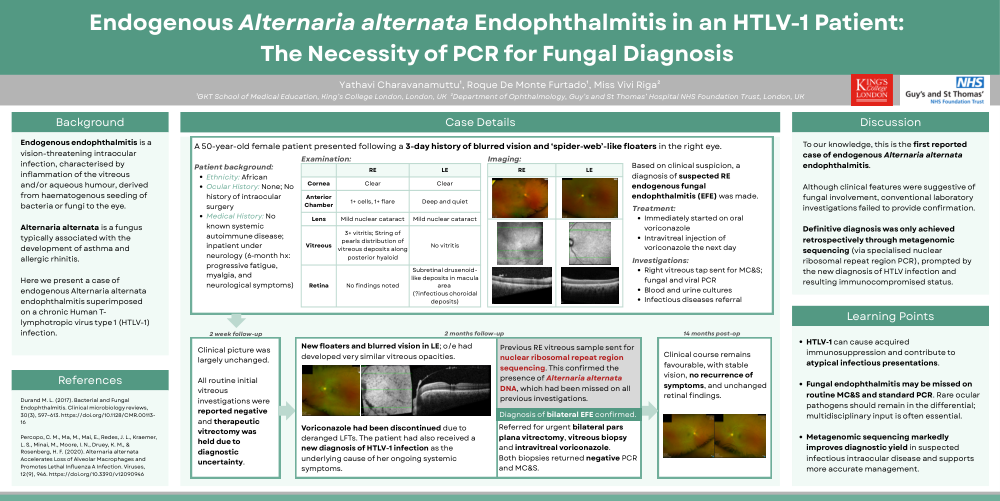
A 50-year-old female patient presented following a 3-day history of blurred vision and ‘spider-web’-like floaters in the right eye.
Patient background:
- Ethnicity: African heritage
- Ocular History: None; No history of intraocular surgery
- Medical History: No known systemic autoimmune disease; inpatient under Neurology, undergoing evaluation for a 6‑month history of progressive fatigue, myalgia, and neurological symptoms
Examination:
|
|
Right Eye (RE) |
Left Eye (LE) |
|
Cornea |
Clear |
Clear |
|
Anterior Chamber |
1+ cells, 1+ flare |
Deep and quiet |
|
Lens |
Mild nuclear cataract |
Mild nuclear cataract |
|
Vitreous |
3+ vitritis; String of pearls distribution of vitreous deposits along posterior hyaloid |
No vitritis |
|
Retina |
No findings noted |
3 subretinal drusenoid-like deposits in the macular area (possible infectious choroidal deposits) |
Based on clinical suspicion, a diagnosis of suspected RE endogenous fungal endophthalmitis (EFE) was made.
Treatment:
- immediately started on oral voriconazole
- intravitreal injection of voriconazole the next day
Investigations:
- Right vitreous tap sent for Microscopy, Culture and Sensitivities (MC&S), alongside fungal and viral PCR
- Blood and urine cultures
- Infectious diseases referral
2 week follow-up
Clinical picture was largely unchanged. All routine initial vitreous investigations were reported negative and a therapeutic vitrectomy was held in view of the diagnostic uncertainty.
2 month follow-up
LE had become symptomatic in with floaters and blurred vision. On examination, she had developed very similar vitreous opacities.
Since the previous follow-up, voriconazole had been discontinued due to deranged liver function tests. The patient had also received a new diagnosis of HTLV-1 infection as the underlying cause of her ongoing systemic symptoms of tropical spastic paraparesis.
The initial RE vitreous sample was sent for nuclear ribosomal repeat region sequencing. This confirmed the presence of Alternaria alternata DNA, which had been missed on all previous investigations. A diagnosis of bilateral EFE was confirmed leading to an urgent bilateral pars plana vitrectomy, vitreous biopsy and intravitreal voriconazole. Both biopsies again returned negative PCR and MC&S results.
1 year post-operative follow-up
At fourteen months postoperatively, her clinical course remains favourable, with stable vision, no recurrence of symptoms, and unchanged retinal findings.
Discussion:
To our knowledge, this is the first reported case of endogenous Alternaria alternata endophthalmitis in the literature, with only a handful of cases of post-operative infection.
This case highlights the diagnostic and management challenges in cases of suspected intraocular infections. Although the clinical features were strongly suggestive of fungal involvement, conventional laboratory investigations failed to provide confirmation. Definitive diagnosis was achieved only retrospectively through specialised nuclear ribosomal repeat region PCR, prompted by the new diagnosis of HTLV infection and resulting immunocompromised status.
Learning points:
- HTLV‑1 can cause acquired immunosuppression and contribute to atypical infectious presentations.
- Fungal endophthalmitis may be missed on routine MC&S and standard PCR. Rare ocular pathogens should remain in the differential; multidisciplinary input is often essential.
- Metagenomic sequencing markedly improves diagnostic yield in suspected infectious intraocular disease and supports more accurate management.