296 posters, 7 videos, 13 audios, 14 topics, 10 sessions, 1,019 authors, 259 institutions
ePostersLive by SciGen Technologies S.A. All rights reserved.
RCOphth Annual Congress 2026
18 - 21 May, 2026 | Manchester Central, Manchester

P040
Early experiences of the Yokoyama Loop Myopexy in the United Kingdom
Poster Presenter
Authors
Affiliations
Part of Topic
Case reports
Audio
Background:
High myopia may cause large-angle acquired esotropia due to superotemporal globe prolapse
This results in inferior and nasal displacement of the lateral rectus, producing severe diplopia and loss of binocular vision
Conventional recess–resect strabismus surgery is often unsuccessful as it does not correct anatomical displacement
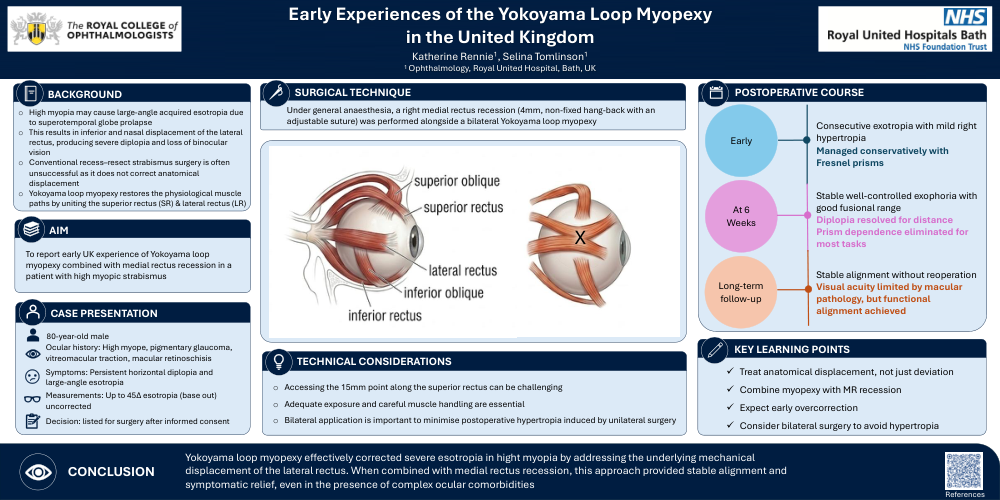
Yokoyama loop myopexy restores the physiological muscle paths by uniting the superior rectus (SR) & lateral rectus (LR)
To report early UK experience of Yokoyama loop myopexy combined with medial rectus recession in a patient with high myopic strabismus
Case presentation:
80-year-old male
Ocular history: High myope, pigmentary glaucoma, vitreomacular traction, macular retinoschisis
Symptoms: Persistent horizontal diplopia and large-angle esotropia
Measurements: Up to 45Δ esotropia (base out) uncorrected
Decision: listed for surgery after informed consent
Surgical technique:
Under general anaesthesia, a right medial rectus recession (4mm, non-fixed hang-back with an adjustable suture) was performed alongside a bilateral Yokoyama loop myopexy