296 posters, 7 videos, 13 audios, 14 topics, 10 sessions, 1,019 authors, 259 institutions
ePostersLive by SciGen Technologies S.A. All rights reserved.
RCOphth Annual Congress 2026
18 - 21 May, 2026 | Manchester Central, Manchester

P269
Topical anaesthetic prior to cyclopentolate 1% and phenylephrine 2.5%: Does this allow faster dilation and cycloplegia in children?
Poster Presenter
Authors
Affiliations
Part of Topic
Paediatric ophthalmology
Introduction
Pupillary dilatation and cycloplegia is essential for accurate refraction and fundus examination in children. However, achieving adequate dilation can prolong the overall patient journey time leading to delays, reduced capacity and negatively impacting patient feedback.
Topical anaesthetic drops can disrupt tight junctions and alter cell membrane permeability. This allows for enhanced penetration of co-administered topical medication. This could potentially reduce the time to effective dilatation.
This quality improvement project compared pupil dilation times in children who received topical anaesthesia, (Oxybuprocaine), prior to cyclopentolate 1% and phenylephrine 2.5% drops with those receiving cyclopentolate 1% and phenylephrine 2.5% alone. We wanted to determine if this intervention would help reduce patient journey time.
Aim
To reduce overall patient journey time in paediatric ophthalmology clinics by evaluating whether the use of topical anaesthesia prior to cyclopentolate 1% and phenylephrine 2.5% results in faster pupil dilation compared with standard dilation practice (cyclopentolate 1% and phenylephrine 2.5% alone).
Plan
A prospective comparison was designed involving two groups of paediatric patients attending for their appointment who required a cycloplegic refraction:
- Intervention Group: Topical oxybuprocaine instilled prior to cyclopentolate 1% and phenylephrine 2.5%.
- Control Group: Cyclopentolate 1% and phenylephrine 2.5% only.
Patients were randomised, between the intervention and control, on alternating days by the orthoptic team.
Do
The intervention was implemented during routine clinics. After initial instillation of topical anaesthesia the patient was asked to blink a few times prior to administrating cyclopentolate 1% and phenylephrine 2.5%. Pupils were assessed at 20 minutes, and then every 10 minutes up to 60 minutes using a pen torch. If pupils were not sufficiently dilated at 30 minutes, a second drop of cyclopentolate and phenylephrine was administered in both groups of patients.
All timings, interventions, and iris colour data were recorded to ensure consistency. The time taken to dilate was calculated per patient and the data analysed.
Study
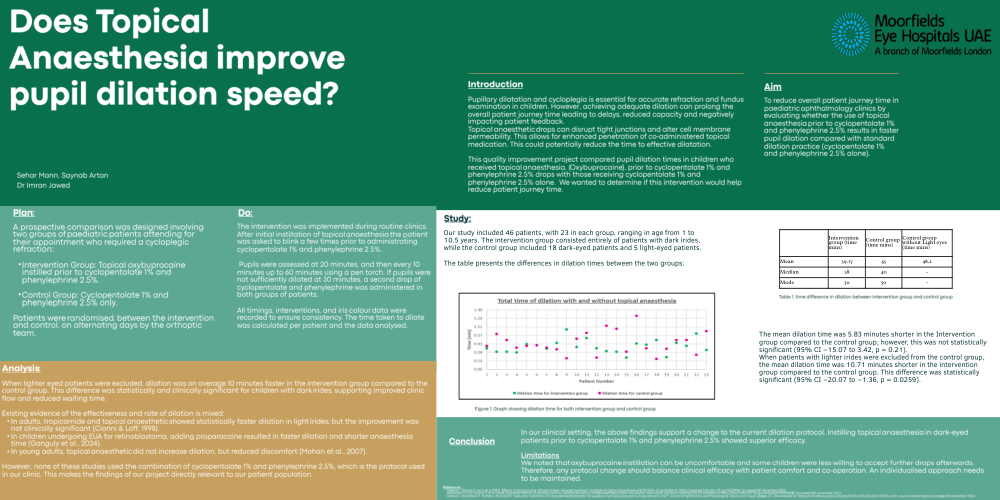
Our study included 46 patients, with 23 in each group, ranging in age from 1 to 10.5 years. The intervention group consisted entirely of patients with dark irides, while the control group included 18 dark-eyed patients and 5 light-eyed patients. The table presents the differences in dilation times between the two groups:
|
Control group without light eyed patients |
|
|
Mean |
48.2 |
|
Intervention group |
|
|
|
Time (mins) |
|
Mean |
39.17 |
|
Median |
38 |
|
Mode |
30 |
|
Control group |
|
|
|
Time (mins) |
|
Mean |
45 |
|
Median |
40 |
|
Mode |
50 |
The mean dilation time was 5.83 minutes shorter in the Intervention group compared to the control group; however, this was not statistically significant (95% CI −15.07 to 3.42, p = 0.21).
When patients with lighter irides were excluded from the control group, the mean dilation time was 10.71 minutes shorter in the intervention group compared to the control group. This difference was statistically significant (95% CI −20.07 to −1.36, p = 0.0259).
Analysis
When lighter eyed patients were excluded, dilation was on average 10 minutes faster in the intervention group compared to the control group. This difference was statistically and clinically significant for children with dark irides, supporting improved clinic flow and reduced waiting time.
Existing evidence of the effectiveness and rate of dilation is mixed:
- In adults, tropicamide and topical anaesthetic showed statistically faster dilation in light irides, but the improvement was not clinically significant (Cionni & Loff, 1998).
- In children undergoing EUA for retinoblastoma, adding proparacaine resulted in faster dilation and shorter anaesthesia time (Ganguly et al., 2024).
- In young adults, topical anaesthetic did not increase dilation, but reduced discomfort (Mohan et al., 2007).
However, none of these studies used the combination of cyclopentolate 1% and phenylephrine 2.5%, which is the protocol used in our clinic. This makes the findings of our project directly relevant to our patient population.
Conclusion
In our clinical setting, the above findings support a change to the current dilation protocol. Instilling topical anaesthesia in dark-eyed patients prior to cyclopentolate 1% and phenylephrine 2.5% showed superior efficacy.
Limitations
We noted that oxybuprocaine instillation can be uncomfortable and some children were less willing to accept further drops afterwards. Therefore, any protocol change should balance clinical efficacy with patient comfort and co-operation. An individualised approach needs to be maintained.