296 posters, 7 videos, 13 audios, 14 topics, 10 sessions, 1,019 authors, 259 institutions
ePostersLive by SciGen Technologies S.A. All rights reserved.
RCOphth Annual Congress 2026
18 - 21 May, 2026 | Manchester Central, Manchester

P253
Assessing Referrals for Paediatric Suspicious Optic Discs: A 6-Month Audit of Accuracy and Outcomes
Poster Presenter
Authors
Part of Topic
Paediatric ophthalmology
INTRODUCTION
Blurred or suspicious optic discs in children can indicate serious sight-threatening
and life-threatening conditions, including papilloedema secondary to raised
intracranial pressure, optic neuritis, or other neuro-ophthalmological pathology.
Timely and accurate referral is crucial, as delayed diagnosis can result in permanent
visual impairment or neurological sequelae.
The paediatric ophthalmology service at Hillingdon Hospital (London, UK) observed
a significant increase in optician referrals for suspicious optic discs. This audit aimed
to assess the accuracy of these referrals, review compliance with requested
timeframes, evaluate clinical outcomes and management, and identify potential
improvements in the referral pathway.
METHODS
A retrospective audit was conducted at Hillingdon Hospital over a 6-month period
from September 28, 2024, to April 16, 2025. All consecutive referrals for suspicious
or blurred optic disc margins to the paediatric ophthalmology service were included.
Data collected included referral indication and requested urgency, patient
demographics and presenting symptoms, dates of referral and clinic attendance,
comprehensive clinical examination findings including visual acuity, intraocular
pressure, relative afferent pupillary defect assessment, Ishihara colour vision testing,
optic disc optical coherence tomography, fundus photography, final diagnoses, and
follow-up management plans. Clinical assessments were compared against the
Moorfields Eye Hospital guidelines for management and referral for suspicious optic
discs in children.
RESULTS
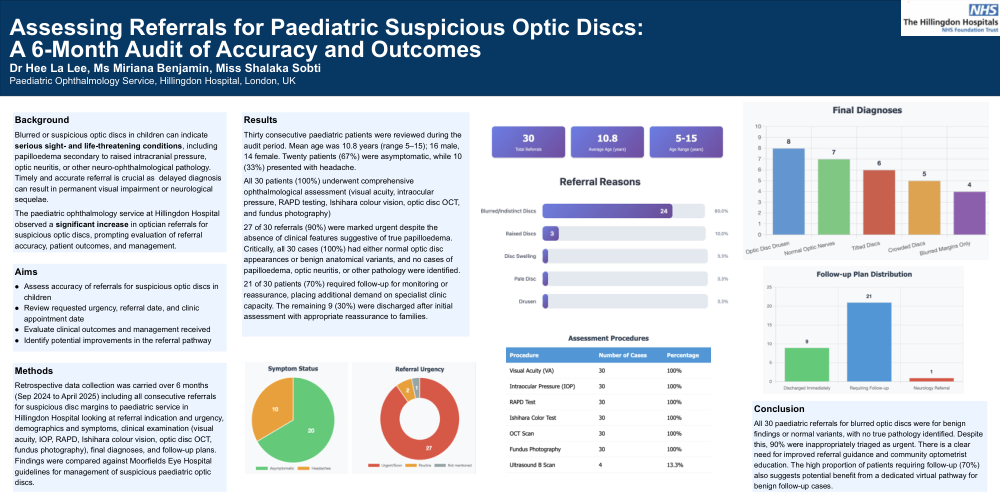
Thirty consecutive paediatric patients were identified and reviewed during the audit
period. All 30 patients (100%) underwent ophthalmological assessment including
visual acuity, intraocular pressure measurement, RAPD testing, Ishihara colour
vision assessment, optic disc OCT imaging, and fundus photography, demonstrating
excellent adherence to investigation protocols.
Regarding referral urgency, 27 of 30 referrals (90%) were marked as urgent despite
the absence of concerning clinical features or symptoms suggestive of true
papilloedema. Critically, all 30 cases (100%) were found to have either normal optic
disc appearances or benign anatomical variants, with no cases of papilloedema,
optic neuritis, or other pathological conditions identified. This represents a significant
over-triage of referral urgency and highlights potential gaps in community-based
assessment protocols.
21 of 30 patients (70%) required follow-up appointments for monitoring or
reassurance, placing additional demand on specialist clinic capacity. The remaining
9 patients (30%) were discharged following initial assessment with appropriate
reassurance provided to families.
CONCLUSIONS
This audit revealed that all referrals for blurred optic discs in paediatric patients
during the study period were for benign findings or normal anatomical variants, with
no true pathology identified. Despite this, 90% were inappropriately triaged as urgent
referrals, potentially diverting resources from genuinely urgent cases and causing
unnecessary anxiety for families.
These findings highlight the need for improved referral guidance and educational
support for community optometrists to better differentiate between physiological
variants and pathological optic disc changes in children. The high proportion of
patients requiring follow-up (70%) suggests potential benefit from developing a
virtual or streamlined review pathway for benign cases, which could improve service
efficiency and patient experience