Loading...

296 posters, 7 videos, 13 audios, 14 topics, 10 sessions, 1,019 authors, 259 institutions

ePostersLive by SciGen Technologies S.A. All rights reserved.

RCOphth Annual Congress 2026

18 - 21 May, 2026 | Manchester Central, Manchester

RCOphth Annual Congress 2026 banner

P262

Hyperautofluorescent parafoveal ring in children with rod-cone dystrophy and literature review
Part of Topic

Paediatric ophthalmology

Background:

Autofluorescence is an increasingly useful tool
A blue light is used to excite natural fluorophores in the retina which then further emit light
Patterns of autofluorescence can aide diagnosis and determine prognosis
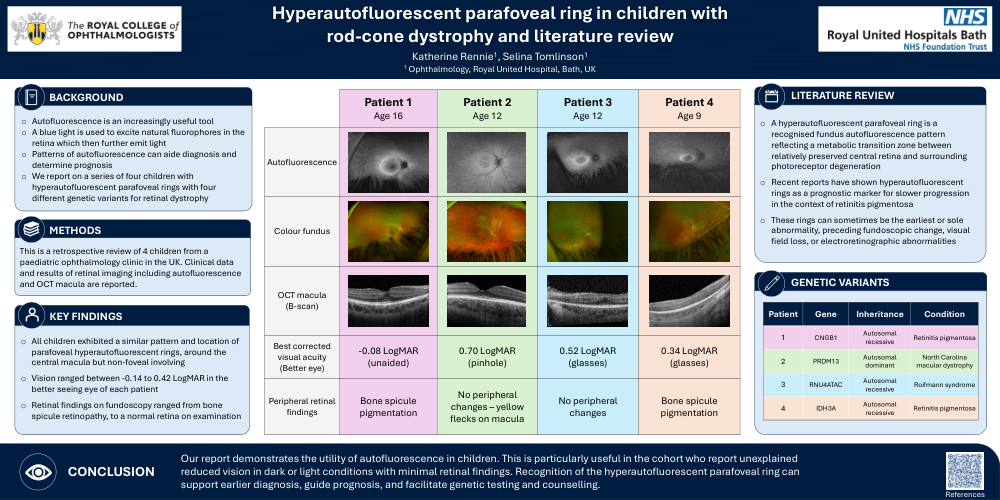
We report on a series of four children with hyperautofluorescent parafoveal rings with four different genetic variants for retinal dystrophy
 
Methods:

This is a retrospective review of 4 children from a paediatric ophthalmology clinic in the UK. Clinical data and results of retinal imaging including autofluorescence and OCT macula are reported. 

Key Findings:

All children exhibited a similar pattern and location of parafoveal hyperautofluorescent rings, around the central macula but non-foveal involving
Vision ranged between -0.14 to 0.42 LogMAR in the better seeing eye of each patient
Retinal findings on fundoscopy ranged from bone spicule retinopathy, to a normal retina on examination
 
Literature review:
A hyperautofluorescent parafoveal ring is a recognised fundus autofluorescence pattern reflecting a metabolic transition zone between relatively preserved central retina and surrounding photoreceptor degeneration
Recent reports have shown hyperautofluorescent rings as a prognostic marker for slower progression in the context of retinitis pigmentosa
These rings can sometimes be the earliest or sole abnormality, preceding fundoscopic change, visual field loss, or electroretinographic abnormalities
 
Conclusion:

Our report demonstrates the utility of autofluorescence in children. This is particularly useful in the cohort who report unexplained reduced vision in dark or light conditions with minimal retinal findings. Recognition of the hyperautofluorescent parafoveal ring can support earlier diagnosis, guide prognosis, and facilitate genetic testing and counselling.

rco2026 banner
Copyright © 2015-2026, ePostersLive® SciGen is a registered trademark of SciGen Technologies S.A. Patent pending.

This website and third-party tools we use rely on cookies for the best user experience. By selecting "I agree", you agree to cookie usage as described in our Privacy Policy.