296 posters, 7 videos, 13 audios, 14 topics, 10 sessions, 1,019 authors, 259 institutions
ePostersLive by SciGen Technologies S.A. All rights reserved.
RCOphth Annual Congress 2026
18 - 21 May, 2026 | Manchester Central, Manchester

P261
From Hospital to Community: Service evaluation of multi-locality community optometry-based Post Vision Screening services for children in England
Poster Presenter
Authors
Part of Topic
Paediatric ophthalmology
Audio
From Hospital to Community - Service evaluation of multi‑locality community optometry‑based Post Vision Screening services for children in England
Authors:
Amy Hughes, Angela Henderson and Lisa Gibson
Primary Eyecare Services, England
Introduction
- All children aged 4–5 in England should receive vision screening as part of the NHS Healthy Child Programme.¹˒²
- The pathways for those children who do not meet the expected vision standard vary across England and include referral to hospital, referral to a commissioned community optometry service, and informal signposting for further assessment.
- NHS‑funded community Post Vision Screening (PVS) services are designed to provide accessible, high‑quality care for children identified through school vision screening as not meeting expected visual standards.
- PVS services are delivered by accredited optometrists in community settings and aim to reduce unnecessary referrals to hospital eye services (HES), minimise travel for families, and improve patient outcomes.
- The outcomes of children entering three Post Vision Screening services provided by Primary Eyecare Services over a three‑year period were evaluated.
Methods
- The service evaluation involved a retrospective analysis of three years (1 April 2022 to 31 March 2025) of routinely collected service data from three PVS services provided by Primary Eyecare Services.
- The three services were selected, two in North East England and one in London, as providing the full service pathway, an initial screening appointment followed by 6‑week and 18‑week follow‑ups where clinically indicated.
- Children were referred into the PVS service following school vision screening if they did not meet visual standards or were unable to complete the test.
- Accredited optometrists based in community optometry practices undertook comprehensive clinical assessments, including cycloplegic refraction, cover testing, fundus examination, and prescribing of glasses where appropriate.
- Outcomes for children entering the service were evaluated across three time points, the initial community optometry appointment and at 6‑week review and 18‑week review, if required.
- Possible outcomes were discharge, continuing in the service, referral to hospital orthoptics, or referral to hospital for consultant opinion, urgent or routine.
- The proportion of children prescribed glasses at their initial appointment is reported.
Results
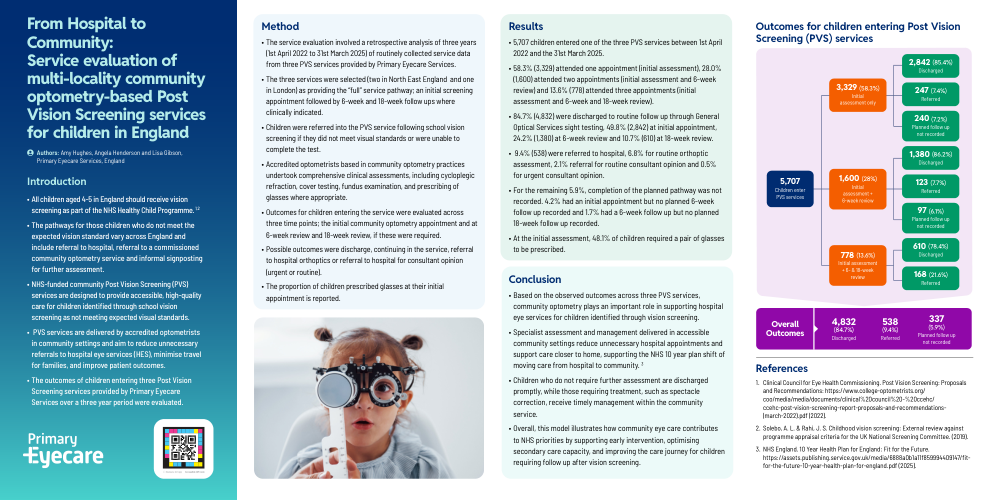
- 5,707 children entered one of the three PVS services between 1 April 2022 and 31 March 2025.
- 58.3 percent (3,329) attended one appointment, initial assessment only, 28.0 percent (1,600) attended two appointments, initial assessment and 6‑week review, and 13.6 percent (778) attended three appointments, initial assessment with 6‑week and 18‑week review.
- 84.7 percent (4,832) were discharged to routine follow‑up through General Optical Services sight testing, 49.8 percent (2,842) at the initial appointment, 24.2 percent (1,380) at the 6‑week review, and 10.7 percent (610) at the 18‑week review.
- 9.4 percent (538) were referred to hospital, including 6.8 percent for routine orthoptic assessment, 2.1 percent for routine consultant opinion, and 0.5 percent for urgent consultant opinion.
- For the remaining 5.9 percent, completion of the planned pathway was not recorded. Of these, 4.2 percent had an initial appointment but no planned 6‑week follow‑up recorded, and 1.7 percent had a 6‑week follow‑up but no planned 18‑week follow‑up recorded.
- At the initial assessment, 48.1 percent of children required a pair of glasses to be prescribed.
Conclusion
- Based on the observed outcomes across three PVS services, community optometry plays an important role in supporting hospital eye services for children identified through vision screening.
- Specialist assessment and management delivered in accessible community settings reduce unnecessary hospital appointments and support care closer to home, supporting the NHS 10 year plan shift of moving care from hospital to community.
- Children who do not require further assessment are discharged promptly, while those requiring treatment, such as spectacle correction, receive timely management within the community service.
- Overall, this model illustrates how community eye care contributes to NHS priorities by supporting early intervention, optimising secondary care capacity, and improving the care journey for children requiring follow‑up after vision screening.
References
- Clinical Council for Eye Health Commissioning. Post Vision Screening: Proposals and Recommendations. 2022.
- Solebo, A.L. and Rahi, J.S. Childhood vision screening: External review against programme appraisal criteria for the UK National Screening Committee. 2019.
- NHS England. 10 Year Health Plan for England: Fit for the Future. 2025.