296 posters, 7 videos, 13 audios, 14 topics, 10 sessions, 1,019 authors, 259 institutions
ePostersLive by SciGen Technologies S.A. All rights reserved.
RCOphth Annual Congress 2026
18 - 21 May, 2026 | Manchester Central, Manchester

P023
Real-World Performance of the 2020 RCOphth Imaging-Led Hydroxychloroquine Retinopathy Screening Pathway: A Five-Year Virtual Clinic Analysis of 505 Patients
Poster Presenter
Part of Topic
Audit and clinical governance
INTRODUCTION
Hydroxychloroquine (HCQ) retinopathy is a preventable yet irreversible form of retinal
toxicity, and its true prevalence has become increasingly apparent with the widespread
adoption of multimodal imaging. Prolonged duration of therapy, high daily dosing, renal
impairment and concurrent tamoxifen use substantially elevate toxicity risk. In December
2020, the Royal College of Ophthalmologists (RCOphth) introduced major revisions to the
national HCQ monitoring guideline. These revisions removed the requirement for baseline
ophthalmic screening and established an imaging-led approach in which SD-OCT and
widefield FAF serve as the primary diagnostic tools, with visual field (VF) testing reserved
only for cases demonstrating structural abnormalities. This represented a major shift from the
earlier 2018 guideline, which mandated annual OCT, FAF and VF for all eligible patients.
The aim of this study was to evaluate real-world outcomes following implementation of the
2020 guideline within a large virtual HCQ screening service, assessing demographic
characteristics, systemic risk factors, treatment indications, imaging-based diagnostic yield
and pathway-related delays, and comparing our findings with earlier cohorts screened under
the 2018 guideline.
METHODS
This retrospective study included 505 patients who attended the hydroxychloroquine virtual
screening clinic between January 2021 and December 2025. Demographic features, HCQ
indication, therapy duration, daily dosing (standardising alternate-day regimens to 300
mg/day), renal function, tamoxifen exposure, referral source and best-corrected visual acuity
were recorded. All patients underwent SD-OCT and widefield FAF imaging according to the
2020 RCOphth guideline. VF testing (10-2 or 30-2) was performed only when OCT or FAF
abnormalities were detected. mfERG was used when VF reliability was limited or when
structure–function correlation was unclear. Toxicity was classified using the revised RCOphth
definitions.
RESULTS
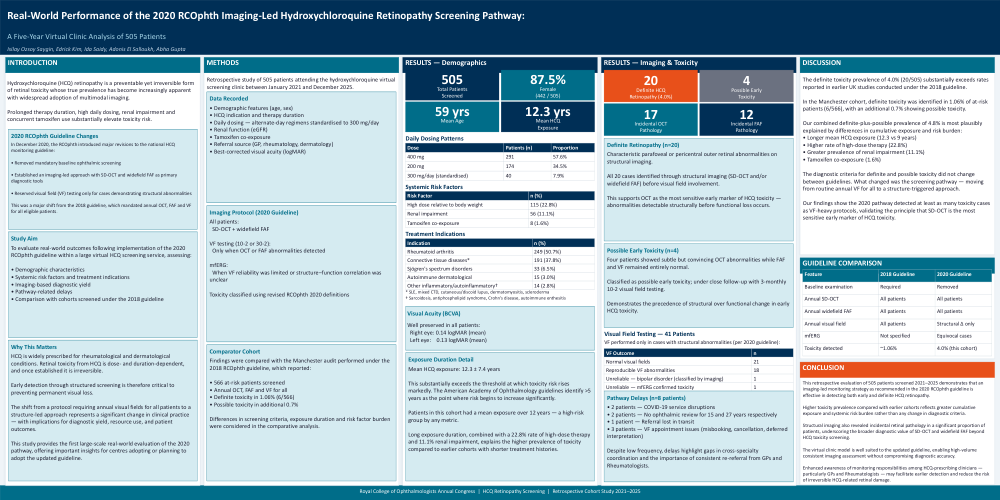
The cohort had a mean age of 59 years, with a strong female predominance (442/505; 87.5%).
The mean duration of HCQ exposure was 12.3 ± 7.4 years. Daily dosing patterns showed that
291 patients (57.6%) were receiving 400 mg, 174 (34.5%) were receiving 200 mg and 40
(7.9%) were on a regimen standardised to 300 mg/day. Renal impairment was present in 56
patients (11.1%), tamoxifen exposure in 8 patients (1.6%) and 115 patients (22.8%) were
receiving daily doses considered high relative to body weight. Best-corrected visual acuity
remained well preserved, averaging 0.14 logMAR in the right eye and 0.13 logMAR in the
left.
Treatment indications reflected contemporary prescribing patterns. Rheumatoid arthritis
accounted for 50.7% (n = 249) of patients. Connective tissue diseases represented 37.8%
(n = 191), including systemic lupus erythematosus, mixed connective tissue disease,
cutaneous and discoid lupus, dermatomyositis and scleroderma. Sjögren’s spectrum
disorders constituted 6.5% (n = 33). Autoimmune dermatological conditions represented
3.0% (n = 15), while other inflammatory or autoinflammatory disorders comprised
2.8% (n = 14), including sarcoidosis, antiphospholipid syndrome, Crohn’s disease and
autoimmune enthesitis.
Structural imaging served as the cornerstone of diagnostic assessment. Twenty patients
demonstrated definite HCQ retinopathy, showing characteristic parafoveal or pericentral
outer retinal abnormalities. Four patients were classified as possible early toxicity, each
displaying subtle but convincing OCT abnormalities while FAF and VF remained normal.
These individuals continue under close follow-up with three-monthly 10-2 VF testing.
Additional unrelated retinal pathology was identified in 17 OCT scans and 12 FAF images.
VF testing was performed in 41 patients, consistent with the guideline limiting VF to those
with structural abnormalities. Of these, 21 showed normal visual fields, while 18
demonstrated reproducible abnormalities consistent with functional involvement. Two
patients produced unreliable visual fields despite repeat testing. One continued to exhibit
unstable fixation due to underlying bipolar disorder, rendering functional assessment
unreliable; based on characteristic OCT and FAF findings, this patient was classified as
having definite toxicity and is being followed with structural imaging alone. The second
patient underwent mfERG, which showed an abnormal electrophysiological response,
enabling accurate classification of toxicity in the absence of interpretable VF data.
A total of eight patients experienced delays within the monitoring pathway. Two delays
were associated with COVID-19 disruptions; two patients had not undergone ophthalmic
review for exceptionally long periods—fifteen and twenty-seven years, respectively; one
referral had been lost; and three delays resulted from VF appointment issues including
misbooking, cancellation or deferred interpretation. Although infrequent, these delays
demonstrate how gaps in follow-up or re-referral may occur among long-term HCQ users and
underscore the importance of consistent referral practices from General Practitioners and
Rheumatologists.
DISCUSSION
The prevalence of definite toxicity in this cohort—20 of 505 patients (4.0%)—is higher than
that reported in earlier UK studies performed under the 2018 RCOphth guideline. In the
previous Manchester audit, definite toxicity was identified in 1.06% of at-risk patients
(6/566) and 1.09% of all screened patients, with an additional 0.7% showing possible toxicity.
Our combined definite-plus-possible prevalence of 4.8% therefore exceeds earlier rates. The
most plausible explanation lies in differences in exposure duration and systemic risk burden:
patients in our cohort had longer mean HCQ exposure (12.3 vs 9 years) and a higher
prevalence of recognised risk factors, including high-dose therapy (22.8%), renal
impairment (11.1%) and tamoxifen use (1.6%). These features are well-established
contributors to increased toxicity risk and likely account for the higher prevalence observed.
Importantly, the criteria for definite and possible toxicity did not change between the 2018
and 2020 guidelines; what changed was the screening pathway. The 2018 guideline
mandated baseline examinations and annual OCT, FAF and VF testing, whereas the 2020
revision removed baseline screening and introduced an imaging-led, VF-triggered
approach. Our findings show that despite performing far fewer routine visual fields, the 2020
pathway detected at least as many cases of toxicity as earlier VF-heavy protocols. This
supports the principle that OCT is the most sensitive early marker of HCQ toxicity, as
demonstrated by the four patients with OCT-only abnormalities and normal FAF and VF.
The virtual clinic model used in this service appears to be well suited to the updated guideline,
allowing high-volume, consistent imaging assessment without compromising diagnostic
accuracy. The delays observed, while infrequent, highlight areas for improvement in cross-
specialty communication and underscore the importance of increasing guideline awareness
among HCQ-prescribing clinicians.
CONCLUSION
This retrospective evaluation of 505 patients screened between 2021 and 2025 demonstrates
that an imaging-led monitoring strategy, as recommended in the 2020 RCOphth guideline, is
effective in detecting both early and definite hydroxychloroquine retinopathy. Structural
imaging also revealed incidental retinal pathology, emphasising the broader diagnostic value
of SD-OCT and widefield FAF. Although most patients were appropriately referred and
monitored, occasional gaps in follow-up highlight opportunities to strengthen coordination
between ophthalmology, primary care and rheumatology. Enhanced awareness of monitoring
responsibilities among prescribers may facilitate earlier detection and reduce the risk of
irreversible HCQ-related retinal damage.