296 posters, 7 videos, 13 audios, 14 topics, 10 sessions, 1,019 authors, 259 institutions
ePostersLive by SciGen Technologies S.A. All rights reserved.
RCOphth Annual Congress 2026
18 - 21 May, 2026 | Manchester Central, Manchester

P022
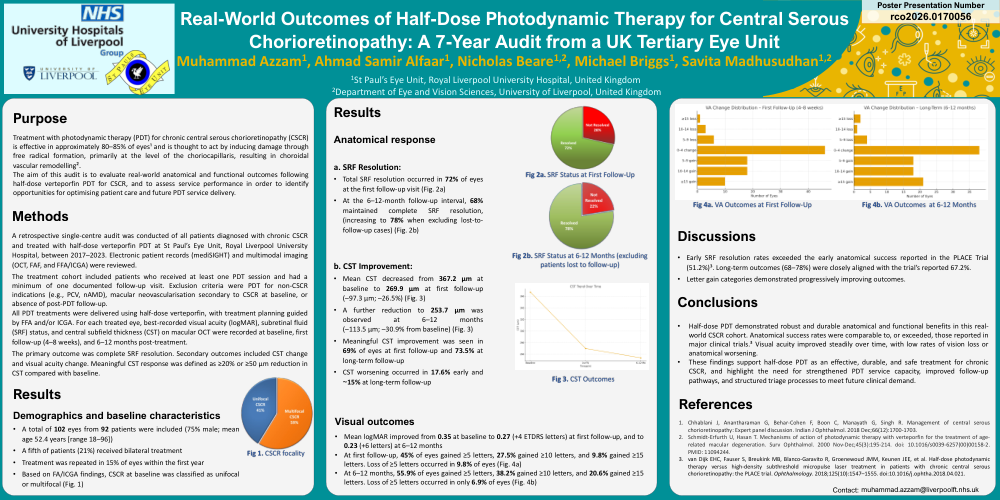
Real-World Outcomes of Half-Dose Photodynamic Therapy for Central Serous Chorioretinopathy: A 7-Year Audit from a UK Tertiary Eye Unit
Poster Presenter
Part of Topic
Audit and clinical governance
Real-World Outcomes of Half-Dose Photodynamic Therapy for Central Serous Chorioretinopathy: A 7-Year Audit from a UK Tertiary Eye Unit
Muhammad Azzam1, Ahmad Samir Alfaar1, Nicholas Beare1,2, Michael Briggs1, Savita Madhusudhan1,2
1St Paul’s Eye Unit, Royal Liverpool University Hospital, United Kingdom
2Department of Eye and Vision Sciences, University of Liverpool, United Kingdom
Purpose
Treatment with photodynamic therapy (PDT) for chronic central serous chorioretinopathy (CSCR) is effective in approximately 80–85% of eyes¹ and is thought to act by inducing damage through free radical formation, primarily at the level of the choriocapillaris, resulting in choroidal vascular remodelling².
The aim of this audit is to evaluate real-world anatomical and functional outcomes following half-dose verteporfin PDT for CSCR, and to assess service performance in order to identify opportunities for optimising patient care and future PDT service delivery.
Methods
A retrospective single-centre audit was conducted of all patients diagnosed with chronic CSCR and treated with half-dose verteporfin PDT at St Paul’s Eye Unit, Royal Liverpool University Hospital, between 2017–2023. Electronic patient records (mediSIGHT) and multimodal imaging (OCT, FAF, and FFA/ICGA) were reviewed.
The treatment cohort included patients who received at least one PDT session and had a minimum of one documented follow-up visit. Exclusion criteria were PDT for non-CSCR indications (e.g., PCV, nAMD), macular neovascularisation secondary to CSCR at baseline, or absence of post-PDT follow-up.
All PDT treatments were delivered using half-dose verteporfin, with treatment planning guided by FFA and/or ICGA. For each treated eye, best-recorded visual acuity (logMAR), subretinal fluid (SRF) status, and central subfield thickness (CST) on macular OCT were recorded at baseline, first follow-up (4–8 weeks), and 6–12 months post-treatment.
The primary outcome was complete SRF resolution. Secondary outcomes included CST change and visual acuity change. Meaningful CST response was defined as ≥20% or ≥50 µm reduction in CST compared with baseline.
Results
Demographics and baseline characteristics
Results
Anatomical response
a. SRF Resolution:
b. CST Improvement:
Visual outcomes
Discussions
Conclusions
References