296 posters, 7 videos, 13 audios, 14 topics, 10 sessions, 1,019 authors, 259 institutions
ePostersLive by SciGen Technologies S.A. All rights reserved.
RCOphth Annual Congress 2026
18 - 21 May, 2026 | Manchester Central, Manchester

P226
Physiological Stress in Cataract Surgery: A Scoping Study Using Heart-Rate Monitoring
Poster Presenter
Authors
Part of Topic
Miscellaneous
Abstract:
Surgery is well recognised as a significant source of occupational stress for surgeons, leading to higher mortality rates compared to physicians. This scoping study aims evaluate physiological stress responses in ophthalmologists during cataract surgery using heart‑rate monitoring, identify key stressors, and propose strategies to mitigate intraoperative stress.
Introduction:
Surgery is well recognised as a significant source of occupational stress for surgeons, and often greater among trainees and early‑career surgeons, reflecting their developing technical skillset and reduced operative confidence. Recent evidence suggests that cataract surgery can contribute to burnout among ophthalmologists, with detrimental effects on both physical and psychological wellbeing.
In this context, we conducted a scoping study to characterise stress experienced by ophthalmologists during cataract surgery. Our aims were to identify objective stressors, quantify physiological stress responses, and propose potential strategies to mitigate these stressors. We used heart‑rate monitoring as an objective marker of acute physiological stress, comparing intraoperative heart rate with each surgeon’s resting baseline. Heart rate was selected because elevated rates are associated with higher cardiovascular risk, and continuous monitoring via a chest‑strap device is inexpensive, reliable, and minimally intrusive in the operating theatre.
Methods:
Ophthalmologists at varying training levels were recruited from a single UK hospital. Heart rate was recorded using a Polar H10 chest strap during cataract surgery and compared with each surgeon’s resting baseline obtained during a two‑hour out‑of‑hours period. Case complexity was graded using pre-defined patient and cataract factors. Heart‑rate changes were analysed with respect to role (operating vs. supervising) and surgeon seniority.
Results:
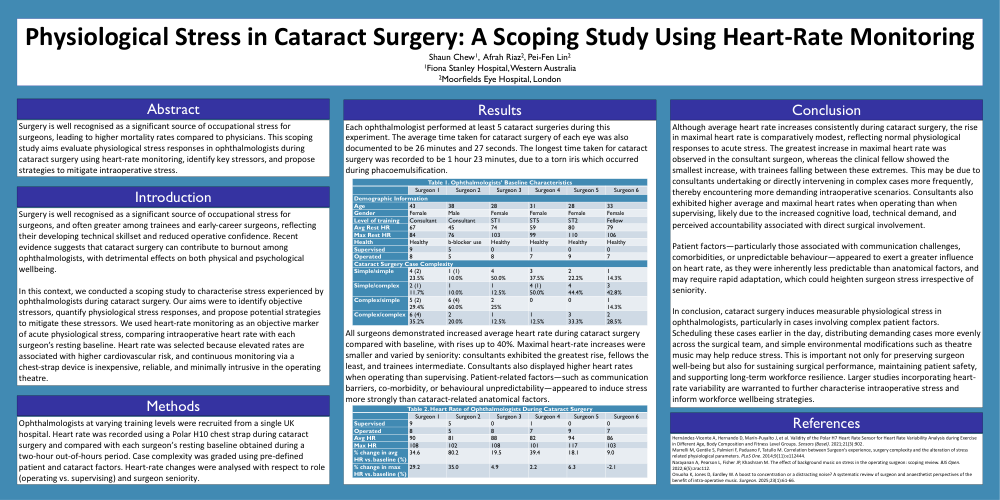
Each ophthalmologist performed at least 5 cataract surgeries during this experiment. The average time taken for cataract surgery of each eye was also documented to be 26 minutes and 27 seconds. The longest time taken for cataract surgery was recorded to be 1 hour 23 minutes, due to a torn iris which occurred during phacoemulsification.
All surgeons demonstrated increased average heart rate during cataract surgery compared with baseline, with rises up to 40%. Maximal heart‑rate increases were smaller and varied by seniority: consultants exhibited the greatest rise, fellows the least, and trainees intermediate. Consultants also displayed higher heart rates when operating than supervising. Patient‑related factors—such as communication barriers, co-morbidity, or behavioural unpredictability—appeared to induce stress more strongly than cataract‑related anatomical factors.
Conclusion:
Although average heart rate increases consistently during cataract surgery, the rise in maximal heart rate is comparatively modest, reflecting normal physiological responses to acute stress. The greatest increase in maximal heart rate was observed in the consultant surgeon, whereas the clinical fellow showed the smallest increase, with trainees falling between these extremes. This may be due to consultants undertaking or directly intervening in complex cases more frequently, thereby encountering more demanding intraoperative scenarios. Consultants also exhibited higher average and maximal heart rates when operating than when supervising, likely due to the increased cognitive load, technical demand, and perceived accountability associated with direct surgical involvement.
Patient factors—particularly those associated with communication challenges, comorbidities, or unpredictable behaviour—appeared to exert a greater influence on heart rate, as they were inherently less predictable than anatomical factors, and may require rapid adaptation, which could heighten surgeon stress irrespective of seniority.
In conclusion, cataract surgery induces measurable physiological stress in ophthalmologists, particularly in cases involving complex patient factors. Scheduling these cases earlier in the day, distributing demanding cases more evenly across the surgical team, and simple environmental modifications such as theatre music may help reduce stress. This is important not only for preserving surgeon well-being but also for sustaining surgical performance, maintaining patient safety, and supporting long-term workforce resilience. Larger studies incorporating heart-rate variability are warranted to further characterise intraoperative stress and inform workforce wellbeing strategies.