296 posters, 7 videos, 13 audios, 14 topics, 10 sessions, 1,019 authors, 259 institutions
ePostersLive by SciGen Technologies S.A. All rights reserved.
RCOphth Annual Congress 2026
18 - 21 May, 2026 | Manchester Central, Manchester

P223
Impact of Mass Azithromycin Administration on Overcoming Barriers to Trachoma Elimination
Poster Presenter
Authors
Part of Topic
Miscellaneous
Impact of Mass Azithromycin Administration on Overcoming Barriers to Trachoma Elimination
Objectives
To assess the effectiveness of azithromycin Mass drug administration (MDA) in reducing trachoma
Introduction
Trachoma is a chronic ocular infection caused by Chlamydia trachomatis and remains concentrated in low-socioeconomic settings (LSES) (Melese et al., 2004). The WHO SAFE strategy underpins global control efforts, with azithromycin playing a key role; however, implementation in resource-limited regions continues to be affected by infrastructure, logistical constraints, and community resistance (Nash et al., 2018; Sanders et al., 2019).
Methodology
A structured review was undertaken using the PICO framework:
- Population: Communities with high trachoma prevalence.
- Intervention: MDA od azithromycin under the SAFE strategy.
- Comparison: Communities receiving standard care or no mass administration.
- Outcome: Reduction in trachoma prevalence
Searches were conducted in PubMed and Scopus for studies published between 2019 and 2025, using combinations of the keywords “trachoma,” “azithromycin,” “mass drug administration,” “SAFE strategy,” and “prevalence.”
Inclusion criteria encompassed peer-reviewed field studies, clinical trials, and implementation analyses reporting post-MDA outcomes. Data were extracted on study setting, MDA rounds, coverage, and post-treatment prevalence, and findings were synthesised narratively.
Results
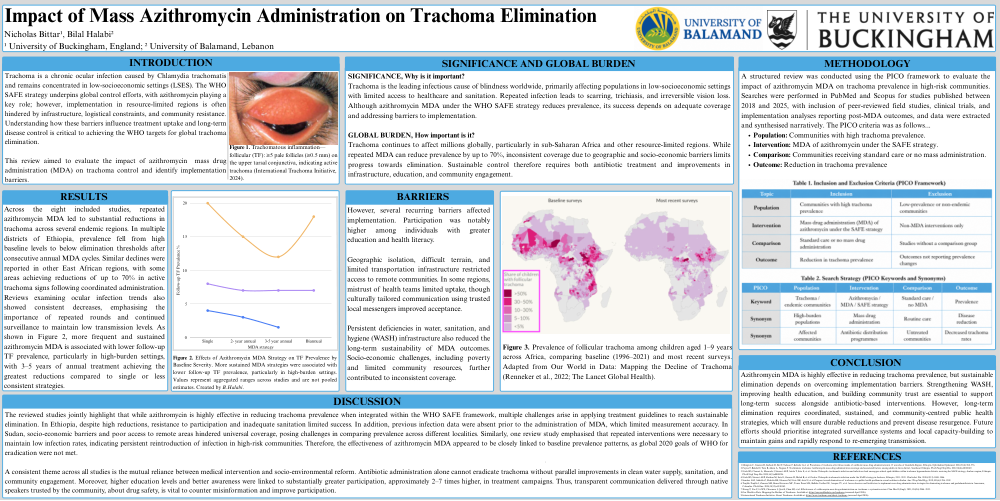
Across the eight selected studies, repeated azithromycin MDA within the SAFE strategy significantly reduced trachoma burden in LSES settings. In Ethiopia, active trachoma prevalence decreased from approximately 30% to <5% over five years (Nash et al., 2018). A separate study in LSES districts of the ‘Amhara region’ reported a reduction from 20% to <2% among preschool-aged children following multiple MDA cycles (Nash et al., 2020). In the ‘Gambella region’, three MDA rounds enabled several districts to reach post-MDA elimination thresholds (Alemayehu et al., 2024). A similar impact was observed in Sudan, where population-based surveys reported up to a 70% reduction across seven localities (Sanders et al., 2019). Systematic reviews considering ocular chlamydia rather than active signs confirmed consistent prevalence reductions across LSES regions, highlighting the need for repeated rounds and continued surveillance (Xiong et al., 2021; Mahmud et al., 2021).
However, multiple barriers to MDA exist including accessibility, limited community acceptance, inadequate Water, Sanitation, and Hygiene (WASH) infrastructure, and socio-economic constraints. Participation in the Goro district was 2–7 times higher among individuals with higher educational attainment (Feyisa et al., 2022). In the Colombian Amazonas region, implementation was impacted by geographic isolation and community mistrust; however, culturally tailored communication improved acceptance (Trujillo-Trujillo et al., 2024). Additional recurring barriers included difficult terrain and access limitations affecting programme reach (Sanders et al., 2019; Trujillo-Trujillo et al., 2024), persistent WASH deficiencies limiting sustained impact (Alemayehu et al., 2024; Xiong et al., 2021), and socio-economic constraints contributing to inconsistent coverage (Feyisa et al., 2022; Sanders et al., 2019).
Discussion
The reviewed studies jointly highlight on the remarkable effectiveness of azithromycin in reducing trachoma prevalence when integrated within the WHO SAFE framework. Nonetheless, multiple challenges arise in applying treatment guidelines to reach sustainable trachoma elimination. In Ethiopia, despite high reductions, resistance to participation and inadequate sanitation limited success. In addition, previous infection data was absent prior to the administration of MDA, which limited the measurement effectiveness(Nash, Stewart et al. 2018). In Sudan, socio-economic barriers and poor access to remote areas hindered universal coverage, posing challenges in comparing prevalence across different localities(Sanders, Abdalla et al. 2019). Similarly,(Nash, Chernet et al. 2020) emphasised that repeated interventions were necessary to maintain low infection rates, indicating persistent reintroduction of infection in high-risk communities. Therefore, effectiveness of azithromycin MDA was linked to the prevalence of trachoma among various districts, as 2020 goals of WHO in eradication were not met (Xiong, Yue et al. 2021).
A consistent theme across all studies is the mutual reliance between medical intervention and socio-environmental reform. Antibiotic administration alone cannot eradicate trachoma without parallel improvements in clean water supply, sanitation, and community engagement (Alemayehu, Mekonen et al. 2024). Moreover, Education level or proper knowledge were linked to 2 to 7 times higher participation in treatment campaigns (Feyisa, Bekele et al. 2022). Thus, transparent communication, through native speakers accepted by community, about drug safety is vital to counter misinformation improving participation (Trujillo-Trujillo, Zamora et al. 2024)
Conclusion
Azithromycin MDA remains the highest effective intervention for controlling trachoma in endemic settings. Substantial reductions in prevalence have been achieved across Ethiopia Sudan and Colombia, confirming its pivotal role in the WHO SAFE strategy. However, the spread of community resistance, logistical barriers, and inadequate WASH infrastructure continues to threaten sustainability on the long term. Future visions should prioritise overcoming implementation barriers, strengthening WASH and community engagement alongside antibiotic strategies to ensure durable trachoma elimination and prevent the biggest cause of blindness globally.
1. Alemayehu, A., A. Mekonen, B. Mengistu, A. Mihret, A. Asmare, A. Bakhtiari, B. Mengistu, C. Jimenez, D. Kebede, D. Bol, F. Tadesse, F. Kebede, G. Gebru, H. Frawley, J. Ngondi, M. Jemal, M. Brady, N. Negussu, R. Butcher, S. McPherson, S. Backers, A. W. Solomon, M. D. Bejiga and E. M. Harding-Esch (2024). "Prevalence of Trachoma After Three Rounds of Antibiotic Mass Drug Administration in 13 Woredas of Gambella Region, Ethiopia." Ophthalmic Epidemiol 31(6): 568-576.
2. Feyisa, T., D. Bekele, B. Tura, A. Adem and F. Nugusu (2022). "To eliminate trachoma: Azithromycin mass drug administration coverage and associated factors among adults in Goro district, Southeast Ethiopia." PLoS Negl Trop Dis 16(6): e0010169.
3. Nash, S. D., A. Chernet, J. Moncada, A. E. P. Stewart, T. Astale, E. Sata, M. Zerihun, D. Gessese, B. Melak, G. Ayenew, Z. Ayele, M. Chanyalew, T. M. Lietman, E. K. Callahan, J. Schachter and Z. Tadesse (2020). "Ocular Chlamydia trachomatis infection and infectious load among pre-school aged children within trachoma hyperendemic districts receiving the SAFE strategy, Amhara region, Ethiopia." PLoS Negl Trop Dis 14(5): e0008226.
4. Nash, S. D., A. E. P. Stewart, M. Zerihun, E. Sata, D. Gessese, B. Melak, T. Endeshaw, M. Chanyalew, A. Chernet, B. Bayissasse, J. Moncada, T. M. Lietman, P. M. Emerson, J. D. King, Z. Tadesse and E. K. Callahan (2018). "Ocular Chlamydia trachomatis Infection Under the Surgery, Antibiotics, Facial Cleanliness, and Environmental Improvement Strategy in Amhara, Ethiopia, 2011-2015." Clin Infect Dis 67(12): 1840-1846.
5. Sanders, A. M., Z. Abdalla, B. E. Elshafie, M. Elsanosi, A. W. Nute, N. Aziz, E. K. Callahan and S. D. Nash (2019). "Progress toward Elimination of Trachoma as a Public Health Problem in Seven Localities in the Republic of Sudan: Results from Population-Based Surveys." Am J Trop Med Hyg 101(6): 1296-1302.
6. Trujillo-Trujillo, J., S. M. Zamora, M. C. Bernal Lizarazu, M. L. Torres Perez, O. E. Bellido Cuellar, C. V. Araque, S. J. Pulido Martinez, C. M. Vargas Pelaez, F. Rossi, L. F. Moyano Ariza and L. M. Bernal Parra (2024). "Access barriers and facilitators to implement mass drugs administration strategies for eliminating trachoma and geohelminthiasis in the department of Amazonas, Colombia." PLoS One 19(12): e0310143.
7. Xiong, T., Y. Yue, W. X. Li, I. Choonara, S. Qazi, H. J. Chen, J. Tang, J. Shi, H. Wang, L. N. Zeng, B. Xia, L. N. Qiao, Y. Qu and D. Z. Mu (2021). "Effectiveness of azithromycin mass drug administration on trachoma: a systematic review." Chin Med J (Engl) 134(24): 2944-2953.