296 posters, 7 videos, 13 audios, 14 topics, 10 sessions, 1,019 authors, 259 institutions
ePostersLive by SciGen Technologies S.A. All rights reserved.
RCOphth Annual Congress 2026
18 - 21 May, 2026 | Manchester Central, Manchester

P019
Patient-Reported Functional Vision After Anti-VEGF Therapy for nAMD: A study using the DLTV Questionnaire
Poster Presenter
Part of Topic
Audit and clinical governance
Introduction:
Age-related macular degeneration (AMD) is a major cause of visual impairment in older adults worldwide, with approximately two-thirds of visual impairment or blindness registrations in the UK attributed to AMD. The neovascular (wet) form of AMD (nAMD) is characterised by the proliferation of abnormal choroidal blood vessels beneath the macula, leading to central vision loss. Anti-VEGF (vascular endothelial growth factor) therapies have revolutionised treatment, improving clinical visual acuity (VA) outcomes. However, traditional VA measures such as logMAR or Snellen charts do not fully capture the impact of visual impairment on daily functioning. Consequently, patient-reported outcome measures (PROMs), such as the Daily Living Tasks Dependent on Vision (DLTV) questionnaire, have become increasingly important as they provide valuable insights into quality of life. By quantifying self-reported difficulty across 22 vision-dependent tasks, the DLTV offers a holistic perspective on how patients perceive and adapt to their visual limitations.
Aims:
This study evaluated the impact of six months of anti-VEGF therapy on self-reported functional vision in patients with nAMD using the DLTV questionnaire. The relationship between changes in VA and DLTV scores to assess whether clinical improvements translate into meaningful functional gains were explored. Additionally, the study aimed to assess the practical value and sensitivity of the DLTV as a PROM in this patient population.
Methods:
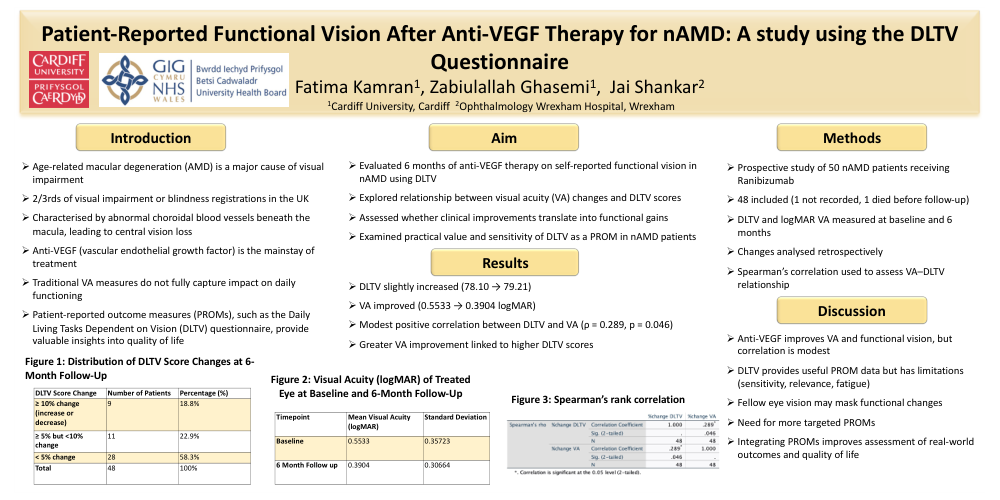
A prospective study was conducted on 50 patients receiving ranibizumab for nAMD at a secondary care ophthalmology clinic. A total of 48 patients were included in the analysis, as one was not listed on the electronic database and one patient passed away before the six-month follow-up. Each participant completed the DLTV questionnaire and underwent logMAR VA testing at baseline and at six months. Changes in VA and DLTV scores were calculated and analysed retrospectively. Spearman’s rank correlation was used to assess the relationship between percentage changes in clinical and functional outcomes.
Results:
Mean DLTV scores increased slightly from 78.10 to 79.21, and mean VA improved from 0.5533 to 0.3904 logMAR over six months. A statistically significant, though modest, positive correlation was observed between percentage changes in DLTV and VA (ρ = 0.289, p = 0.046), suggesting patients with a greater improvement in VA, had a greater increase in their DLTV score.
Conclusion:
Anti-VEGF therapy improves both visual acuity and patient-reported functional vision in nAMD; however, the correlation between these measures is modest. PROMs such as the DLTV provide valuable complementary data but have limitations, including reduced sensitivity to subtle changes, task irrelevance for certain demographics, and potential respondent fatigue due to questionnaire length. It is also important to recognise that improvements in functional vision—or a lack of improvement—may be influenced by the visual status of the fellow eye, as good vision in the untreated eye can mask functional gains in the treated one. Future research should focus on developing more targeted PROMs to enhance the assessment of real-world treatment outcomes. Integrating such tools into standard care pathways will ensure that ophthalmic treatment outcomes are evaluated not only in terms of visual acuity gains but also through improvements in patients’ quality of life and functional independence.