296 posters, 7 videos, 13 audios, 14 topics, 10 sessions, 1,019 authors, 259 institutions
ePostersLive by SciGen Technologies S.A. All rights reserved.
RCOphth Annual Congress 2026
18 - 21 May, 2026 | Manchester Central, Manchester

P018
Paediatric Corneal Pathology: A Retrospective Audit of Presentation, Management, and Outcomes
Poster Presenter
Authors
Part of Topic
Audit and clinical governance
Paediatric Corneal Pathology: A Retrospective Audit of Presentation, Management, and Outcomes
Asmar Jumshudova, Nadia Azad — Royal Berkshire NHS Foundation Trust
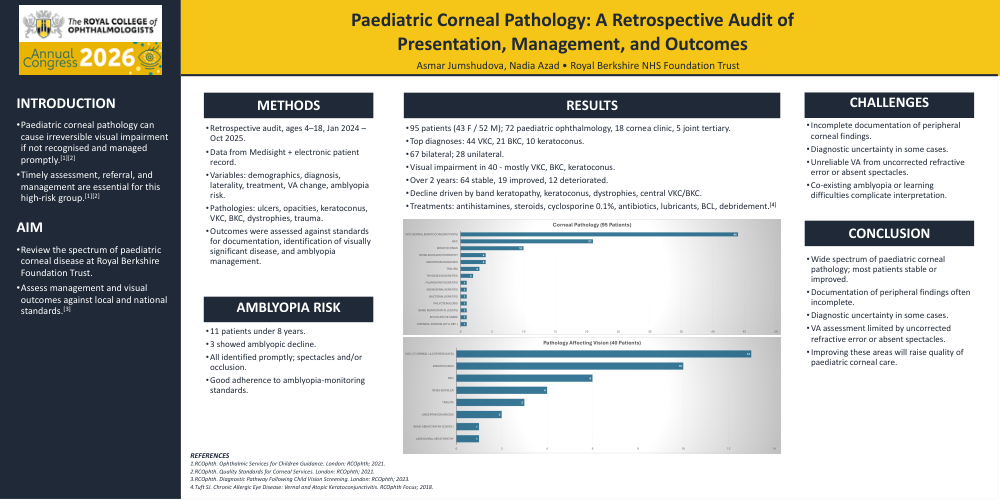
INTRODUCTION Paediatric corneal pathology can cause irreversible visual impairment if not recognised and managed promptly. Timely assessment, referral, and management are essential for this high-risk group.
AIM Review the spectrum of paediatric corneal disease at Royal Berkshire Foundation Trust. Assess management and visual outcomes against local and national standards.
METHODS Retrospective audit, ages 4–18, Jan 2024 – Oct 2025. Data from Medisight and the electronic patient record. Variables: demographics, diagnosis, laterality, treatment, VA change, amblyopia risk. Pathologies included ulcers, opacities, keratoconus, VKC, BKC, dystrophies, and trauma. Outcomes assessed against standards for documentation, identification of visually significant disease, and amblyopia management.
RESULTS 95 patients (43 F / 52 M); 72 seen in paediatric ophthalmology, 18 in cornea clinic, 5 in joint tertiary clinic. Top diagnoses: 44 VKC, 21 BKC, 10 keratoconus. 67 bilateral; 28 unilateral. Visual impairment in 40 — mostly VKC, BKC, and keratoconus. Over 2 years: 64 stable, 19 improved, 12 deteriorated. Decline driven by band keratopathy, keratoconus, dystrophies, and central VKC/BKC. Treatments included antihistamines, steroids, cyclosporine 0.1%, antibiotics, lubricants, bandage contact lenses, and debridement.
AMBLYOPIA RISK 11 patients under 8 years; 3 showed amblyopic decline. All identified promptly and managed with spectacles and/or occlusion. Good adherence to amblyopia-monitoring standards.
CHALLENGES Incomplete documentation of peripheral corneal findings. Diagnostic uncertainty in some cases. Unreliable visual acuity from uncorrected refractive error or absent spectacles. Co-existing amblyopia or learning difficulties complicate interpretation.
CONCLUSION A wide spectrum of paediatric corneal pathology was seen, with most patients stable or improved. Documentation of peripheral findings is often incomplete and diagnostic uncertainty persists in some cases. VA assessment is limited by uncorrected refractive error or absent spectacles. Improving these areas will raise the quality of paediatric corneal care.
Keywords: paediatric ophthalmology, cornea, corneal pathology, audit, vernal keratoconjunctivitis, VKC, blepharokeratoconjunctivitis, BKC, keratoconus, amblyopia, visual acuity, Royal Berkshire, RCOphth standards.