296 posters, 7 videos, 13 audios, 14 topics, 10 sessions, 1,019 authors, 260 institutions
ePostersLive by SciGen Technologies S.A. All rights reserved.
RCOphth Annual Congress 2026
18 - 21 May, 2026 | Manchester Central, Manchester

P122
Real world comparative results of three commonly used MIGS, Hydrus, Istent and OMNI.
Poster Presenter
Part of Topic
Glaucoma
Title: Retrospective cohort study of the effectiveness and safety outcomes of patients undergoing different minimally invasive glaucoma surgery (MIGS)
Introduction / Background:
Minimally invasive glaucoma surgery (MIGS) procedures have emerged as new treatment modalities to reduce intraocular pressure and slow down the progression of optic nerve damage. Their benefits include IOP reduction with reduced rates of complications and post-operative follow-up. As their adoption becomes more widespread, it is critical to examine if these claims translate to real-world benefits. Much of the clinical evidence derives from randomised control trials. This study aims to provide real-world evidence on the outcomes of three popular MIGS modalities: iStent, Hydrus and OMNI in a tertiary glaucoma setting.
Methods:
This retrospective observational study included all patients who underwent iStent, Hydrus and Omni at the Princess Alexandra Eye Pavilion (PAEP) from 16/05/2022 to 15/05/2023. Clinical outcomes were assessed over a 24-month follow-up period. The effectiveness outcomes include success rate (≥20% IOP reduction from baseline), absolute IOP reduction, decrease in number of anti-glaucoma medication and the percentage of patients who remained medication-free at the end of follow-up period. The safety outcomes include re-operations and adverse effects.
Results:
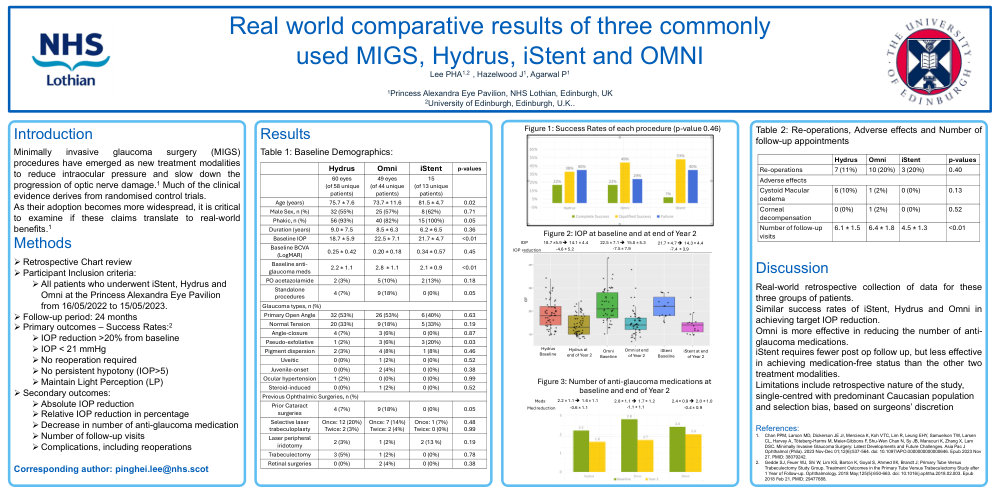
124 eyes of 115 patients received surgical glaucoma intervention during the study period. 60 eyes of 58 patients (age 75.7 ± 7.6, n = 32 male, 55%) underwent Hydrus insertion; 49 eyes of 44 unique patients underwent Omni insertion (age 73.7 ±11.6, n = 25 male, 57%) while 15 eyes of 13 patients (age 81.5 ± 4.7, n = 8 male, 62%) received iStent. At the end of the 2-year follow-up period, the three cohorts achieved the following success rate: Hydrus 60%, Omni 71% and iStent 60%. The three cohorts achieved similar levels of IOP reduction from baseline: Hydrus -4.6 ± 5.2, Omni -7.5 ± 7.9 and iStent -7.4 ± 3.9. As for the reduction in the number of anti-glaucoma medications, Omni achieved the largest reduction of -1.1± 1.1, while Hydrus and iStent achieved a reduction of -0.6± 1.1 and -0.4± 0.9, respectively. At the end of the follow-up period, 22% of the Omni cohort remained medication-free, compared with 22% and 7% in the Hydrus and iStent cohorts respectively. Of the three cohorts, the iStent cohort had the fewest follow-up appointments - only 4.5± 1.3 visits within the 2-year follow-up period, while the Omni and Hydrus cohorts required 6.4± 1.8 and 6.1± 1.5 appointments over the same period, respectively. 20% of the Omni and iStent cohorts required re-operation, while 11% of Hydrus cohort required re-operation.
Conclusion:
This is the real-world retrospective collection of data for these three groups of patients. The results show iStent, Hydrus and Omni to have similar success rate in achieving target IOP reduction. However, Omni is more effective in reducing the number of anti-glaucoma medications. iStent requires fewer post op follow up, but less effective in achieving medication-free status than the other two treatment modalities.