296 posters, 7 videos, 13 audios, 14 topics, 10 sessions, 1,019 authors, 259 institutions
ePostersLive by SciGen Technologies S.A. All rights reserved.
RCOphth Annual Congress 2026
18 - 21 May, 2026 | Manchester Central, Manchester

P010
Health Economics and Patients Experience of Removing Day 1 Post Vitreo-Retinal (VR) Surgery Clinic Visit
Poster Presenter
Authors
Ahmed Bakr, Kodchawan (Pim) Doungsong, Rhiannon Edwards, David Steel, Teresa Sandinha
Affiliations
University of Liverpool, School of Medicine, Liverpool, UK, Centre for Health Economics & Medicines Evaluation, Bangor University, Bangor, Wales, Sunderland Eye Infirmary, Sunderland, UK - Northern Ophthalmic Research and Innovation Institute, University of Sunderland, Sunderland, UK - Bioscience institute Newcastle University, Newcastle Upon Tyne, UK, Liverpool University Hospitals, Department of Eye and Vision Science, Institute of Life course and medical sciences, University of Liverpool - St Paul’s Eye Unit, Royal Liverpool University Hospital, Liverpool, United Kingdom
Part of Topic
Audit and clinical governance
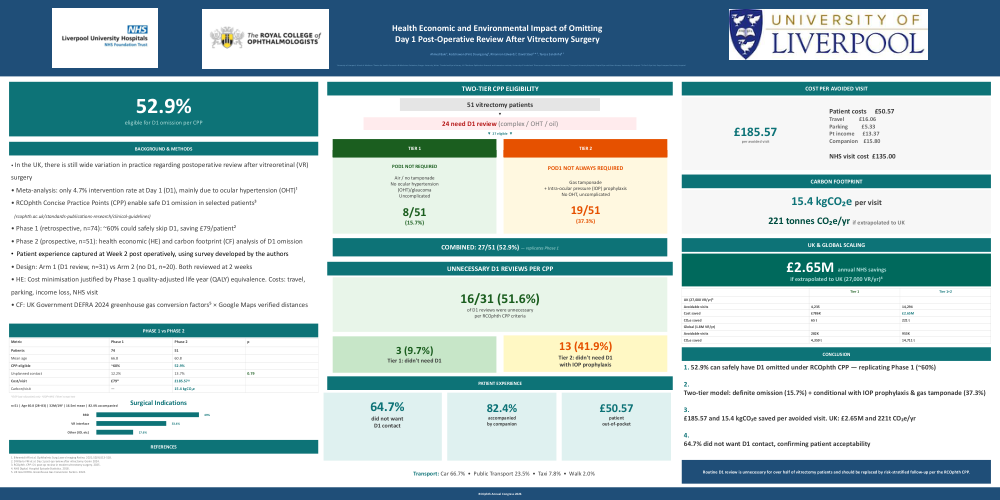
Purpose: To evaluate the health economic and environmental impact of omitting routine Day 1 post-operative review after vitrectomy surgery using the RCOphth Concise Practice Points (CPP) framework.
Methods: Single-centre prospective study of 51 consecutive vitrectomy patients at St Paul's Eye Unit, Liverpool. Patients were classified into two tiers of CPP eligibility for Day 1 omission based on surgical complexity, ocular co-morbidity, and tamponade type. Cost-minimisation analysis included patient travel, parking, income loss, companion costs, and NHS outpatient visit costs. Carbon footprint was calculated using DEFRA 2024 greenhouse gas conversion factors.
Results: 27/51 (52.9%) patients were eligible for Day 1 omission per CPP criteria, replicating Phase 1 findings (~60%). Of the 31 patients who received Day 1 review, 16 (51.6%) were unnecessary per CPP. Each avoided visit saves £185.57 and 15.4 kgCO₂e. If extrapolated to UK vitrectomy volume (27,000/year), this represents £2.65 million in annual NHS savings and 221 tonnes CO₂e reduction. 64.7% of patients did not want Day 1 medical contact.
Conclusion: Over half of routine Day 1 reviews after vitrectomy are unnecessary and should be replaced by risk-stratified follow-up per the RCOphth CPP, delivering significant cost savings and environmental benefit.