296 posters, 7 videos, 13 audios, 14 topics, 10 sessions, 1,019 authors, 259 institutions
ePostersLive by SciGen Technologies S.A. All rights reserved.
RCOphth Annual Congress 2026
18 - 21 May, 2026 | Manchester Central, Manchester

P009
Empowering Primary Care patients registered blind or partially sighted: A Supra-Regional Quality Improvement Project
Poster Presenter
Authors
Part of Topic
Audit and clinical governance
Empowering Primary Care patients registered blind or partially sighted: A Supra-Regional Quality Improvement Project
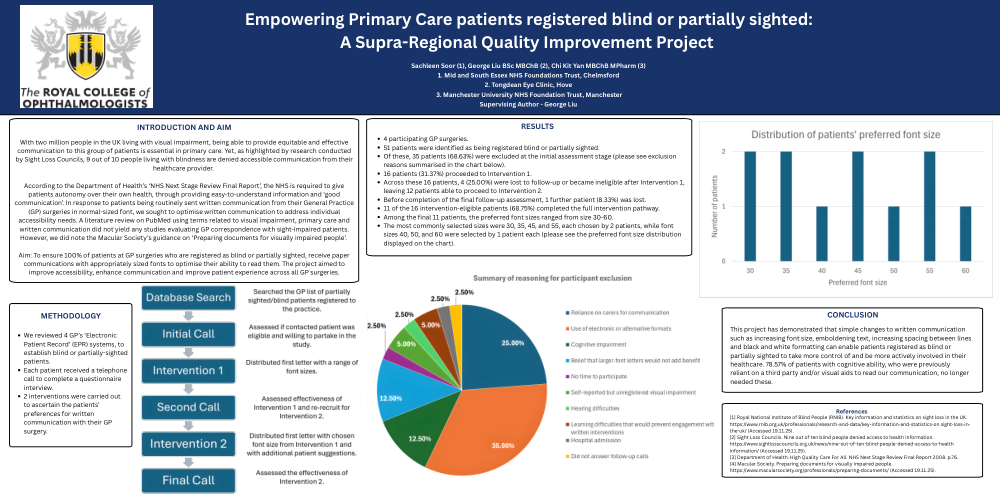
INTRODUCTION AND AIM - With two million people in the UK living with visual impairment, being able to provide equitable and effective communication to this group of patients is essential in primary care. Yet, as highlighted by research conducted by Sight Loss Councils, 9 out of 10 people living with blindness are denied accessible communication from their healthcare provider. According to the Department of Health’s ‘NHS Next Stage Review Final Report’ , the NHS is required to give patients autonomy over their own health, through providing easy-to-understand information and ‘good communication’ . In response to patients being routinely sent written communication from their General Practice (GP) surgeries in normal-sized font, we sought to optimise written communication to address individual accessibility needs. A literature review on PubMed using terms related to visual impairment, primary care and written communication did not yield any studies evaluating GP correspondence with sight-impaired patients. However, we did note the Macular Society’s guidance on ‘Preparing documents for visually impaired people’. Aim: To ensure 100% of patients at GP surgeries who are registered as blind or partially sighted, receive paper communications with appropriately sized fonts to optimise their ability to read them. The project aimed to improve accessibility, enhance communication and improve patient experience across all GP surgeries.
METHODOLOGY - We reviewed 4 GP’s ‘Electronic Patient Record’ (EPR) systems, to establish blind or partially-sighted patients. Each patient received a telephone call to complete a questionnaire interview. 2 interventions were carried out to ascertain the patients’ preferences for written communication with their GP surgery.
RESULTS - 4 participating GP surgeries. 51 patients were identified as being registered blind or partially sighted. Of these, 35 patients (68.63%) were excluded at the initial assessment stage (please see exclusion reasons summarised in the chart below). 16 patients (31.37%) proceeded to Intervention 1. Across these 16 patients, 4 (25.00%) were lost to follow-up or became ineligible after Intervention 1, leaving 12 patients able to proceed to Intervention 2. Before completion of the final follow-up assessment, 1 further patient (8.33%) was lost. 11 of the 16 intervention-eligible patients (68.75%) completed the full intervention pathway. Among the final 11 patients, the preferred font sizes ranged from size 30-60. The most commonly selected sizes were 30, 35, 45, and 55, each chosen by 2 patients, while font sizes 40, 50, and 60 were selected by 1 patient each (please see the preferred font size distribution displayed on the chart).
CONCLUSION - This project has demonstrated that simple changes to written communication such as increasing font size, emboldening text, increasing spacing between lines and black and white formatting can enable patients registered as blind or partially sighted to take more control of and be more actively involved in their healthcare. 78.57% of patients with cognitive ability, who were previously reliant on a third party and/or visual aids to read our communication, no longer needed these.