58 posters, 14 topics, 4 sessions, 188 authors, 62 institutions
ePostersLive by SciGen Technologies S.A. All rights reserved.
PSRC 69th Annual Meeting 2024
May 16-19, 2024 | The Westin Copley Place, Boston, MA

EP56
How Do We Measure Access: The Utility Of Area Of Deprivation Index For Assessing Disparities In Breast Reconstruction
Poster Presenter
Authors
Affiliations
Part of Topic
Patient Safety/Health Care Cost/Access to Care
Title: How Do We Measure Access: The Utility of Area of Deprivation Index for Assessing Disparities in Breast Reconstructive
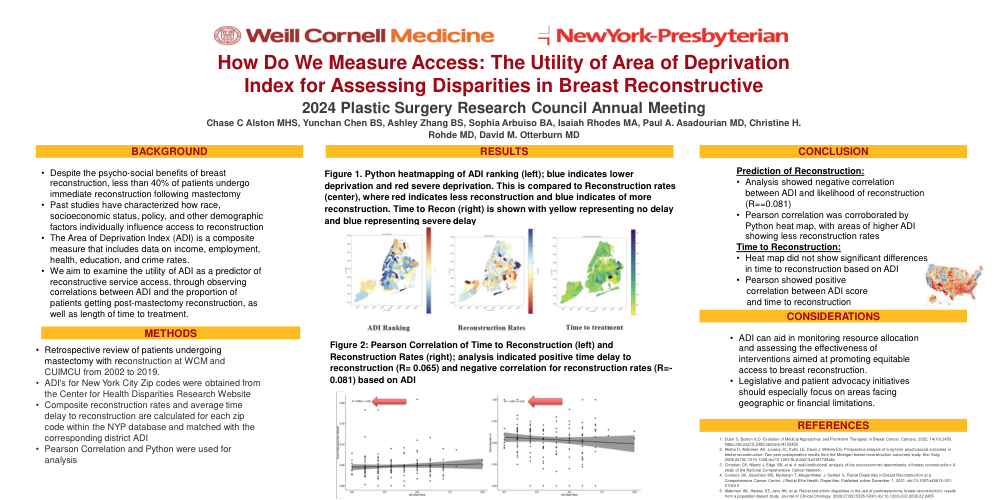
Background:Despite the psycho-social benefits of breast reconstruction, less than 40% of patients undergo immediate reconstruction following mastectomy. Past studies have characterized how race, socioeconomic status, policy, and other demographic factors individually influence access to reconstruction. The Area of Deprivation Index (ADI) is a composite measure that includes data on income, employment, health, education, and crime rates. We aim to examine the utility of ADI as a predictor of reconstructive service access, through observing correlations between ADI and the proportion of patients getting post-mastectomy reconstruction, as well as length of time to treatment.
Methods: Retrospective review of patients undergoing mastectomy with reconstruction at WCM and CUIMCU from 2002 to 2019. ADI's for New York City Zip codes were obtained from the Center for Health Disparities Research Website. Composite reconstruction rates and average time delay to reconstruction are calculated for each zip code within the NYP database and matched with the corresponding district ADI. Pearson Correlation and Python were used for analysis
Results: Figure 1. Python heatmapping of ADI ranking (left); blue indicates lower deprivation and red severe deprivation. This is compared to Reconstruction rates (center), where red indicates less reconstruction and blue indicates of more reconstruction. Time to Recon (right) is shown with yellow representing no delay and blue representing severe delay | Figure 2: Pearson Correlation of Time to Reconstruction (left) and Reconstruction Rates (right); analysis indicated positive time delay to reconstruction (R= 0.065) and negative correlation for reconstruction rates (R=-0.081) based on ADI
Conclusions:
Prediction of Reconstruction: Analysis showed negative correlation between ADI and likelihood of reconstruction (R==0.081). Pearson correlation was corroborated by Python heat map, with areas of higher ADI showing less reconstruction rates
Time to Reconstruction: Heat map did not show significant differences in time to reconstruction based on ADI. Pearson showed positive correlation between ADI score and time to reconstruction
Considerations: ADI can aid in monitoring resource allocation and assessing the effectiveness of interventions aimed at promoting equitable access to breast reconstruction. Legislative and patient advocacy initiatives should especially focus on areas facing geographic or financial limitations.