58 posters, 14 topics, 4 sessions, 188 authors, 62 institutions
ePostersLive by SciGen Technologies S.A. All rights reserved.
PSRC 69th Annual Meeting 2024
May 16-19, 2024 | The Westin Copley Place, Boston, MA

EP55
CMS’s Hospital Price Transparency Regulation Analysis Demonstrates Increasing Compliance For Breast Reconstruction-Related Procedures
Poster Presenter
Authors
Affiliations
Part of Topic
Patient Safety/Health Care Cost/Access to Care
CMS’s Hospital Price Transparency Regulation Analysis Demonstrates Increasing Compliance for Breast Reconstruction-Related Procedures
Sophia Salingaros, BA1, David M. Otterburn, MD1
1Division of Plastic and Reconstructive Surgery, New York-Presbyterian-Weill Cornell Medical Center
Background
In an attempt to encourage cost-conscious “shopping” of healthcare services, the Centers for Medicare and Medicaid Services (CMS) introduced the Hospital Price Transparency Rule effective January 1, 2021, mandating hospitals publish standard charges for all items and services.1
Plastic surgery-related procedures are often elective, thus benefiting from transparent pricing. A 2022 study found that the most commonly reported plastic surgery pricing data were for adjacent tissue transfers (32.4% of hospitals).3 We sought to investigate the current price transparency landscape of breast reconstruction procedures.
Methods
The 50 largest US hospitals were selected from Becker’s Hospital Review.4 Pricing information for 6 breast reconstruction-related procedures was compiled from hospital website standard charges files.
Results
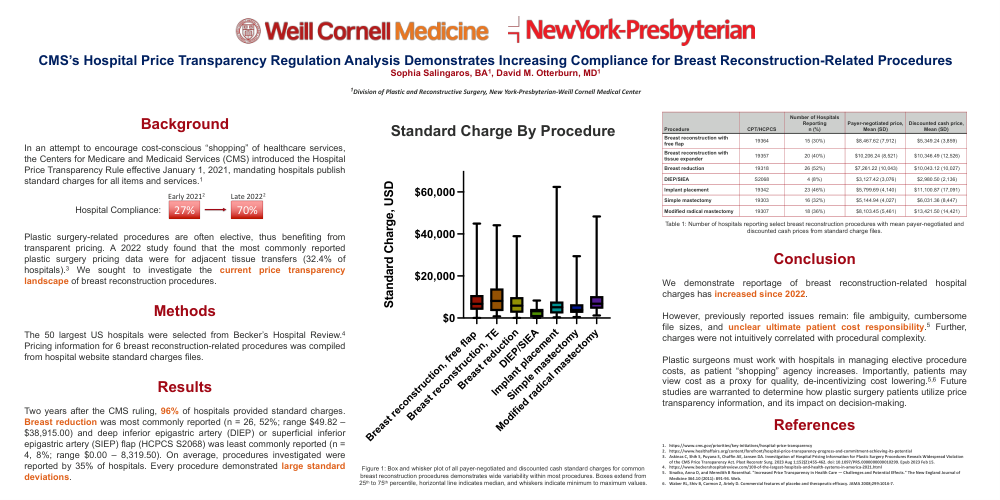
Two years after the CMS ruling, 96%of hospitals provided standard charges. Breast reduction was most commonly reported (n = 26, 52%;range $49.82 – $38,915.00) and deep inferior epigastric artery (DIEP) or superficial inferior epigastric artery (SIEP) flap (HCPCS S2068) was least commonly reported (n = 4, 8%; range $0.00 – 8,319.50). On average, procedures investigated were reported by 35% of hospitals. Every procedure demonstrated large standard deviations.
Conclusion
We demonstrate reportage of breast reconstruction-related hospital charges has increased since 2022.
However, previously reported issues remain:file ambiguity, cumbersome file sizes, and unclear ultimate patient cost responsibility.5Further, charges were not intuitively correlated with procedural complexity.
Plastic surgeons must work with hospitals in managing elective procedure costs, as patient “shopping” agency increases. Importantly, patients may view cost as a proxy for quality, de-incentivizing cost lowering.5,6 Future studies are warranted to determine how plastic surgery patients utilize price transparency information, and its impact on decision-making.
References