58 posters, 14 topics, 4 sessions, 188 authors, 62 institutions
ePostersLive by SciGen Technologies S.A. All rights reserved.
PSRC 69th Annual Meeting 2024
May 16-19, 2024 | The Westin Copley Place, Boston, MA

EP49
Clinical Insights And Optimization Of Surgical Approach For Lateral Femoral Cutaneous Nerve Injury/entrapment: A Comprehensive Analysis Of 184 Cases
Poster Presenter
Authors
Rachana Suresh, Emma Rowley, Tim Tollestrup, Godard de Rutier, Lee Dellon
Affiliations
Johns Hopkins University School of Medicine, Department of Plastic and Reconstructive Surgery, Johns Hopkins School of Medicine Baltimore, MD 21205., The Dellon Institutes for Peripheral Nerve Surgery Henderson, NV 89052., Haaglanden Medisch Centrum, The Hague, Netherlands., The Dellon Institutes for Peripheral Nerve Surgery Henderson, NV 89052; 4 Touro University Nevada, Henderson, NV 89014; 5 Haaglanden Medisch Centrum, The Hague, Netherlands.
Part of Topic
Nerve
Clinical Insights and Optimization of Surgical Approach for Lateral Femoral Cutaneous Nerve Injury/Entrapment: A Comprehensive Analysis of 184 Cases.
Purpose: Neurolysis and neurectomy are the two most commonly utilized surgical techniques for treating Meralgia Paresthetica (MP) caused by lateral femoral cutaneous nerve (LFCN) entrapment or injury. However, there is a lack of definitive evidence from randomized studies regarding their relative effectiveness, and no clinical algorithm currently guides the choice of technique for specific clinical scenarios. The purpose of this study was to develop an algorithm that incorporates knowledge of anatomic variability with potential surgical approaches to the LFCN based on clinical experience gained from a cohort of 184 patients.
Methods: The initial surgical approach for MP patients involved neurolysis. However, neurectomy was considered in cases where anatomical anomalies prevented effective neurolysis or when there was substantial nerve damage from prior trauma or surgery. We queried medical records of MP patients who underwent neurolysis or neurectomy between February 2010 and June 2022, collecting data on age, sex, BMI, comorbidities, surgical history, and trauma history. We classified LFCN anatomy into Types A, B/C, and D/E, following Aszmann et al.'s classification, based on intraoperative observations. Surgical success, categorized as excellent, good, or failure, was assessed through patient self-reports and retrieved from medical records. Patients were grouped by surgical intervention for intergroup comparisons of demographic and clinical data using the Chi-squared test for categorical variables and Student’s t-test for continuous variables. The management algorithm was developed based on observations of patient characteristics and outcomes in this patient cohort.
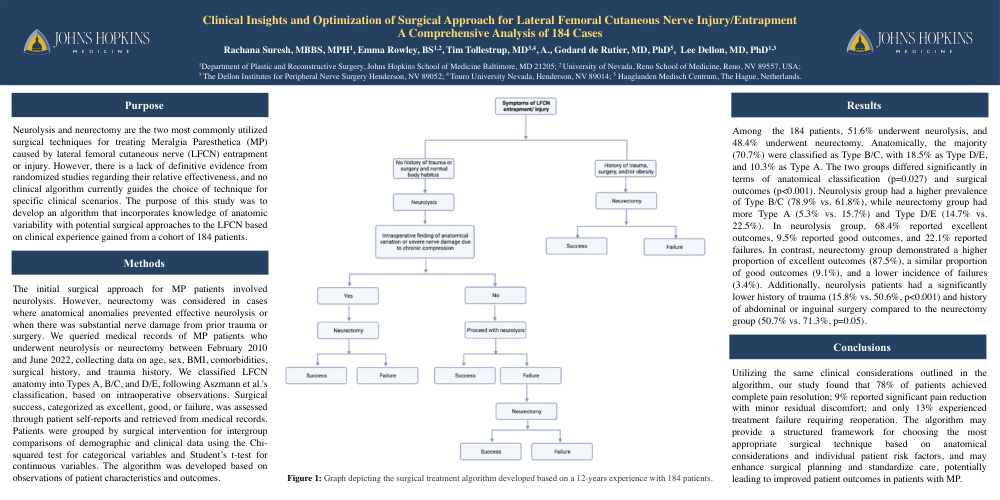
Results:Among 184 patients included in the study, 51.6% underwent neurolysis, and 48.4% underwent neurectomy. Anatomically, the majority (70.7%) were classified as Type B/C, with 18.5% as Type D/E, and 10.3% as Type A. The two groups differed significantly in terms of anatomical classification (p=0.027) and surgical outcomes (p<0.001). The neurolysis group had a higher prevalence of Type B/C (78.9% vs. 61.8%), while the neurectomy group had more Type A (5.3% vs. 15.7%) and Type D/E (14.7% vs. 22.5%). In the neurolysis group, 68.4% reported excellent outcomes, 9.5% reported good outcomes, and 22.1% reported failures. In contrast, the neurectomy group demonstrated a higher proportion of excellent outcomes (87.5%), a similar proportion of good outcomes (9.1%), and a lower incidence of failures (3.4%). Additionally, neurolysis patients had a significantly lower history of trauma (15.8% vs. 50.6%, p<0.001) and history of abdominal or inguinal surgery compared to the neurectomy group (50.7% vs. 71.3%, p=0.05). Presented in Figure 1 is the surgical treatment algorithm developed based on a 12-years experience with 184 patients.
Conclusion: Utilizing the same clinical considerations outlined in the abstract's surgical algorithm, our study found that 78% of patients achieved excellent outcomes, denoting complete pain resolution; 9% reported good outcomes, reflecting significant pain reduction with minor residual discomfort; and only 13% experienced treatment failure, characterized by the absence of symptom relief or the need for reoperation. The algorithm may provide a structured framework for choosing the most appropriate surgical technique based on anatomical considerations and individual patient risk factors, and may enhance surgical planning and standardize care, potentially leading to improved patient outcomes in patients with MP.