58 posters, 14 topics, 4 sessions, 188 authors, 62 institutions
ePostersLive by SciGen Technologies S.A. All rights reserved.
PSRC 69th Annual Meeting 2024
May 16-19, 2024 | The Westin Copley Place, Boston, MA

EP38
AI Assessment Of Dynamic Reanimation In Unilateral Facial Paralysis: Towards Automated Surgical Outcomes
Poster Presenter
Authors
Jess Rames, Elena Millesi, Luis Antezana, Waleed Gibreel, Samir Mardini
Affiliations
Part of Topic
Innovation/Commercialization/Technology
Title:
AI Assessment Of Dynamic Reanimation In Unilateral Facial Paralysis: Towards Automated Surgical Outcomes
Authors:
Jess Rames, MD, MEng; Elena Millesi, MD; Luis A. Antezana, MD ; Waleed Gibreel, MBBS; Samir Mardini, MD
Background:
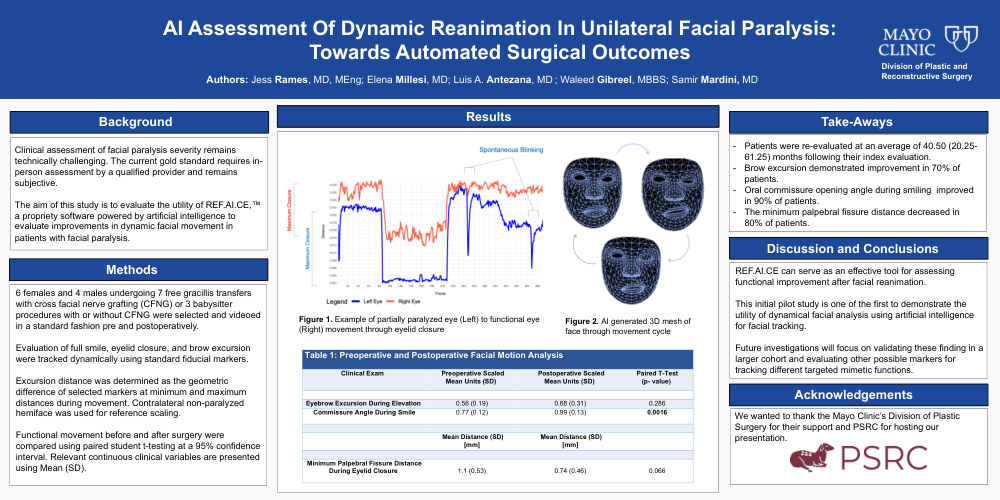
Clinical assessment of facial paralysis severity remains technically challenging. The current gold standard requires in-person assessment by a qualified provider and remains subjective.The aim of this study is to evaluate the utility of REF.AI.CE,™ a propriety software powered by artificial intelligence to evaluate improvements in dynamic facial movement in patients with facial paralysis.
Methods:
6 females and 4 males undergoing 7 free gracillis transfers with cross facial nerve grafting (CFNG) or 3 babysitter procedures with or without CFNG were selected and videoed in a standard fashion pre and postoperatively.
Evaluation of full smile, eyelid closure, and brow excursion were tracked dynamically using standard fiducial markers.Excursion distance was determined as the geometric difference of selected markers at minimum and maximum distances during movement. Contralateral non-paralyzed hemiface was used for reference scaling. Functional movement before and after surgery were compared using paired student t-testing at a 95% confidence interval. Relevant continuous clinical variables are presented using Mean (SD).
Take-Aways:
Discussion and Conclusions:
REF.AI.CE can serve as an effective tool for assessing functional improvement after facial reanimation. This initial pilot study is one of the first to demonstrate the utility of dynamical facial analysis using artificial intelligence for facial tracking. Future investigations will focus on validating these finding in a larger cohort and evaluating other possible markers for tracking different targeted mimetic functions.