58 posters, 14 topics, 4 sessions, 188 authors, 62 institutions
ePostersLive by SciGen Technologies S.A. All rights reserved.
PSRC 69th Annual Meeting 2024
May 16-19, 2024 | The Westin Copley Place, Boston, MA

EP33
The Impact Of Education And Literacy On Written Versus Verbal Administration Of Upper Extremity Patient-reported Outcome Measures
Poster Presenter
Authors
Roland Zama, Desraj Clark, Aygul Iskandarova, Gabriel Yohe, Chao Long, Aviram Giladi
Affiliations
The Curtis National Hand Center, Department of Orthopedic Surgery, Walter Reed National Military Medical Center, Bethesda, MD, USA, Department of Plastic and Reconstructive Surgery, Johns Hopkins Hospital, Baltimore, MD, USA
Part of Topic
Hand
The Impact Of Education And Literacy On Written Versus Verbal Administration Of Upper Extremity Patient-reported Outcome Measures:
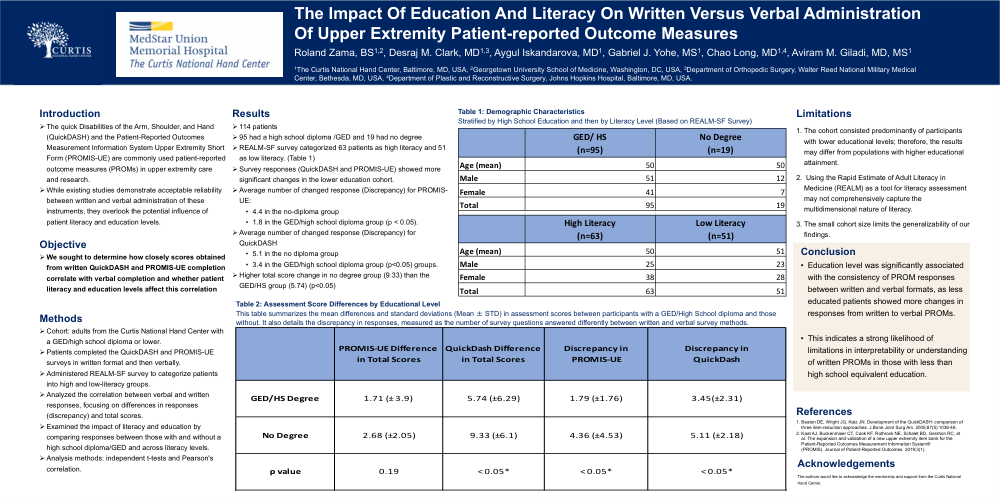
Introduction: The quick Disabilities of the Arm, Shoulder, and Hand (quickDASH) and the Patient-Reported Outcomes Measurement Information System Upper Extremity Short Form (PROMIS-UE) are commonly used patient-reported outcome measures (PROMs) in upper extremity care and research. While existing studies demonstrate acceptable reliability between written and verbal administration of these instruments, they overlook the potential influence of patient literacy and education levels. We sought to determine how closely scores obtained from written quickDASH and PROMIS-UE completion correlate with verbal completion and whether patient literacy and education levels affect this correlation
METHODS: We recruited adults self-reporting a General Educational Diploma (GED)/high school diploma or lower from the Curtis National Hand Center clinic. Using the Rapid Estimate of Adult Literacy in Medicine survey (REALM), we stratified participants into high and low-literacy groups. Both groups completed written quickDash and PROMIS-UE followed by verbal administration of both PROMs. We assessed the correlation between each patient's verbal and written responses, analyzing differences in question responses and total scores. We examined the influence of literacy and education by comparing responses and scores between high and low-literacy groups and between individuals with a high school diploma/GED versus those with less education using independent t-test and Pearson's correlation.
RESULTS: Of the 114 patients in this study, 95 had a high school diploma or GED. Responses to the quickDASH and PROMIS-UE surveys changed in both educational groups, but responses changed significantly more within the lower education cohort. On average, the number of questions with an answer change for PROMIS-UE was significantly higher in the no-diploma group (4.4) compared to the GED/HS diploma group (1.8) (p < 0.05). The quickDASH had similar findings with a higher mean response change in the no-diploma group (5.1) compared to the GED/HS diploma group (3.4) (p < 0.05). Although the no-diploma group had more total score variability compared to the GED/HS Diploma group, this difference was not significant. Based on the REALM survey, we categorized 63 patients as having high literacy and 51 as having low literacy. We found a non-significant difference in the number of questions that changed and total score changes for both literacy groups.
CONCLUSION:Education level was significantly associated with the consistency of PROM responses between written and verbal formats, as patients with less education had significantly more question responses change when going from written to verbal PROM administration. This indicates a strong likelihood of limitations in interpretability or understanding of written PROMs in those with less than high school equivalent education. This information is valuable for any system focusing on PROMs in patient care or research.