358 posters, 97 topics, 122 sessions, 958 authors, 239 institutions
ePostersLive by SciGen Technologies S.A. All rights reserved.
79th PostGraduate Assembly in Anesthesiology 2025
December 12 - 15, 2025 | New York City

2123
Anesthetic considerations in Nonbacterial Thrombotic Endocarditis: Intraoperative Heparin Resistance and Hypercoagulability in Cardiac Surgery
Poster Presenter
Authors
Affiliations
Part of Topic
Cardiovascular - Perioperative Management
Introduction
Nonbacterial thrombotic endocarditis (NBTE) is a rare condition typically associated with malignancy or autoimmune disorders. It presents unique diagnostic and perioperative challenges. The case presents the anesthetic management of a 37-year-old female with NBTE requiring surgical excision of mitral valve vegetation.
Case Summary
-
The patient is a 37F with a complex hypercoagulable history, including multiple spontaneous abortions, recurrent VTE (including PEs on anticoagulation), and uterine fibroids.
-
She was referred for mitral valve surgery due to enlarging vegetations on TEE (1 cm anterior leaflet, 2 mm posterior kissing lesion).
-
Extensive infectious and autoimmune workup was negative.
-
Diagnosis: Nonbacterial thrombotic endocarditis (NBTE).
-
The plan was for vegetation excision with possible valve replacement.
Preoperative Planning
-
Multidisciplinary collaboration was conducted with cardiology, infectious disease, cardiothoracic surgery, and hematology.
-
Heparin resistance was anticipated based on clinical history.
-
A pre-induction arterial line was placed.
-
Induction was performed with IV midazolam, fentanyl, lidocaine, propofol, and rocuronium.
-
Post-induction, a central line and PA catheter were placed.
Intraoperative Course
-
An initial heparin bolus of $300~u/kg$ did not achieve an ACT >400.
-
A repeat bolus was ineffective; the ACT remained <400.
-
The Pre-op AT III level was 74% (normal: 80-120%).
-
Intraoperative AT III administration was given to achieve an ACT >400, and CPB was initiated.
-
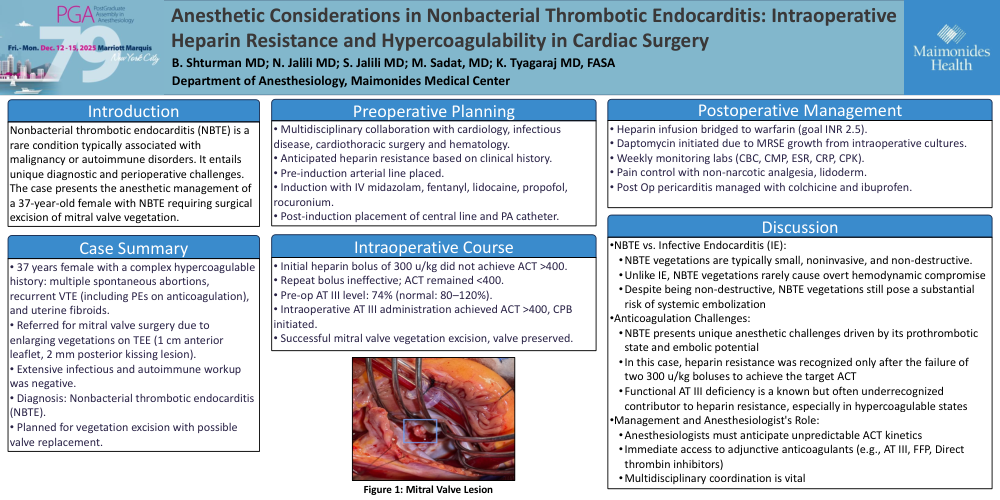
Successful mitral valve vegetation excision was performed, and the valve was preserved.
Postoperative Management
-
Heparin infusion was bridged to warfarin (goal INR 2.5).
-
Daptomycin was initiated due to MRSE growth from intraoperative cultures.
-
Weekly monitoring labs included CBC, CMP, ESR, CRP, and CPK.
-
Pain control utilized non-narcotic analgesia and lidoderm.
-
Post Op pericarditis was managed with colchicine and ibuprofen.
Discussion
-
NBTE vs. Infective Endocarditis (IE) Differences:
-
NBTE vegetations are typically small, noninvasive, and non-destructive
-
Unlike infective endocarditis, NBTE vegetations rarely cause overt hemodynamic compromise
-
Despite being non-destructive, NBTE vegetations still pose a substantial risk of systemic embolization
-
Anticoagulation Challenges (Heparin Resistance):
-
NBTE presents unique anesthetic challenges driven by its prothrombotic state and embolic potential
-
In this case, heparin resistance was recognized only after the failure of two 300 u/kg boluses to achieve the target ACT
-
Borderline AT III levels likely contributed to this resistance
-
Functional AT III deficiency is a known but often underrecognized contributor to heparin resistance, especially in hypercoagulable states
-
Management and Anesthesiologist's Role:
-
The necessity for swift intraoperative troubleshooting is underscored by the failed heparin boluses
-
Timely administration of AT III concentrate was essential, as it restored adequate anticoagulation, allowing for safe progression to cardiopulmonary bypass (CPB)
-
Anesthesiologists must anticipate unpredictable ACT kinetics in NBTE
-
It's necessary to ensure immediate access to adjunctive anticoagulants (e.g., AT III, Fresh Frozen Plasma (FFP), Direct thrombin inhibitors)
-
Multidisciplinary coordination is vital for surgical and anesthetic planning.