358 posters, 97 topics, 122 sessions, 958 authors, 239 institutions
ePostersLive by SciGen Technologies S.A. All rights reserved.
79th PostGraduate Assembly in Anesthesiology 2025
December 12 - 15, 2025 | New York City

2085
Awake Fiberoptic Intubation Without Lidocaine: Managing a Complex Airway in a Patient with Severe Amide Allergy and Tracheal Compression
Poster Presenter
Authors
Affiliations
Part of Topic
Airway
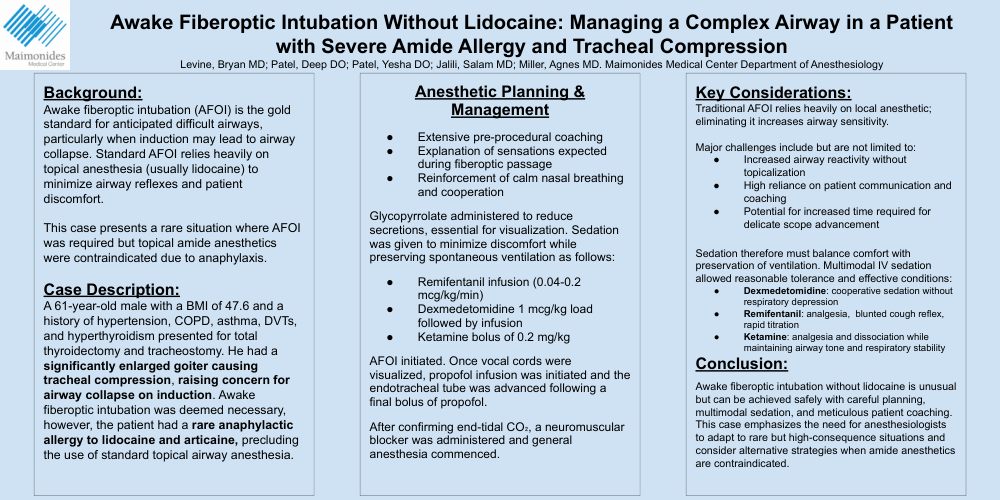
Awake Fiberoptic Intubation Without Lidocaine: Managing a Complex Airway in a Patient
with Severe Amide Allergy and Tracheal Compression
Levine, Bryan MD; Patel, Deep DO; Patel, Yesha DO; Jalili, Salam MD; Miller, Agnes MD. Maimonides Medical Center Department of Anesthesiology
Background:
Awake fiberoptic intubation (AFOI) is the gold standard for anticipated difficult airways, particularly when induction may lead to airway collapse. Standard AFOI relies heavily on topical anesthesia (usually lidocaine) to minimize airway reflexes and patient discomfort.
This case presents a rare situation where AFOI was required but topical amide anesthetics were contraindicated due to anaphylaxis.
Case Description:
A 61-year-old male with a BMI of 47.6 and a history of hypertension, COPD, asthma, DVTs, and hyperthyroidism presented for total thyroidectomy and tracheostomy. He had a significantly enlarged goiter causing tracheal compression, raising concern for airway collapse on induction. Awake fiberoptic intubation was deemed necessary, however, the patient had a rare anaphylactic allergy to lidocaine and articaine, precluding the use of standard topical airway anesthesia.
Anesthetic Planning & Management
-
● Extensive pre-procedural coaching
-
● Explanation of sensations expected
during fiberoptic passage
-
● Reinforcement of calm nasal breathing
and cooperation
Glycopyrrolate administered to reduce secretions, essential for visualization. Sedation was given to minimize discomfort while preserving spontaneous ventilation as follows:
-
● Remifentanil infusion (0.04-0.2 mcg/kg/min)
-
● Dexmedetomidine 1 mcg/kg load followed by infusion
-
● Ketamine bolus of 0.2 mg/kg
AFOI initiated. Once vocal cords were visualized, propofol infusion was initiated and the endotracheal tube was advanced following a final bolus of propofol.
After confirming end-tidal CO2, a neuromuscular blocker was administered and general anesthesia commenced.
-
Key Considerations:
Traditional AFOI relies heavily on local anesthetic; eliminating it increases airway sensitivity.
Major challenges include but are not limited to:
-
● Increased airway reactivity without
topicalization
-
● High reliance on patient communication and
coaching
-
● Potential for increased time required for
delicate scope advancement
Sedation therefore must balance comfort with
preservation of ventilation. Multimodal IV sedation
allowed reasonable tolerance and effective conditions:
-
● Dexmedetomidine: cooperative sedation without
respiratory depression
-
● Remifentanil: analgesia, blunted cough reflex,
rapid titration
-
● Ketamine: analgesia and dissociation while
maintaining airway tone and respiratory stability
Conclusion:
Awake fiberoptic intubation without lidocaine is unusual but can be achieved safely with careful planning, multimodal sedation, and meticulous patient coaching. This case emphasizes the need for anesthesiologists to adapt to rare but high-consequence situations and consider alternative strategies when amide anesthetics are contraindicated.