358 posters, 97 topics, 122 sessions, 958 authors, 239 institutions
ePostersLive by SciGen Technologies S.A. All rights reserved.
79th PostGraduate Assembly in Anesthesiology 2025
December 12 - 15, 2025 | New York City

2079
Unexpected Difficulties During Foreign Body Retrieval in a Patient with an Aspirated Partial Dental Bridge
Poster Presenter
Part of Topic
Airway
Background:
Airway foreign body aspiration in adults is rare but can rapidly become life-threatening.
Anesthetic management requires maintaining oxygenation and airway control while minimizing object displacement.
Sharing the airway with the proceduralist provides an additional challenge, requiring close interdisciplinary communication.
Foreign body removal can be performed using either rigid or flexible bronchoscopy.
Rigid bronchoscopes provide superior airway control and are preferred for larger or more deeply impacted objects, while flexible bronchoscopes allow access to more distal airways and are typically used when rigid bronchoscope expertise or equipment is unavailable.
Case Presentation:
A 49-year-old male, current tobacco smoker, with remote PMH of asthma, presented after aspiration of his partial dental bridge while asleep.
The patient endorsed dyspnea, chest pressure, coughing, and hemoptysis upon awakening, which had since resolved upon arrival to the hospital.
The patient was hemodynamically stable, with SpO2 >96% on room air.
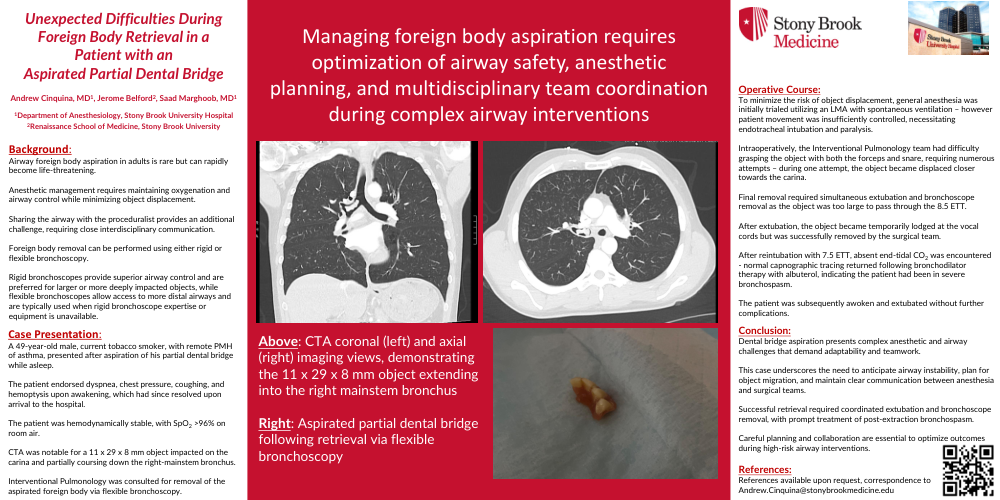
CTA was notable for a 11 x 29 x 8 mm object impacted on the carina and partially coursing down the right-mainstem bronchus.
Interventional Pulmonology was consulted for removal of the aspirated foreign body via flexible bronchoscopy.
Operative Course:
To minimize the risk of object displacement, general anesthesia was initially trialed utilizing an LMA with spontaneous ventilation – however patient movement was insufficiently controlled, necessitating endotracheal intubation and paralysis.
Intraoperatively, the Interventional Pulmonology team had difficulty grasping the object with both the forceps and snare, requiring numerous attempts – during one attempt, the object became displaced closer towards the carina.
Final removal required simultaneous extubation and bronchoscope removal as the object was too large to pass through the 8.5 ETT.
After extubation, the object became temporarily lodged at the vocal cords but was successfully removed by the surgical team.
After reintubation with 7.5 ETT, absent end-tidal CO2 was encountered - normal capnographic tracing returned following bronchodilator therapy with albuterol, indicating the patient had been in severe bronchospasm.
The patient was subsequently awoken and extubated without further complications.
Conclusion:
Dental bridge aspiration presents complex anesthetic and airway challenges that demand adaptability and teamwork.
This case underscores the need to anticipate airway instability, plan for object migration, and maintain clear communication between anesthesia and surgical teams.
Successful retrieval required coordinated extubation and bronchoscope removal, with prompt treatment of post-extraction bronchospasm.
Careful planning and collaboration are essential to optimize outcomes during high-risk airway interventions.