358 posters, 97 topics, 122 sessions, 958 authors, 239 institutions
ePostersLive by SciGen Technologies S.A. All rights reserved.
79th PostGraduate Assembly in Anesthesiology 2025
December 12 - 15, 2025 | New York City

4025
Quality Improvement Training in Closed System Technique Significantly Reduces OR Staff Exposure to Waste Anesthetic Gases
Poster Presenter
Authors
Affiliations
Part of Topic
Fundamentals of Anesthesiology
Quality Improvement Training in Closed System Technique Significantly Reduces OR Staff Exposure to Waste Anesthetic Gases
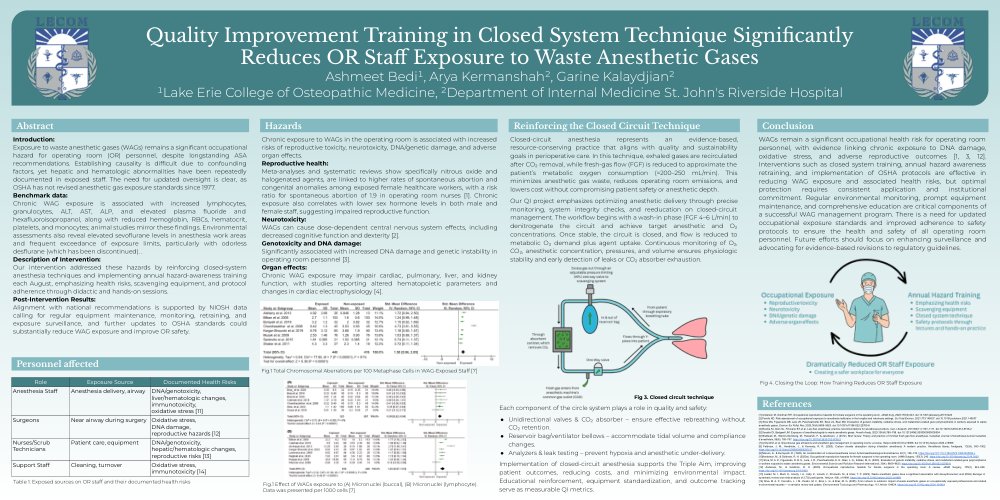
Abstract: Introduction: Exposure to waste anesthetic gases (WAGs) remains a significant occupational hazard for operating room (OR) personnel, despite longstanding ASA recommendations. Establishing causality is difficult due to confounding factors, yet hepatic and hematologic abnormalities have been repeatedly documented in exposed staff. The need for updated oversight is clear, as OSHA has not revised anesthetic gas exposure standards since 1977. Benchmark data: Chronic WAG exposure is associated with increased lymphocytes, granulocytes, ALT, AST, ALP, and elevated plasma fluoride and hexafluoroisopropanol, along with reduced hemoglobin, RBCs, hematocrit, platelets, and monocytes; animal studies mirror these findings. Environmental assessments also reveal elevated sevoflurane levels in anesthesia work areas and frequent exceedance of exposure limits, particularly with odorless desflurane (which has been discontinued). . Description of Intervention: Our intervention addressed these hazards by reinforcing closed-system anesthesia techniques and implementing annual hazard-awareness training each August, emphasizing health risks, scavenging equipment, and protocol adherence through didactic and hands-on sessions. Post-Intervention Results: Alignment with national recommendations is supported by NIOSH data calling for regular equipment maintenance, monitoring, retraining, and exposure surveillance, and further updates to OSHA standards could substantially reduce WAG exposure and improve OR safety
Hazards: Chronic exposure to WAGs in the operating room is associated with increased risks of reproductive toxicity, neurotoxicity, DNA/genetic damage, and adverse organ effects. Reproductive health: Meta-analyses and systematic reviews show specifically nitrous oxide and halogenated agents, are linked to higher rates of spontaneous abortion and congenital anomalies among exposed female healthcare workers, with a risk ratio for spontaneous abortion of 1.9 in operating room nurses [1]. Chronic exposure also correlates with lower sex hormone levels in both male and female staff, suggesting impaired reproductive function. Neurotoxicity: WAGs can cause dose-dependent central nervous system effects, including decreased cognitive function and dexterity [2]. Genotoxicity and DNA damage: Significantly associated with increased DNA damage and genetic instability in operating room personnel [3]. Organ effects: Chronic WAG exposure may impair cardiac, pulmonary, liver, and kidney function, with studies reporting altered hematopoietic parameters and changes in cardiac electrophysiology [4].
Reinforcing the Closed Circuit Technique: Closed-circuit anesthesia represents an evidence-based, resource-conserving practice that aligns with quality and sustainability goals in perioperative care. In this technique, exhaled gases are recirculated after CO₂ removal, while fresh-gas flow (FGF) is reduced to approximate the patient’s metabolic oxygen consumption (≈200–250 mL/min). This minimizes anesthetic gas waste, reduces operating room emissions, and lowers cost without compromising patient safety or anesthetic depth. Our QI project emphasizes optimizing anesthetic delivery through precise monitoring, system integrity checks, and reeducation on closed-circuit management. The workflow begins with a wash-in phase (FGF 4–6 L/min) to denitrogenate the circuit and achieve target anesthetic and O₂ concentrations. Once stable, the circuit is closed, and flow is reduced to metabolic O₂ demand plus agent uptake. Continuous monitoring of O₂, CO₂, anesthetic concentration, pressures, and volume ensures physiologic stability and early detection of leaks or CO₂ absorber exhaustion. Each component of the circle system plays a role in quality and safety: ● Unidirectional valves & CO₂ absorber – ensure effective rebreathing without CO₂ retention. ● Reservoir bag/ventilator bellows – accommodate tidal volume and compliance changes. ● Analyzers & leak testing – prevent hypoxia and anesthetic under-delivery. Implementation of closed-circuit anesthesia supports the Triple Aim, improving patient outcomes, reducing costs, and minimizing environmental impact. Educational reinforcement, equipment standardization, and outcome tracking serve as measurable QI metrics.
Conclusion: WAGs remain a significant occupational health risk for operating room personnel, with evidence linking chronic exposure to DNA damage, oxidative stress, and adverse reproductive outcomes [1, 3, 12]. Interventions such as closed system training, annual hazard awareness retraining, and implementation of OSHA protocols are effective in reducing WAG exposure and associated health risks, but optimal protection requires consistent application and institutional commitment. Regular environmental monitoring, prompt equipment maintenance, and comprehensive education are critical components of a successful WAG management program. There is a need for updated occupational exposure standards and improved adherence to safety protocols to ensure the health and safety of all operating room personnel. Future efforts should focus on enhancing surveillance and advocating for evidence-based revisions to regulatory guidelines.
References: [1] Anderson M, Goldman RH. Occupational reproductive hazards for female surgeons in the operating room. JAMA Surg. 2020;155(3):243. doi:10.1001/jamasurg.2019.5420 [2] Perello KD. Risk assessment of occupational exposure to anesthesia isoflurane in the hospital and veterinary settings. Sci Total Environ. 2021;773:145637. doi:10.1016/j.scitotenv.2021.145637 [3] Silva MA, Figueiredo DB, Lara JR, Paschoalinotte EE, Braz LG, Braz MG. Evaluation of genetic instability, oxidative stress, and metabolism-related gene polymorphisms in workers exposed to waste anesthetic gases. Environ Sci Pollut Res. 2023;30(4):9609–9623. doi:10.1007/s11356-022-22765-8 [4] Bosma KJ, Dain SL, Finucane BT, et al. Low-flow anesthesia: practice recommendations for anesthesia providers. Can J Anaesth. 2013;60(11):1107–1117. doi:10.1007/s12630-012-9736-2 [5] Sessler DI, Badgwell JM. Exposure of anesthesiologists to waste anesthetic gases. Anesth Analg. 2023;136(4):789–798. doi:10.1213/ANE.0000000000005504 [6] Brattwall, M., Warrén-Stomberg, M., Hesselvik, F., & Jakobsson, J. (2012). Brief review: Theory and practice of minimal fresh gas flow anesthesia. Canadian Journal of Anesthesia/Journal Canadien d’anesthésie, 59(8), 785–797. https://doi.org/10.1007/s12630-012-9736-2 [7] Al-Sa’di M, et al. Greenhouse gas emissions and anesthetic gas management in operating rooms: a review. Heliyon.2023;9(10):e19988. doi:10.1016/j.heliyon.2023.e19988 [8] Feldman, J. M., Hendrickx, J., & Kennedy, R. R. (2020). Carbon dioxide absorption during inhalation anesthesia: A modern practice. Anesthesia & Analgesia, 132(4), 993–1002. https://doi.org/10.1213/ane.0000000000005137 [9] Mizuno, K., & Sumiyoshi, R. (1998). Air contamination of a closed anesthesia circuit. Acta Anaesthesiologica Scandinavica, 42(1), 128–130. https://doi.org/10.1111/j.1399-6576.1998.tb05093.x [10]Anderson, M., & Goldman, R. H. (2020a). Occupational reproductive hazards for female surgeons in the operating room. JAMA Surgery, 155(3), 243. https://doi.org/10.1001/jamasurg.2019.5420 [11] Silva, M. A. P., Figueiredo, D. B. S., Lara, J. R., Paschoalinotte, E. E., Braz, L. G., & Braz, M. G. (2023). Evaluation of genetic instability, oxidative stress, and metabolism-related gene polymorphisms in workers exposed to waste anesthetic gases. Environmental Science and Pollution Research International, 30(4), 9609–9623. https://doi.org/10.1007/s11356-022-22765-8 [12] Anderson, M., & Goldman, R. H. (2020). Occupational reproductive hazards for female surgeons in the operating room: A review. JAMA Surgery, 155(3), 243–249. https://doi.org/10.1001/jamasurg.2019.5420 [13] Lestari, M. I., Murti, K., Liberty, I. A., Hafy, Z., Linardi, V., Khoirudin, M., & Umar, T. P. (2023). Waste anesthetic gases have a significant association with deoxyribonucleic acid (DNA) damage: A systematic review and meta-analysis of 2,732 participants. Heliyon, 9(9), e19988. https://doi.org/10.1016/j.heliyon.2023.e19988 [14] Silva, M. A. P., Carvalho, L. I. M., Destro, M. V., Braz, L. G., & Braz, M. G. (2025). From indoors to outdoors: Impact of waste anesthetic gases on occupationally exposed professionals and related environmental hazards — a narrative review and update. Environmental Toxicology and Pharmacology, 113, Article 104624. https://doi.org/10.1016/j.etap.2024.104624