358 posters, 97 topics, 122 sessions, 958 authors, 239 institutions
ePostersLive by SciGen Technologies S.A. All rights reserved.
79th PostGraduate Assembly in Anesthesiology 2025
December 12 - 15, 2025 | New York City

3151
Psychiatric Comorbidities Predict Increased Surgical Burden and Healthcare Utilization in Hidradenitis Suppurativa: Implications for Perioperative Anesthesia Planning
Poster Presenter
Part of Topic
Ambulatory - Perioperative Management
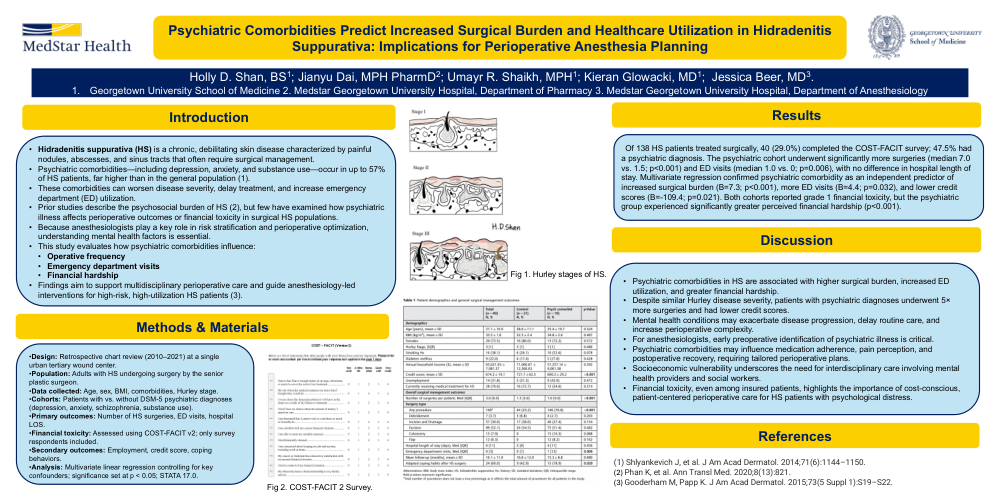
| Psychiatric Comorbidities Predict Increased Surgical Burden and Healthcare Utilization in Hidradenitis Suppurativa: Implications for Perioperative Anesthesia Planning | |
| Hidradenitis suppurativa (HS) is a debilitating chronic skin condition marked by painful nodules, abscesses, and sinus tracts that often require surgical intervention. Psychiatric comorbidities—including depression, anxiety, and substance use—are reported in up to 57% of HS patients, significantly higher than the general population?1?. These comorbidities may impact disease severity, delay treatment, and increase reliance on emergency services. While prior studies have described the psychosocial burden of HS?2?, limited research has evaluated how psychiatric illness affects perioperative outcomes or financial toxicity in surgical populations. Given anesthesiologists’ central role in risk stratification and perioperative optimization, understanding the interplay between mental health, surgical burden, and healthcare utilization is critical. This study assesses how psychiatric comorbidities influence operative frequency, emergency department visits, and financial hardship in HS patients to inform multidisciplinary perioperative care and guide anesthesiology-led interventions for high-risk, high-utilization patients?3?. | |
| A retrospective chart review was conducted at a single urban tertiary wound care center between January 2010 and December 2021. Adult patients diagnosed with hidradenitis suppurativa (HS) who underwent surgical treatment by the senior plastic surgeon were identified. Demographic and clinical variables—including age, sex, body mass index (BMI), comorbidities, and Hurley stage—were extracted from electronic health records. Patients were stratified into two cohorts based on the presence or absence of a psychiatric diagnosis, defined by DSM-5 criteria (including depression, anxiety, schizophrenia, or substance use disorders) documented prior to or at the time of HS diagnosis. Primary outcomes included number of HS-related surgical procedures, emergency department (ED) visits, and hospital length of stay (LOS). Financial distress was assessed using the Comprehensive Score for Financial Toxicity (COST-FACIT Version 2), a validated 12-item patient-reported outcome tool. Patient s who completed the COST-FACIT survey were included in financial analysis. Secondary outcomes included employment status, credit score, and coping behaviors (e.g., therapy, meditation). Multivariate linear regression was used to control for confounding variables such as age, sex, BMI, smoking status, and diabetes. Statistical significance was set at p<0.05. All analyses were performed using STATA 17.0 (StataCorp, College Station, TX). |
|
| Of 138 HS patients treated surgically, 40 (29.0%) completed the COST-FACIT survey; 47.5% had a psychiatric diagnosis. The psychiatric cohort underwent significantly more surgeries (median 7.0 vs. 1.5; p<0.001) and ED visits (median 1.0 vs. 0; p=0.006), with no difference in hospital length of stay. Multivariate regression confirmed psychiatric comorbidity as an independent predictor of increased surgical burden (B=7.3; p<0.001), more ED visits (B=4.4; p=0.032), and lower credit scores (B=-109.4; p=0.021). Both cohorts reported grade 1 financial toxicity, but the psychiatric group experienced significantly greater perceived financial hardship (p<0.001). | |
| This study demonstrates that psychiatric comorbidities in patients with hidradenitis suppurativa (HS) are associated with significantly higher surgical burden, more emergency department utilization, and greater financial hardship. Despite similar disease severity by Hurley staging, patients with psychiatric diagnoses underwent five times more surgeries and had lower credit scores. These findings suggest that mental health status may exacerbate disease progression or delay routine care, leading to increased perioperative complexity. For anesthesiologists, this highlights the need for early identification of psychiatric illness during preoperative assessment. Psychiatric comorbidities may affect medication adherence, pain perception, and postoperative recovery, warranting tailored anesthetic and perioperative plans. Additionally, given the socioeconomic vulnerability of this population, interdisciplinary coordination with mental health professionals and social workers is essential. Financial toxicity, even among insured patients, further emphasizes the role of perioperative teams in facilitating cost-conscious, patient-centered care for HS patients with psychological distress. | |
| Shlyankevich J, et al. J Am Acad Dermatol. 2014;71(6):1144–1150. Phan K, et al. Ann Transl Med. 2020;8(13):821. Gooderham M, Papp K. J Am Acad Dermatol. 2015;73(5 Suppl 1):S19–S22. |