358 posters, 97 topics, 122 sessions, 958 authors, 239 institutions
ePostersLive by SciGen Technologies S.A. All rights reserved.
79th PostGraduate Assembly in Anesthesiology 2025
December 12 - 15, 2025 | New York City

2040
Prophylactic Intralipid Administration in Local Anesthetic Overdose
Poster Presenter
Part of Topic
Ambulatory - Perioperative Management
Preemptive intralipid administration in local anesthetic overdose
Evangelia Sgouta MS1, Fotios Vlahos MS2, Iosifina Giannakikou MD3
- National and Kapodistrian University of Athens, GR; 2. University of Milano-Bicocca, IT; 3. Hygeia Hospital, Department of Anesthesia, Athens, GR
INTRODUCTION
Local anesthetic systemic toxicity (LAST) is a rare complication of local anesthesia (LA) that causes neurotoxicity and cardiotoxicity.
Lipid resuscitation therapy (LRT) with a 20% intravenous lipid emulsion (LE) should be initiated promptly at the onset of central nervous system and/or cardiovascular system symptoms.
CASE PRESENTATION
- A 53-year-old woman (76 kg) with AFib and SLE on chronic immunosuppression underwent lower blepharoplasty, facelift, and neck lift under GA.
- LA was administered sequentially over 5 hours based on surgical steps:
- 273 mg of lidocaine in the first 4 hours
- 400 mg of undiluted plain lidocaine, as a single SQ injection -exceeding recommended max dose (76 kg x 4.5 mg/kg = 342 mg)
- Patient was hemodynamically stable without any arrhythmias or hypotension.
- CNS toxicity could not be assessed under GA.
- EEG monitoring for early detection of LAST was not feasible during the facelift.
- Serum lidocaine levels were not obtained due to delayed turnaround.
- Preemptive treatment was initiated with benzodiazepines and a 1.5 mL/kg bolus of 20% LE over 10 minutes, without maintenance infusion.
- Postoperatively, temporary paresis of the buccal and marginal mandibular branches of the right facial nerve was noted.
- Patient recovered uneventfully with no postoperative complications.
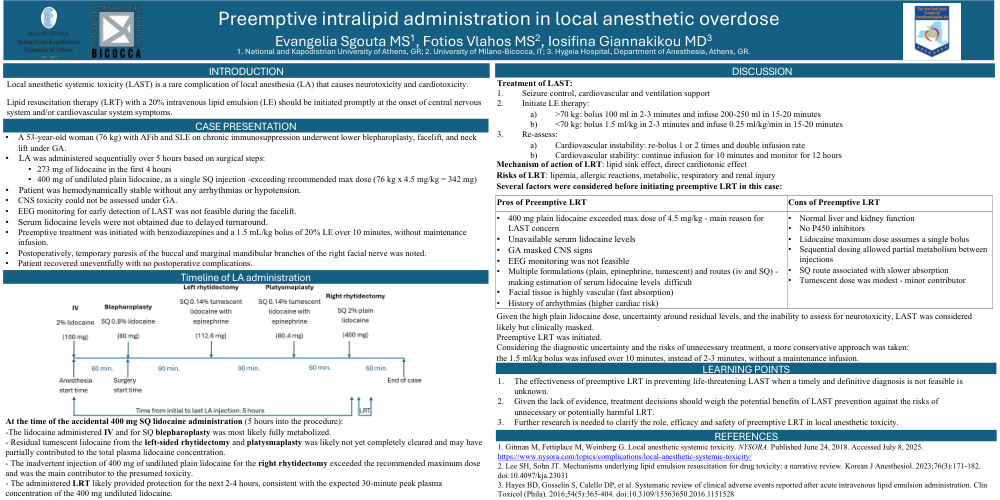
Timeline of LA administration
At the time of the accidental 400 mg SQ lidocaine administration (5 hours into the procedure):
-The lidocaine administered IV and for SQ blepharoplasty was most likely fully metabolized.
- Residual tumescent lidocaine from the left-sided rhytidectomy and platysmaplasty was likely not yet completely cleared and may have partially contributed to the total plasma lidocaine concentration.
- The inadvertent injection of 400 mg of undiluted plain lidocaine for the right rhytidectomy exceeded the recommended maximum dose and was the main contributor to the presumed toxicity.
- The administered LRT likely provided protection for the next 2-4 hours, consistent with the expected 30-minute peak plasma concentration of the 400 mg undiluted lidocaine.
DISCUSSION
Treatment of LAST:
- Seizure control, cardiovascular and ventilation support
- Initiate LE therapy:
a) >70 kg: bolus 100 ml in 2-3 minutes and infuse 200-250 ml in 15-20 minutes
b) <70 kg: bolus 1.5 ml/kg in 2-3 minutes and infuse 0.25 ml/kg/min in 15-20 minutes
- Re-assess:
a) Cardiovascular instability: re-bolus 1 or 2 times and double infusion rate
b) Cardiovascular stability: continue infusion for 10 minutes and monitor for 12 hours
Mechanism of action of LRT: lipid sink effect, direct cardiotonic effect
Risks of LRT: lipemia, allergic reactions, metabolic, respiratory and renal injury
Several factors were considered before initiating preemptive LRT in this case:
Pros of Preemptive LRT:
- 400 mg plain lidocaine exceeded max dose of 4.5 mg/kg - main reason for LAST concern
- Unavailable serum lidocaine levels
- GA masked CNS signs
- EEG monitoring was not feasible
- Multiple formulations (plain, epinephrine, tumescent) and routes (iv and SQ) - making estimation of serum lidocaine levels difficult
- Facial tissue is highly vascular (fast absorption)
- History of arrhythmias (higher cardiac risk)
Cons of Preemptive LRT:
- Normal liver and kidney function
- No P450 inhibitors
- Lidocaine maximum dose assumes a single bolus
- Sequential dosing allowed partial metabolism between injections
- SQ route associated with slower absorption
- Tumescent dose was modest - minor contributor
Given the high plain lidocaine dose, uncertainty around residual levels, and the inability to assess for neurotoxicity, LAST was considered likely but clinically masked.
Preemptive LRT was initiated.
Considering the diagnostic uncertainty and the risks of unnecessary treatment, a more conservative approach was taken:
the 1.5 ml/kg bolus was infused over 10 minutes, instead of 2-3 minutes, without a maintenance infusion.
LEARNING POINTS
- The effectiveness of preemptive LRT in preventing life-threatening LAST when a timely and definitive diagnosis is not feasible is unknown.
- Given the lack of evidence, treatment decisions should weigh the potential benefits of LAST prevention against the risks of unnecessary or potentially harmful LRT.
- Further research is needed to clarify the role, efficacy and safety of preemptive LRT in local anesthetic toxicity.
REFERENCES
1. Gitman M, Fettiplace M, Weinberg G. Local anesthetic systemic toxicity. NYSORA. Published June 24, 2018. Accessed July 8, 2025. https://www.nysora.com/topics/complications/local-anesthetic-systemic-toxicity/
2. Lee SH, Sohn JT. Mechanisms underlying lipid emulsion resuscitation for drug toxicity: a narrative review. Korean J Anesthesiol. 2023;76(3):171-182. doi:10.4097/kja.23031
3. Hayes BD, Gosselin S, Calello DP, et al. Systematic review of clinical adverse events reported after acute intravenous lipid emulsion administration. Clin Toxicol (Phila). 2016;54(5):365-404. doi:10.3109/15563650.2016.1151528