358 posters, 97 topics, 122 sessions, 958 authors, 239 institutions
ePostersLive by SciGen Technologies S.A. All rights reserved.
79th PostGraduate Assembly in Anesthesiology 2025
December 12 - 15, 2025 | New York City

3129
Effect of Ultrasound-Guided Bilateral Suprazygomatic Maxillary Nerve Block on Postoperative Pain Control Following Cleft Palate Repair
Poster Presenter
Authors
Gwyneth Bradley, Amanda Bunnell, Jennifer Smith, Natalie Barnett
Affiliations
Part of Topic
Pediatric - Regional and Acute Pain
ABSTRACT
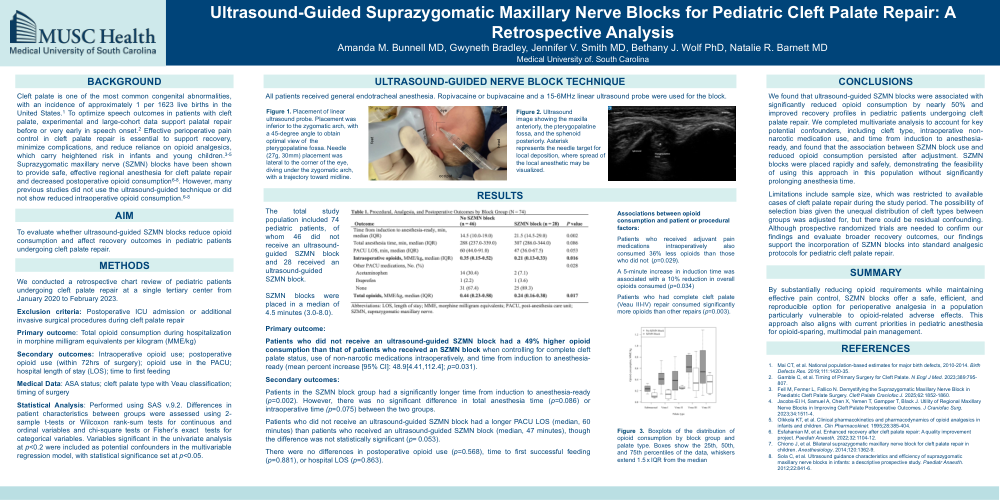
Background: Effective perioperative pain control in cleft palate repair is essential to support recovery, minimize complications, and reduce reliance on opioid analgesics, which carry heightened risks in infants and young children. We evaluated whether ultrasound-guided bilateral suprazygomatic maxillary nerve (SZMN) blocks reduce opioid consumption for cleft palate repair.
Aims: To evaluate whether ultrasound-guided bilateral SZMN blocks reduce opioid consumption and affect recovery outcomes in pediatric patients undergoing cleft palate repair.
Methods: We conducted a retrospective chart review of pediatric patients undergoing cleft palate repair at a single tertiary center between January 2020 and February 2023. The primary outcome was total opioid consumption during hospitalization, measured as morphine milligram equivalents per kilogram. The secondary outcomes included intraoperative opioid use, postoperative opioid use, recovery milestones, and length of stay.
Results: Among 74 patients who met inclusion criteria, 28 received ultrasound-guided SZMN blocks. Patients who did not receive SZMN blocks consumed, on average, 57% more opioids than patients who received SZMN blocks. Postoperative opioid use, time to first feeding, and hospital length of stay did not differ between patients who did and did not receive SZMN blocks. SZMN blocks were placed in a median of 4.5 minutes, showing feasibility of use in this population.
Conclusions: Our findings support that ultrasound-guided SZMN blocks are a safe and effective technique for reducing opioid exposure in pediatric patients undergoing cleft palate repair. By substantially lowering intraoperative and overall opioid use without prolonging recovery, SZMN blocks are a valuable addition to multimodal analgesia strategies for cleft palate repair.
Keywords: cleft palate, nerve block, pediatric anesthesia, pain management