358 posters, 97 topics, 122 sessions, 958 authors, 239 institutions
ePostersLive by SciGen Technologies S.A. All rights reserved.
79th PostGraduate Assembly in Anesthesiology 2025
December 12 - 15, 2025 | New York City

3126
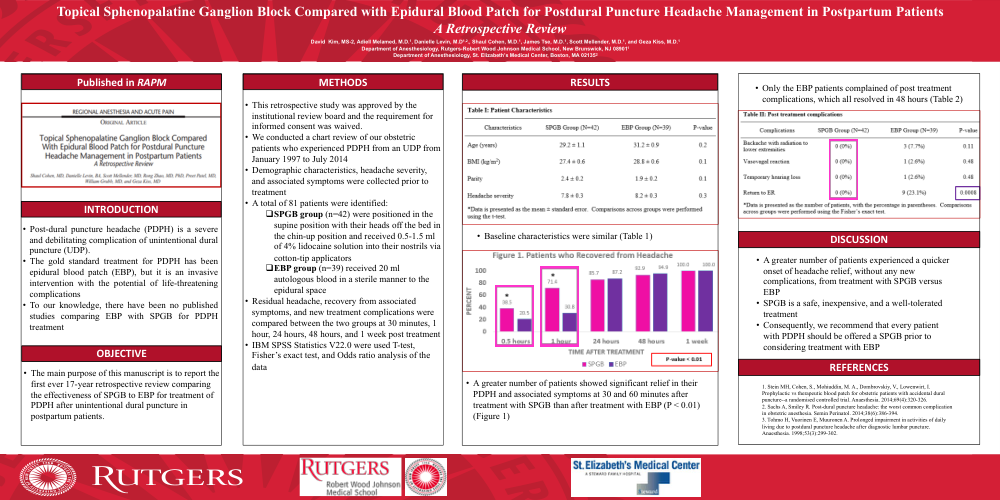
Topical Sphenopalatine Ganglion Block Compared with Epidural Blood Patch for Postdural Puncture Headache Management in Postpartum Patients: A Retrospective Review
Poster Presenter
Authors
Affiliations
Part of Topic
Pediatric - Regional and Acute Pain
Topical Sphenopalatine Ganglion Block Compared with Epidural Blood Patch for Postdural Puncture Headache Management in Postpartum Patients A Retrospective Review.
David Kim, MS-2, Adiell Melamed, M.D.1, Danielle Levin, M.D1,2 ., Shaul Cohen, M.D.1, James Tse, M.D.1, Scott Mellender, M.D.1, and Geza Kiss, M.D.1 Department of Anesthesiology, Rutgers-Robert Wood Johnson Medical School, New Brunswick, NJ 089011
Department of Anesthesiology, St. Elizabeth’s Medical Center, Boston, MA 021352
INTRODUCTION
• Post-dural puncture headache (PDPH) is a severe and debilitating complication of unintentional dural puncture (UDP).
• The gold standard treatment for PDPH has been epidural blood patch (EBP), but it is an invasive intervention with the potential of life-threatening complications
• To our knowledge, there have been no published studies comparing EBP with SPGB for PDPH treatment
OBJECTIVE
• The main purpose of this manuscript is to report the first ever 17-year retrospective review comparing the effectiveness of SPGB to EBP for treatment of PDPH after unintentional dural puncture in postpartum patients.
METHODS
• This retrospective study was approved by the institutional review board and the requirement for informed consent was waived.
• We conducted a chart review of our obstetric patients who experienced PDPH from an UDP from January 1997 to July 2014
• Demographic characteristics, headache severity, and associated symptoms were collected prior to treatment
• A total of 81 patients were identified: qSPGB group (n=42) were positioned in the supine position with their heads off the bed in the chin-up position and received 0.5-1.5 ml of 4% lidocaine solution into their nostrils via cotton-tip applicators qEBP group (n=39) received 20 ml autologous blood in a sterile manner to the epidural space
• Residual headache, recovery from associated symptoms, and new treatment complications were compared between the two groups at 30 minutes, 1 hour, 24 hours, 48 hours, and 1 week post treatment
• IBM SPSS Statistics V22.0 were used T-test, Fisher’s exact test, and Odds ratio analysis of the data
RESULTS
• Baseline characteristics were similar (Table 1)
• A greater number of patients showed significant relief in their PDPH and associated symptoms at 30 and 60 minutes after treatment with SPGB than after treatment with EBP (P < 0.01) (Figure 1)
• Only the EBP patients complained of post treatment complications, which all resolved in 48 hours (Table 2)
DISCUSSION
• A greater number of patients experienced a quicker onset of headache relief, without any new complications, from treatment with SPGB versus EBP
• SPGB is a safe, inexpensive, and a well-tolerated treatment
• Consequently, we recommend that every patient with PDPH should be offered a SPGB prior to considering treatment with EBP
REFERENCES
1. Stein MH, Cohen, S., Mohiuddin, M. A., Dombrovskiy, V., Lowenwirt, I. Prophylactic vs therapeutic blood patch for obstetric patients with accidental dural puncture--a randomised controlled trial. Anaesthesia. 2014;69(4):320-326. 2. Sachs A, Smiley R. Post-dural puncture headache: the worst common complication in obstetric anesthesia. Semin Perinatol. 2014;38(6):386-394. 3. Tohmo H, Vuorinen E, Muuronen A. Prolonged impairment in activities of daily living due to postdural puncture headache after diagnostic lumbar puncture. Anaesthesia. 1998;53(3):299-302