358 posters, 97 topics, 122 sessions, 958 authors, 239 institutions
ePostersLive by SciGen Technologies S.A. All rights reserved.
79th PostGraduate Assembly in Anesthesiology 2025
December 12 - 15, 2025 | New York City

3125
Acute Respiratory Distress Syndrome Phenotypes and Delirium after Extubation in the Intensive Care Unit
Part of Topic
Critical Care - OTHER ARDS
Acute Respiratory Distress Syndrome Phenotypes and Delirium after Extubation in the Intensive Care Unit
Benedikt Wagner; Joris Pensier, MD, PhD; Kara Liebich; Béla-Simon Paschold, MD; Elena Ahrens; Maxime Fosset, MD; Dario von Wedel; Victor Novack, MD, PhD; Balachundhar Subramaniam, MD, MPH; Daniel S. Talmor MD, MPH; Elias N. Baedorf-Kassis, MD; Maximilian S. Schaefer, MD, PhD
INTRODUCTION
BACKGROUND
• Delirium is a frequent and severe complication, exacerbated by inflammation and common among patients with acute respiratory distress syndrome (ARDS) [Brummel NE et al. Intensive Care Med. 2024]
• Recently, two ARDS phenotypes, hypoinflammatory and hyperinflammatory, have been described based on distinct biomarker profiles [Redaelli S et al. Intensive Care Med. 2023]
• We investigated how these inflammatory phenotypes are linked to delirium and through which clinical pathways
METHODS
SETTING AND STUDY DESIGN
• We performed a retrospective cohort study of ARDS patients who underwent extubation in an intensive care unit at Beth Israel Deaconess Medical Center in Boston, Massachusetts (2011–2024)
• Primary exposure: Phenotype assigned by validated open-access AI Clinical Classifier (https://bostonmontpelliercare.shinyapps.io/AIClarity) at ARDS onset
• Primary Outcome: Delirium after extubation, assessed every 12 hours until ICU discharge, reintubation or death using CAM-ICU STATISTICAL APPROACH
• Multivariable logistic regression estimated adjusted effects and Fine–Gray models accounted for competing risks of death, reintubation, and ICU discharge
• Multi-block mediation quantified indirect effects. • Effect modification by corticosteroids, statins, and acetaminophen
RESULTS
STUDY POPULATION
• Among 2,904 extubated ARDS patients 1,924 (66%) were classified as hypoinflammatory and 980 (34%) as hyperinflammatory at ARDS onset. Delirium occurred in 55% (1,058/1,924) of hypoinflammatory and 68% (668/980) of hyperinflammatory patients following extubation
PRIMARY ANALYSIS
• The hyperinflammatory phenotype was associated with post-extubation delirium (adjusted absolute risk difference = 11.3%, 95% confidence interval (95%CI) [7.4–14.9]; adjusted odds ratio (ORadj ) = 1.62, 95%CI [1.37–1.91], P<0.001)
• Findings were robust in competing-risk analysis (subdistribution hazard ratio = 1.19, 95%CI [1.05-1.33])
MEDIATION ANALYSIS
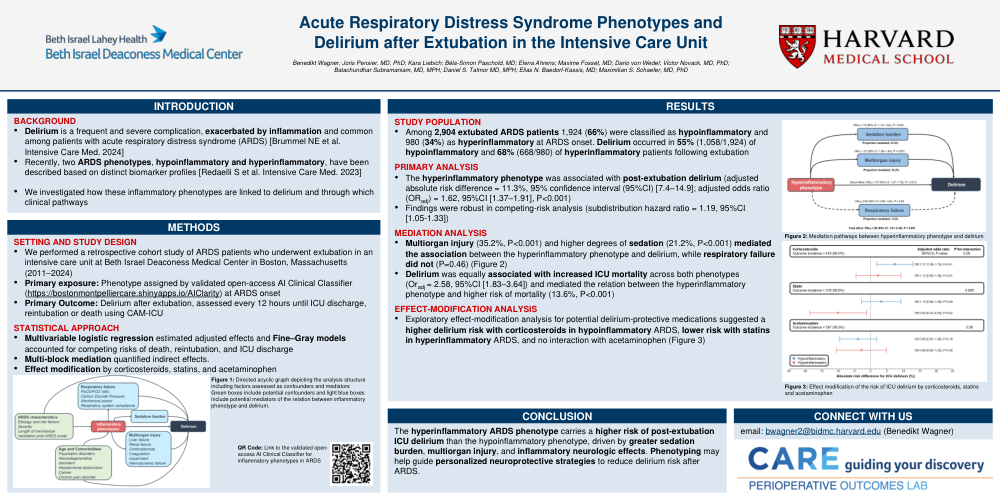
• Multiorgan injury (35.2%, P<0.001) and higher degrees of sedation (21.2%, P<0.001) mediated the association between the hyperinflammatory phenotype and delirium, while respiratory failure did not (P=0.46) (Figure 2)
• Delirium was equally associated with increased ICU mortality across both phenotypes (Oradj = 2.58, 95%CI [1.83–3.64]) and mediated the relation between the hyperinflammatory phenotype and higher risk of mortality (13.6%, P<0.001)
EFFECT-MODIFICATION ANALYSIS
• Exploratory effect-modification analysis for potential delirium-protective medications suggested a higher delirium risk with corticosteroids in hypoinflammatory ARDS, lower risk with statins in hyperinflammatory ARDS, and no interaction with acetaminophen (Figure 3)
CONCLUSION
• The hyperinflammatory ARDS phenotype carries a higher risk of post-extubation ICU delirium than the hypoinflammatory phenotype, driven by greater sedation burden, multiorgan injury, and inflammatory neurologic effects. Phenotyping may help guide personalized neuroprotective strategies to reduce delirium risk after ARDS.
CONNECT WITH US
email: bwagner2@bidmc.harvard.edu (Benedikt Wagner)