358 posters, 97 topics, 122 sessions, 958 authors, 239 institutions
ePostersLive by SciGen Technologies S.A. All rights reserved.
79th PostGraduate Assembly in Anesthesiology 2025
December 12 - 15, 2025 | New York City

3124
Racial Disparities in Postoperative Outcomes Among Gender Diverse Patients: Implications for Anesthesia Practice
Poster Presenter
Part of Topic
Critical Care - OTHER ARDS
Racial Disparities in Postoperative Outcomes Among Gender-Diverse Patients: Implications for Anesthesia Practice
Kiana Foster, MD Candidate, Class of 2028
Faculty Mentor: Dr. Rose Berkun, M.D., FASA
Florida International University Herbert Wertheim College of Medicine
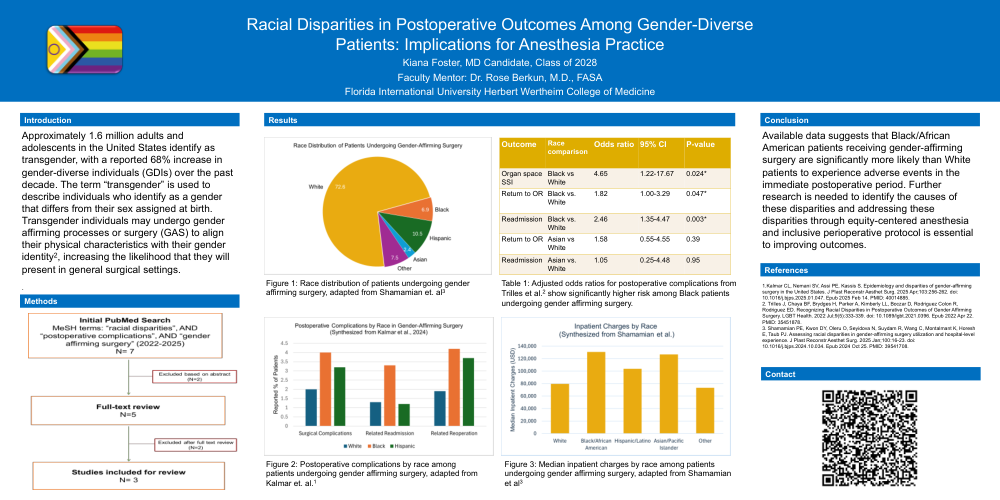
Introduction: Approximately 1.6 million adults and adolescents in the United States identify as transgender, with a reported 68% increase in gender-diverse individuals (GDIs) over the past decade. The term “transgender” is used to describe individuals who identify as a gender that differs from their sex assigned at birth. Transgender individuals may undergo gender affirming processes or surgery (GAS) to align their physical characteristics with their gender identity2, increasing the likelihood that they will present in general surgical settings.
Methods: A structured literature review was conducted via PubMed using MeSH terms “racial disparities” AND “postoperative complications” AND “gender affirming surgery”. Seven articles were included under this search, of which two were excluded based on abstract. Two additional articles were excluded after full text review.
Figure 1: Race distribution of patients undergoing gender affirming surgery, adapted from Shamamian et. al3
Table 1: Adjusted odds ratios for postoperative complications from Trilles et al.2 show significantly higher risk among Black patients undergoing gender affirming surgery.
Figure 2: Postoperative complications by race among patients undergoing gender affirming surgery, adapted from Kalmar et. al.1
Figure 3: Median inpatient charges by race among patients undergoing gender affirming surgery, adapted from Shamamian et al3
Conclusion: Available data suggests that Black/African American patients receiving gender-affirming surgery are significantly more likely than White patients to experience adverse events in the immediate postoperative period. Further research is needed to identify the causes of these disparities and addressing these disparities through equity-centered anesthesia and inclusive perioperative protocol is essential to improving outcomes.
References:
1.Kalmar CL, Nemani SV, Assi PE, Kassis S. Epidemiology and disparities of gender-affirming surgery in the United States. J Plast Reconstr Aesthet Surg. 2025 Apr;103:256-262. doi: 10.1016/j.bjps.2025.01.047. Epub 2025 Feb 14. PMID: 40014885.
2. Trilles J, Chaya BF, Brydges H, Parker A, Kimberly LL, Boczar D, Rodriguez Colon R, Rodriguez ED. Recognizing Racial Disparities in Postoperative Outcomes of Gender Affirming Surgery. LGBT Health. 2022 Jul;9(5):333-339. doi: 10.1089/lgbt.2021.0396. Epub 2022 Apr 22. PMID: 35451878.
3. Shamamian PE, Kwon DY, Oleru O, Seyidova N, Suydam R, Wang C, Montalmant K, Horesh E, Taub PJ. Assessing racial disparities in gender-affirming surgery utilization and hospital-level experience. J Plast Reconstr Aesthet Surg. 2025 Jan;100:16-23. doi: 10.1016/j.bjps.2024.10.034. Epub 2024 Oct 25. PMID: 39541708.