358 posters, 97 topics, 122 sessions, 958 authors, 239 institutions
ePostersLive by SciGen Technologies S.A. All rights reserved.
79th PostGraduate Assembly in Anesthesiology 2025
December 12 - 15, 2025 | New York City

3116
Risk Factors and Downstream Consequences of In-Hospital Opioid-Related Adverse Events Following Total Shoulder Arthroplasty: A National Cohort Study
Part of Topic
Pain Medicine - Perioperative Management
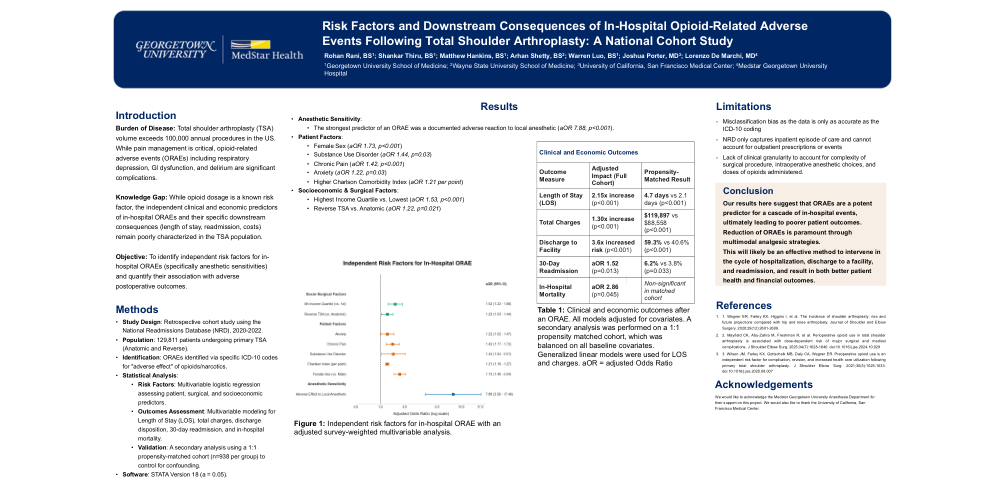
Introduction Burden of Disease: Total shoulder arthroplasty (TSA) volume exceeds 100,000 annual procedures in the US. While pain management is critical, opioid-related adverse events (ORAEs) including respiratory depression, Gl dysfunction, and delirium are significant complications. Knowledge Gap: While opioid dosage is a known risk factor, the independent clinical and economic predictors of in-hospital ORAEs and their specific downstream consequences (length of stay, readmission, costs) remain poorly characterized in the TSA population. Objective: To identify independent risk factors for in- hospital ORAEs (specifically anesthetic sensitivities) and quantify their association with adverse postoperative outcomes. Methods • Study Design: Retrospective cohort study using the National Readmissions Database (NRD), 2020-2022. • Population: 129,811 patients undergoing primary TSA (Anatomic and Reverse). • Identification: ORAEs identified via specific ICD-10 codes for "adverse effect" of opioids/narcotics. • Statistical Analysis: • Risk Factors: Multivariable logistic regression assessing patient, surgical, and socioeconomic predictors. • Outcomes Assessment: Multivariable modeling for Length of Stay (LOS), total charges, discharge disposition, 30-day readmission, and in-hospital mortality. • Validation: A secondary analysis using a 1:1 propensity-matched cohort (n=938 per group) to control for confounding. • Software: STATA Version 18 (a = 0.05). Results • Anesthetic Sensitivity: • The strongest predictor of an ORAE was a documented adverse reaction to local anesthetic (aOR 7.88, p<0.001). • Patient Factors: • Female Sex (aOR 1.73, p<0.001) • Substance Use Disorder (aOR 1.44, p=0.03) • Chronic Pain (aOR 1.42, p<0.001) • Anxiety (aOR 1.22, p=0.03) • Higher Charlson Comorbidity Index (aOR 1.21 per point) Outcome Measure • Socioeconomic & Surgical Factors: • Highest Income Quartile vs. Lowest (aOR 1.53, p<0.001) Clinical and Economic Outcomes Adjusted Impact (Full Cohort) Length of Stay 2.15x increase (LOS) (p<0.001) • Reverse TSA vs. Anatomic (aOR 1.22, p=0.021) Independent Risk Factors for In-Hospital ORAE BOR (95% CI) Socio-Surgical Factors 4th Income Quarils (v5. 151) Reverse TSA (vs Anatomi:) Patient Factors Ansiety Chroris Pain Substance Use Disorder Chartion lodex (per pint) Female Sex (vs. Male) Anesthetic Sensitivity Adverse Effect io Local Anestelis 1.52 (1.23 - 1.88> 1.22 (1.03 - 1.44) 1.22 (1.02 - 1.47) 1.42 (1.17 - 1.72) 1.44 (1.04 - 2.01) 1.21 (1.16 - 1.27) 1.73 (1.48 - 2.04) 7.83 (3.68 - 17.461 0,5 201 50 10.0 17.0 Adjusted Odds Ratio (ag scale) Figure 1: Independent risk factors for in-hospital ORAE with an adjusted survey-weighted multivariable analysis. Propensity- Matched Result 4.7 days vs 2.1 days (p<0.001) Total Charges Discharge to Facility 30-Day Readmission 1.30x increase (p<0.001) 3.6x increased risk (p<0.001) aOR 1.52 (p=0.013) $119,897 vs $88,558 (p<0.001) 59.3% vs 40.6% (p<0.001) 6.2% vs 3.8% (p=0.033) In-Hospital aOR 2.86 Non-significant Mortality (p=0.045) in matched Table 1: Clinical and economic outcomes after an ORAE. All models adjusted for covariates. A secondary analysis was performed on a 1:1 propensity matched cohort, which was balanced on all baseline covariates. Generalized linear models were used for LOS and charges. aOR = adjusted Odds Ratio
Limitations - Misclassification bias as the data is only as accurate as the ICD-10 coding - NRD only captures inpatient episode of care and cannot account for outpatient prescriptions or events - Lack of clinical granularity to account for complexity of surgical procedure, intraoperative anesthetic choices, and doses of opioids administered. Conclusion Our results here suggest that ORAEs are a potent predictor for a cascade of in-hospital events, ultimately leading to poorer patient outcomes. Reduction of ORAEs is paramount through multimodal analgesic strategies. This will likely be an effective method to intervene in the cycle of hospitalization, discharge to a facility, and readmission, and result in both better patient health and financial outcomes.