358 posters, 97 topics, 122 sessions, 958 authors, 239 institutions
ePostersLive by SciGen Technologies S.A. All rights reserved.
79th PostGraduate Assembly in Anesthesiology 2025
December 12 - 15, 2025 | New York City

2207
Flail Chest Management with Rib Plating and Multimodal Analgesia Using Methadone and Cryoablation for Ventilator Liberation of a Polytrauma Patient
Poster Presenter
Part of Topic
Pain Medicine - Perioperative Management
Multidisciplinary Pain Control Including the use of Methadone in a Critical Trauma Patient with Unidentified Polysubstance Use
Michael Lu, BA; Taylor Bentz, MD; Anirudh
Bhimavarapu, BS; Clara Goldberger, BS; Vincent
Bargnes III, MD; Adrian Fischl, MD;
Amruta Desai, DO, MPH, MBA
Department of Anesthesiology, Stony Brook Medicine, Stony Brook, NY
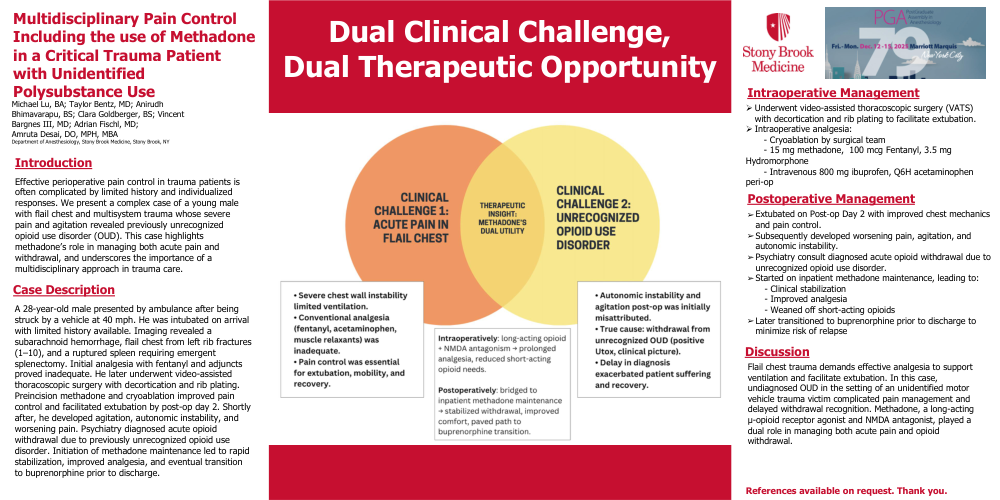
Dual Clinical Challenge,
Dual Therapeutic Opportunity
Introduction
Effective perioperative pain control in trauma patients is often complicated by limited history and individualized responses. We present a complex case of a young male with flail chest and multisystem trauma whose severe pain and agitation revealed previously unrecognized opioid use disorder (OUD). This case highlights methadone’s role in managing both acute pain and withdrawal, and underscores the importance of a multidisciplinary approach in trauma care.
Case Description
A 28-year-old male presented by ambulance after being struck by a vehicle at 40 mph. He was intubated on arrival with limited history available. Imaging revealed a subarachnoid hemorrhage, flail chest from left rib fractures (1–10), and a ruptured spleen requiring emergent splenectomy. Initial analgesia with fentanyl and adjuncts proved inadequate. He later underwent video-assisted thoracoscopic surgery with decortication and rib plating. Preincision methadone and cryoablation improved pain control and facilitated extubation by post-op day 2. Shortly after, he developed agitation, autonomic instability, and worsening pain. Psychiatry diagnosed acute opioid withdrawal due to previously unrecognized opioid use disorder. Initiation of methadone maintenance led to rapid stabilization, improved analgesia, and eventual transition to buprenorphine prior to discharge.
Intraoperative Management
- Cryoablation by surgical team
- 15 mg methadone, 100 mcg Fentanyl, 3.5 mg Hydromorphone
- Intravenous 800 mg ibuprofen, Q6H acetaminophen peri-op
Postoperative Management
- Clinical stabilization
- Improved analgesia
- Weaned off short-acting opioids
Flail chest trauma demands effective analgesia to support ventilation and facilitate extubation. In this case, undiagnosed OUD in the setting of an unidentified motor vehicle trauma victim complicated pain management and delayed withdrawal recognition. Methadone, a long-acting μ-opioid receptor agonist and NMDA antagonist, played a dual role in managing both acute pain and opioid withdrawal.
This case highlights the anesthesiologist’s evolving role in trauma care and the value of early interdisciplinary collaboration in medically complex patients.