358 posters, 97 topics, 122 sessions, 958 authors, 239 institutions
ePostersLive by SciGen Technologies S.A. All rights reserved.
79th PostGraduate Assembly in Anesthesiology 2025
December 12 - 15, 2025 | New York City

3109
Lignocaine versus ketamine as an adjunct to propofol for optimal sedation during endoscopic retrograde cholangiopancreatography (ERCP): a randomized controlled trial
Poster Presenter
Authors
Affiliations
Part of Topic
Introduction
ERCP is an ambulatory procedure performed under propofol based sedation.
Ketamine as an adjunct lowers propofol requirement & maintains hemodynamic stability.1
Limitations - sympathetic stimulation, emergence delirium, prolonged recovery time.2
Lignocaine as an adjunct has similar sedative properties and faster recovery without the side-effects of ketamine3,4
This study was conducted to assess if lignocaine is non-inferior to ketamine as an adjunct for maintaining optimal sedation during ERCP.
Methods
The average propofol consumption between the two groups was compared.
Average heart rate and mean arterial pressure compared
Incidence of desaturation(SpO2 <95%), emergence delirium compared
Post procedurally, time taken to achieve Ramsay Sedation Scale (RSS) score of 3, Modified Aldrete Score (MAS) ≥9 noted & compared
Endoscopist, patient satisfaction and severity of sore throat assessed.
Results
Primary Outcome
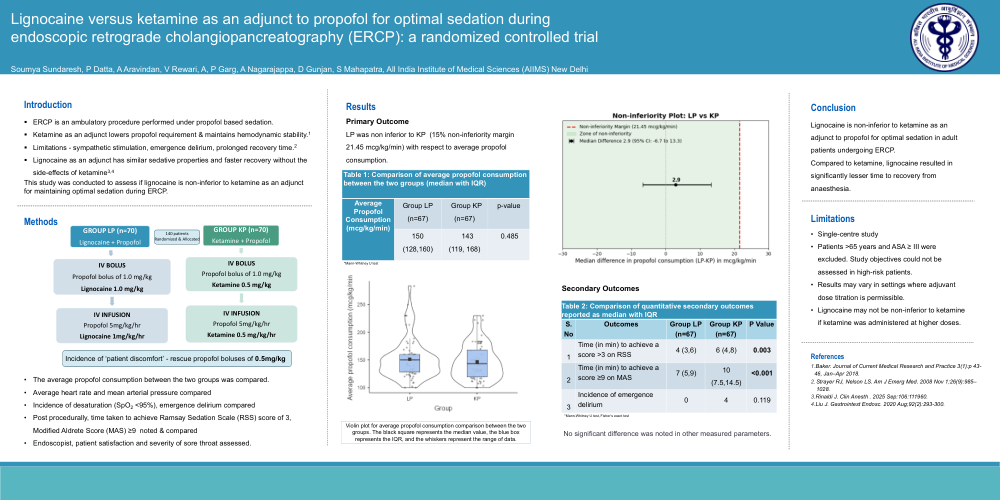
LP was non inferior to KP (15% non-inferiority margin 21.45 mcg/kg/min) with respect to average propofol consumption.
Conclusion
Lignocaine is non-inferior to ketamine as an adjunct to propofol for optimal sedation in adult patients undergoing ERCP.
Compared to ketamine, lignocaine resulted in significantly lesser time to recovery from anaesthesia.
Limitations
Single-centre study
Patients >65 years and ASA ≥ III were excluded. Study objectives could not be assessed in high-risk patients.
Results may vary in settings where adjuvant dose titration is permissible.
Lignocaine may not be non-inferior to ketamine if ketamine was administered at higher doses.
References
1.Baker. Journal of Current Medical Research and Practice 3(1):p 43-46, Jan–Apr 2018.
2.Strayer RJ, Nelson LS. Am J Emerg Med. 2008 Nov 1;26(9):985–1028.
3.Rinaldi J. Clin Anesth . 2025 Sep:106:111960.
4.Liu J. GastrointestEndosc. 2020 Aug;92(2):293-300.