358 posters, 97 topics, 122 sessions, 958 authors, 239 institutions
ePostersLive by SciGen Technologies S.A. All rights reserved.
79th PostGraduate Assembly in Anesthesiology 2025
December 12 - 15, 2025 | New York City

3103
Patient Comorbidities are Associated with Development of Postoperative Delirium
Poster Presenter
Authors
Ethan Levitch, Bennett Ford, Connor Rudnicki, Adrienne Holdridge, Mary Ana Robinson, Bailey Schehr
Affiliations
Part of Topic
Cardiovascular - Perioperative Management
Patient Comorbidities are Associated with Development of Postoperative Delirium
Ethan Levitch, MD, Bennett Ford, BS, Connor Rudnicki, DO, Adrienne H. Holdridge, DNP, Mary Ana Robinson, MSN, Bailey Schehr, MSN, Kacey Wuertz,
DNP, Andrew P. Mullet, MD, Shaun Yockelson, MD, Manila Singh, MD, Bobby D. Nossaman, MD
Critical Care Medicine, Department of Anesthesiology & Perioperative Medicine, New Orleans, Louisiana
Introduction: Post-operative delirium (POD) is a condition
observed in adult patients undergoing
cardiovascular surgery.1-3 It is known to result in
prolonged hospitalization, increased healthcare
costs, and greater morbidity.1 Although studies
have focused on the intra-operative or post-
operative phases of cardiovascular surgery and
association with POD, little information is reported
relating to the pre-operative risk factors in this
population. This study explores the association of
adult patient comorbidities on the occurrence of
POD following cardiovascular surgery.
Methods: Following IRB approval, patient characteristics
(age, sex, and BMI), twelve separate
comorbidities, and the occurrences of POD were
the measures of interest in 852 adult patients
undergoing cardiovascular surgery between
January of 2020 and February of 2025. Data was
manually collected via electronic medical record
chart review and recorded in JMP® 18 for
statistical analysis. Outcomes of interest included
relative risk, risk differences, and odds ratios.
Key analyses included 95% confidence intervals
(CI). Additionally, an overlay plot displaying
incidence of POD was run to rule out possible
confounders during the study period.
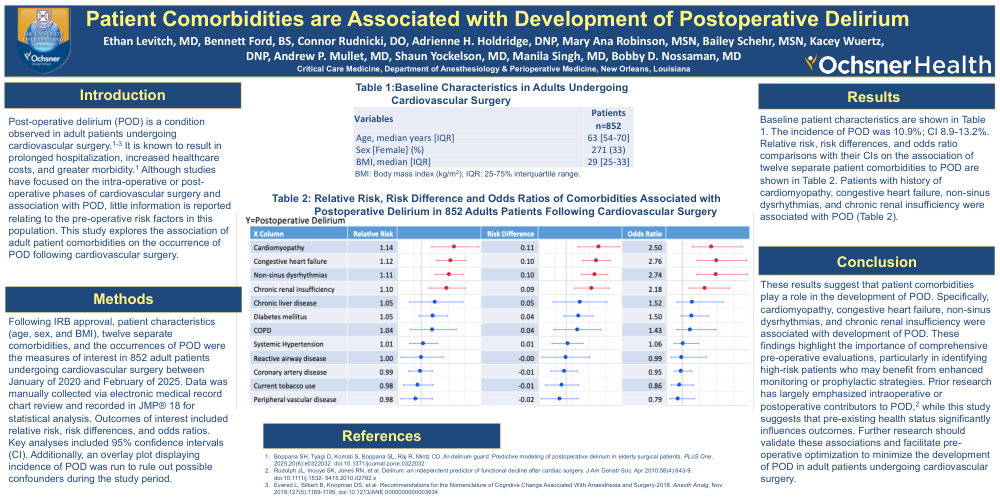
Results: Baseline patient characteristics are shown in Table
1. The incidence of POD was 10.9%; CI 8.9-13.2%.
Relative risk, risk differences, and odds ratio
comparisons with their CIs on the association of
twelve separate patient comorbidities to POD are
shown in Table 2. Patients with history of
cardiomyopathy, congestive heart failure, non-sinus
dysrhythmias, and chronic renal insufficiency were
associated with POD (Table 2).
Conclusion: These results suggest that patient comorbidities
play a role in the development of POD. Specifically,
cardiomyopathy, congestive heart failure, non-sinus
dysrhythmias, and chronic renal insufficiency were
associated with development of POD. These
findings highlight the importance of comprehensive
pre-operative evaluations, particularly in identifying
high-risk patients who may benefit from enhanced
monitoring or prophylactic strategies. Prior research
has largely emphasized intraoperative or
postoperative contributors to POD,2 while this study
suggests that pre-existing health status significantly
influences outcomes. Further research should
validate these associations and facilitate pre-
operative optimization to minimize the development
of POD in adult patients undergoing cardiovascular
surgery.
References: 1. Boppana SH, Tyagi D, Komati S, Boppana SL, Raj R, Mintz CD. AI-delirium guard: Predictive modeling of postoperative delirium in elderly surgical patients. PLoS One.
2025;20(6):e0322032. doi:10.1371/journal.pone.0322032
2. Rudolph JL, Inouye SK, Jones RN, et al. Delirium: an independent predictor of functional decline after cardiac surgery. J Am Geriatr Soc. Apr 2010;58(4):643-9.
doi:10.1111/j.1532- 5415.2010.02762.x
3. Evered L, Silbert B, Knopman DS, et al. Recommendations for the Nomenclature of Cognitive Change Associated With Anaesthesia and Surgery-2018. Anesth Analg. Nov
2018;127(5):1189-1195. doi:10.1213/ANE.0000000000003634