358 posters, 97 topics, 122 sessions, 958 authors, 239 institutions
ePostersLive by SciGen Technologies S.A. All rights reserved.
79th PostGraduate Assembly in Anesthesiology 2025
December 12 - 15, 2025 | New York City

3100
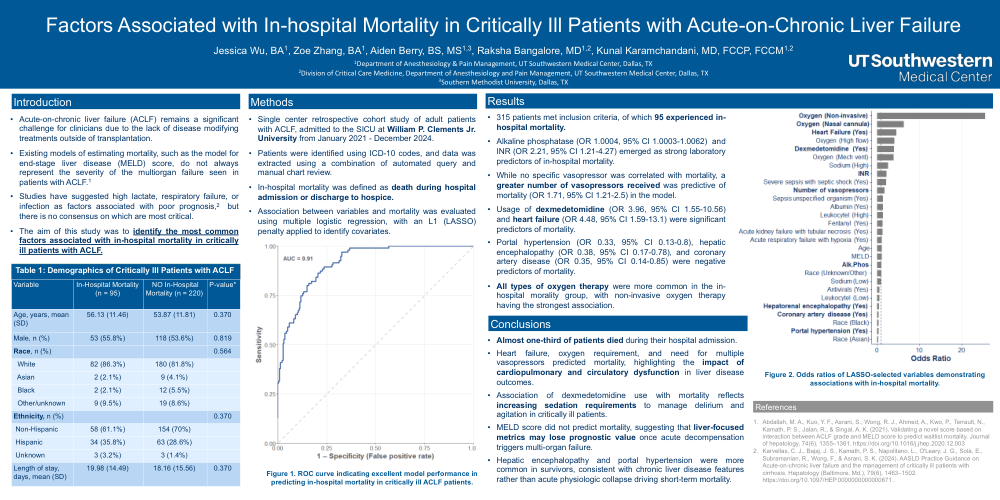
Factors Associated with In-hospital Mortality in Critically Ill Patients with Acute-on-Chronic Liver Failure
Poster Presenter
Part of Topic
Critical Care - Transplant
Introduction
•Acute-on-chronic liver failure (ACLF) remains a significant challenge for clinicians due to the lack of disease modifying treatments outside of transplantation.
•Existing models of estimating mortality, such as the model for end-stage liver disease (MELD) score, do not always represent the severity of the multiorgan failure seen in patients with ACLF.1
•Studies have suggested high lactate, respiratory failure, or infection as factors associated with poor prognosis,2 but there is no consensus on which are most critical.
•The aim of this study was to identify the most common factors associated with in-hospital mortality in critically ill patients with ACLF.
Methods
•Single center retrospective cohort study of adult patients with ACLF, admitted to the SICU at William P. Clements Jr. University from January 2021 - December 2024.
•Patients were identified using ICD-10 codes, and data was extracted using a combination of automated query and manual chart review.
•In-hospital mortality was defined as death during hospital admission or discharge to hospice.
•Association between variables and mortality was evaluated using multiple logistic regression, with an L1 (LASSO) penalty applied to identify covariates.
Results
•315 patients met inclusion criteria, of which 95 experienced in-hospital mortality.
•Alkaline phosphatase (OR 1.0004, 95% CI 1.0003-1.0062) and INR (OR 2.21, 95% CI 1.21-4.27) emerged as strong laboratory predictors of in-hospital mortality.
•While no specific vasopressor was correlated with mortality, a greater number of vasopressors received was predictive of mortality (OR 1.71, 95% CI 1.21-2.5) in the model.
•Usage of dexmedetomidine (OR 3.96, 95% CI 1.55-10.56) and heart failure (OR 4.48, 95% CI 1.59-13.1) were significant predictors of mortality.
•Portal hypertension (OR 0.33, 95% CI 0.13-0.8), hepatic encephalopathy (OR 0.38, 95% CI 0.17-0.78), and coronary artery disease (OR 0.35, 95% CI 0.14-0.85) were negative predictors of mortality.
•All types of oxygen therapy were more common in the in-hospital morality group, with non-invasive oxygen therapy having the strongest association.
Conclusion
•Almost one-third of patients died during their hospital admission.
•Heart failure, oxygen requirement, and need for multiple vasopressors predicted mortality, highlighting the impact of cardiopulmonary and circulatory dysfunction in liver disease outcomes.
•Association of dexmedetomidine use with mortality reflects increasing sedation requirements to manage delirium and agitation in critically ill patients.
•MELD score did not predict mortality, suggesting that liver-focused metrics may lose prognostic value once acute decompensation triggers multi-organ failure.
•Hepatic encephalopathy and portal hypertension were more common in survivors, consistent with chronic liver disease features rather than acute physiologic collapse driving short-term mortality.
References
1.Abdallah, M. A., Kuo, Y. F., Asrani, S., Wong, R. J., Ahmed, A., Kwo, P., Terrault, N., Kamath, P. S., Jalan, R., & Singal, A. K. (2021). Validating a novel score based on interaction between ACLF grade and MELD score to predict waitlist mortality. Journal of hepatology, 74(6), 1355–1361. https://doi.org/10.1016/j.jhep.2020.12.003
2.Karvellas, C. J., Bajaj, J. S., Kamath, P. S., Napolitano, L., O'Leary, J. G., Solà, E., Subramanian, R., Wong, F., & Asrani, S. K. (2024). AASLD Practice Guidance on Acute-on-chronic liver failure and the management of critically ill patients with cirrhosis. Hepatology (Baltimore, Md.), 79(6), 1463–1502. https://doi.org/10.1097/HEP.0000000000000671 .